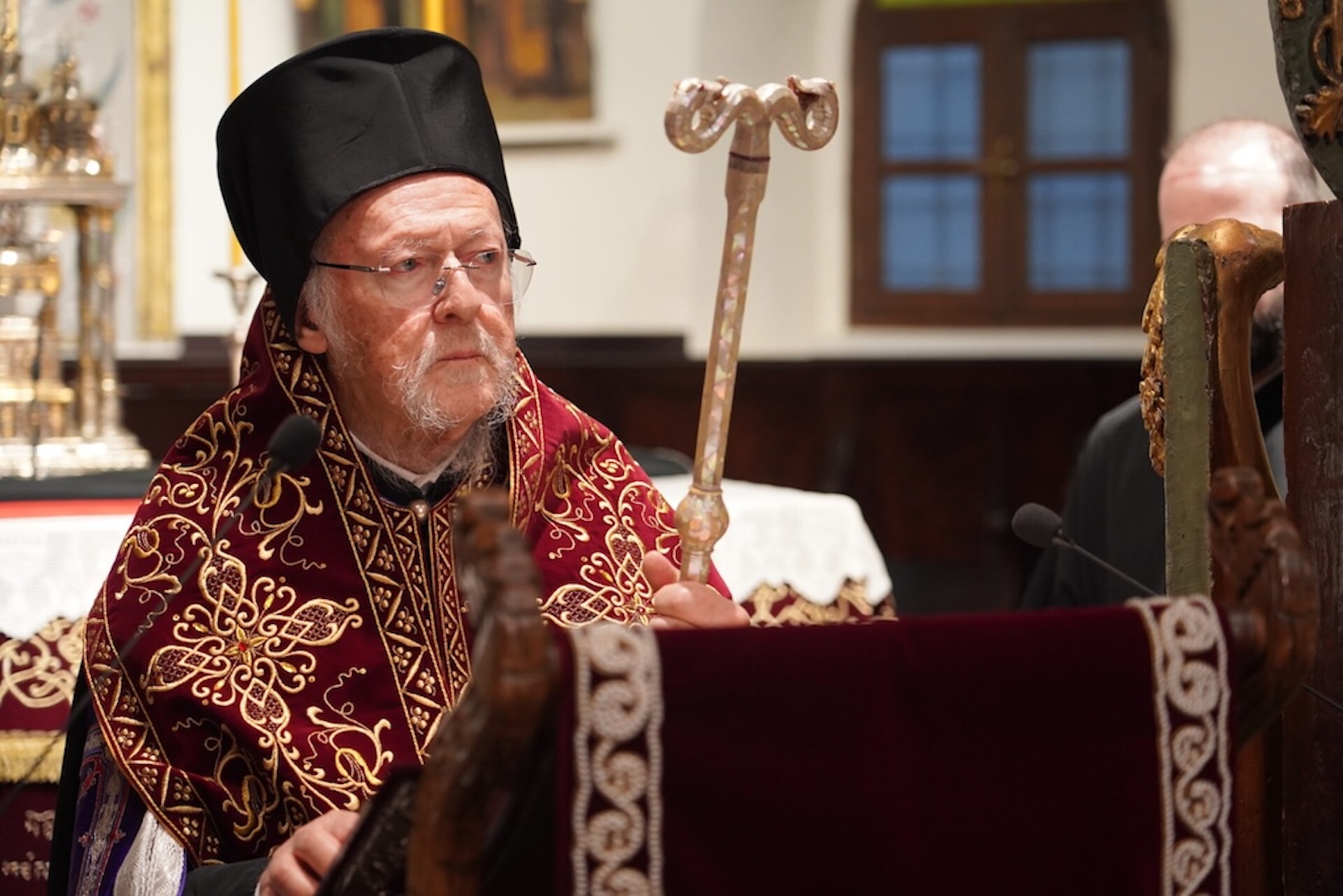
His All-Holiness Ecumenical Patriarch Bartholomew’s Patriarchal Encyclical on the Occasion of Holy Pascha for 2026 is full of holy wisdom that is truly enduring, and abundantly rewards repeated readings, study, and meditation.
His All-Holiness states that “the world-saving Resurrection of our Lord and God and Saviour Jesus Christ” not only “marks the manifest victory of life over death,” but also “renews all creation, and opens to humanity the way of deification by grace.” We can experience the Resurrection of our Lord and Savior by participating in divine services of the Church, for “the Church of Christ preserves the paschal experience in her liturgical life, in the labors of the Saints and Martyrs of the faith, in the eschatological impulse of monasticism, in the proclamation of the Gospel ‘to the ends of the earth,’ in theology and the ecclesial arts, in the good witness of the faithful in the world, in the culture of love and solidarity, and in the immovable certainty that evil does not have the final word in history.”
Such participation is not simply a remembrance of a past event or an empty ceremonial ritual. The Ecumenical Patriarch explains that the Resurrection touches the heart of the creative impulse that animates all human activity. He states that “the Resurrection of the Lord is lived as a Christ-bestowed freedom, which inspires, nourishes, and strengthens the creative powers of the human person and the good struggle for ‘whatever is true, whatever is honorable, whatever is just, whatever is pure, whatever is lovely, whatever is commendable,’ while reminding us all that the journey toward the Resurrection is inseparably bound to the Cross.” Consequently, the suffering of human beings is not meaningless, but ultimately tied to our redemption.
“The joy of the Cross and the Resurrection,” His All-Holiness continues, “has preserved the people of God from identifying themselves with the spirit of this world, while at the same time safeguarding them from barren insularity and a spirituality devoid of dynamism and hope-bearing breath.” He discerns in this transcendent fact a refutation of a common critique of Christian morality: “The life of the faithful, in the crucified and risen Christ ‘for us men,’ still today refutes every alien narrative of Christian ethos as a ‘morality of the weak,’ supposedly embodied in humility, forgiveness, sacrificial love, asceticism, the Lord’s saying ‘but I say to you, do not resist the evil one,’ and other principles and dispositions that belong to the very core of our identity.”
His All-Holiness emphasizes that this critique is fundamentally wrongheaded and based on a misunderstanding of the very heart of the Christian Faith: “Nothing could be further from the truth than this reading of the ethos of Christianity — of sacrificial love that ‘does not seek its own,’ a love interwoven with courage, boldness, and existential authenticity.” He adds that Pascha is the foundation also of charity toward our fellow human beings, for it “is a hymn to this freedom, to faith ‘working through love,’ which is not our own achievement but grace and a gift from above, and which is lived in the holy Sacraments of the Church and in the ‘mystery’ of service to one’s neighbor. Indeed, ‘love for God does not in any way tolerate hatred toward one’s fellow human being.’”
As a result, Pascha is the key to the ending of strife between peoples: “The message of the Cross and the Resurrection resounds today as a Gospel of peace, reconciliation, and justice. War, hatred, and injustice stand opposed to the fundamental Christian principles for whose realization and establishment the people of God pray and labor each day. In the light of the Resurrection, we beseech the Lord on behalf of the victims of wartime violence, the orphans, the mothers who mourn their children, and all those who bear in body and soul the effects of human cruelty and callousness. ‘Christ is risen’ is a denial and condemnation of violence and fear and an invitation to a life of peace. War brings forth lamentation and death; the Resurrection conquers death and bestows incorruptibility.”
The Resurrection is also the basis for the Church’s prophetic witness in the world: “Before the daily images of the cruelty of war, the Church raises her voice and proclaims the sacredness of the human person — of every concrete human being anywhere on earth — and the duty of absolute respect for that dignity.”
As such, the Resurrection of the Lord is nothing less than “the restoration of the human being to his pre-eternal calling. As the ‘beginning of another eternal life,’ it heals alienating relationships and establishes the peace ‘which surpasses all understanding’ — a peace that encompasses worldly reconciliation and pacification.”
His All-Holiness emphasizes that in light of all this, Holy Pascha “is the whole of our spiritual civilization, the very core of our piety.” Not only is it not the simple remembrance of an event involving others, but the Resurrection of the Lord “is also our own resurrection in the present age, and at the same time a prefiguration and foretaste of the ‘common resurrection of all human beings’ and of the renewal of the whole creation.”
Christ is risen! Truly He is risen!