Home » Global Educational Initiative

A Teacher Guide, Brought to you by the Archon Ecumenical Patriarchate Global Educational Initiative
Orthodox students can play a significant role in realizing a better future for our Orthodox church through their faith, their works, and their commitment to learning about and taking an active role in the mission and vision of the Ecumenical Patriarchate.
The Archon Ecumenical Patriarchate Global Educational Initiative is designed to provide students with an introduction to the Ecumenical Patriarch and the Patriarchate in an engaging and creative way. Our Sunday School educators serve as our partners to carry this work forward through our Sprout Lessons!
Students will learn about the factors that shape their Orthodox identity and develop an appreciation for the ways in which our Ecumenical Patriarch and other Orthodox leaders work tirelessly to inspire, lead, and defend the Orthodox faith around the world.
Calling all Young Orthodox Artists!
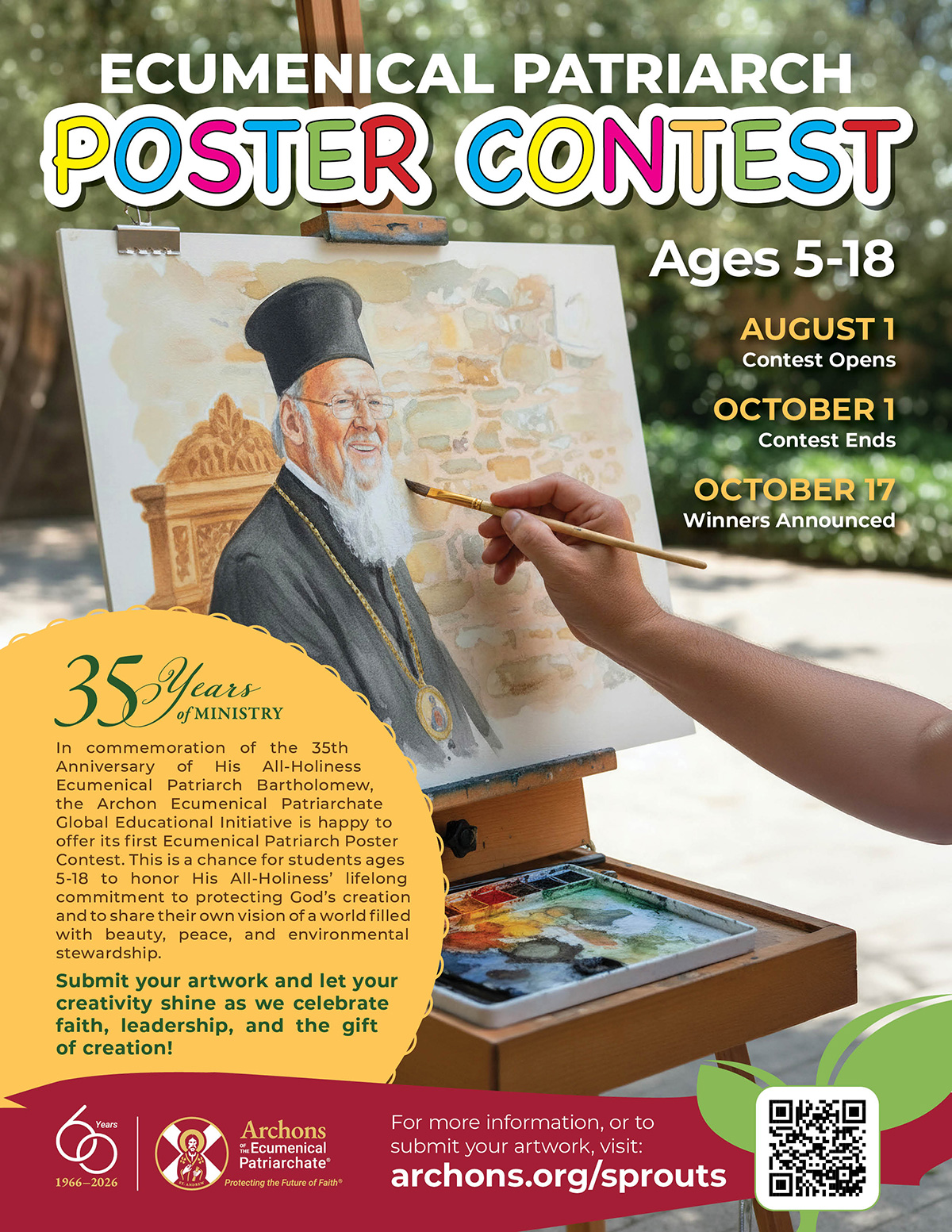
The Archon Ecumenical Patriarchate Global Initiative (The Sprouts Program) announces the inaugural Ecumenical Patriarch Poster Contest, inviting Orthodox students ages 5–18 to create original artwork celebrating His All‑Holiness Ecumenical Patriarch Bartholomew’s 35 years of spiritual leadership and his unwavering commitment to protecting God’s creation as the Green Patriarch.
As this is the first year of the contest, parishes and schools nationwide are warmly encouraged to participate and inspire young artists to express their faith, creativity, and love for God’s world. Eligible participants include Sunday School students from all Orthodox jurisdictions under the spiritual guidance of the Ecumenical Patriarchate, as well as students in Orthodox Christian K–12 schools and other Christian schools with a strong Orthodox presence.
While twelve artworks—across three age categories—will be specially recognized for creativity and effort, the primary purpose of this inaugural contest is to inspire participation, cultivate artistic expression, and encourage young people to honor the Ecumenical Patriarch’s remarkable legacy.
“The Ecumenical Patriarch Poster Contest is an opportunity to encourage creativity, celebrate youth, and highlight the talents of our precious Orthodox students from across the country,” said Dr. Anthony J. Limberakis, National Commander of the Archons of the Ecumenical Patriarchate. “We are excited to recognize these young artists during Archon Weekend, October 15–18, 2026, in New York City.”
For questions on contest rules or other details please contact: sprouts@archons.org
Submission Requirements • Traditional hand‑drawn posters must be scanned and uploaded as a PDF. • Scanned files should be flat, straight, and properly cropped. • Photographs are discouraged due to quality and distortion issues.
Size • Posters should meet state contest size requirements. • 8 × 10 inches is preferred for durability and ease of handling.
Media • Any traditional media may be used: paint, crayon, colored pencil, charcoal, stickers, paper, or other materials. • Mixed‑media artwork is welcome.
Originality • Posters must be created by one individual student; team submissions are not permitted. • Tracing or copying from photographs or other artists’ work is not allowed. • AI‑generated content is not permitted for this contest.
Theme Requirement • The 2026 theme phrase, “The Green Patriarch,” must appear in full on the front of each poster to qualify for judging.
Student Support • Younger students may receive planning guidance from parents or teachers, but each student should complete their own artwork.
Entries will be judged according to the following criteria:
Artwork that does not meet these criteria will not be considered.
Powerpoint File
Watch Video
Frequently Asked Questions
The leading church officer, and all bishops have the same sacramental position in guiding the people of God. He may be called archbishop or metropolitan, the latter simply meaning the bishop of a chief city, or a metropolis.
An archon is a servant leader in the Orthodox church. An archon is an honored titled given by the Ecumenical Patriarch to an Orthodox Christian community leader. They are committed to preserving the Orthodox faith and religious freedom.
An ecumenical council, also called general council, is a meeting of bishops and other church authorities to consider and rule on questions of Christian doctrine, administration, discipline, and other matters in which those entitled to vote are convoked from the whole world (oikoumene) and which secures the approbation of the whole Church.
The Ecumenical Patriarch has the historical, canonical, and theological responsibility to initiate and coordinate actions among all Orthodox Churches, whether under his jurisdiction, independent or autonomous. This includes assembling and convening councils, facilitating inter-Church and inter-faith dialogue, and addressing the issues of the day.
Faith is a means by which believers come to God and put their trust in Him for salvation. Learn More
According to the Bible, faith is the conviction of things not seen, the assurance of things hoped for. Learn More
The Dictionary of Bible Themes defines faith as a constant outlook of trust towards God, whereby human beings abandon all reliance on their own efforts and put their full confidence in him, his word, and his promises. Learn More
The purpose of Orthodox Christianity is the salvation of every human person, uniting us to Christ in the Church, transforming us in holiness, and giving us eternal life. This is the Gospel, the good news, that Jesus is the Messiah, that He rose from the dead, and that we can be saved as a result.
Historically, the Orthodox Church is the oldest of all Christian churches. Ultimately, all Christian communities can trace their own history back to the Orthodox Church. In the pages of the New Testament, we read the beginnings of the Orthodox Church, and even today Orthodox Christianity continues to live on in most of the places mentioned in the New Testament where the Apostles first preached the Gospel. This is the Church that wrote, compiled, and canonized the Holy Scriptures, which formulated the traditional doctrines of Christianity, and that has believed and lived the same faith for 2,000 years.
Today, Orthodox Christianity’s largest communities exist primarily in Eastern Europe and the Middle East, though there are also sizable communities in North America, Western Europe, Africa, Asia, and Australia, primarily through immigration in the 19th and 20th centuries, but also through a growing number of converts to the faith. It is the second largest Christian communion in the world, smaller only than the Roman Catholic Church. The Orthodox Church is sometimes referred to as “Greek Orthodox” or “Eastern Orthodox,” but the best term is simply Orthodox Christian.
Is a neighborhood midway up the Golden Horn, within the borough of Fatih, in Istanbul, Turkey (formerly Constantinople). The streets in the area are full of historic wooden houses, churches, and synagogues dating from Byzantine and Ottoman times. The name phanar comes from Greek "fanari" (φανάρι), meaning lantern. After the fall of Constantinople on May 29, 1453, the Phanar district became the home to most of the Greeks who remained in the city.
Religious freedom refers to the right of individuals or communities, both in public and private settings, to manifest their religion or belief through teaching, practice, worship, and observance. It encompasses the ability to live, speak, and act according to one’s religious convictions without interference from the government or external authorities.
In Christian belief, a saint is a person who is recognized as having an exceptional degree of holiness, likeness, or closeness to God.