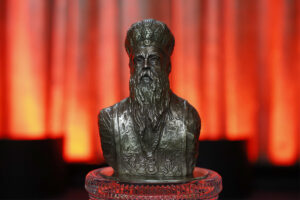
April 22 is Earth Day, a global observance of the need to care for the natural environment that has been a centerpiece of His All-Holiness Ecumenical Patriarch Bartholomew’s long and fruitful diakonia to the Church and the world.
In this insightful video, His All-Holiness reflects upon the importance of proper stewardship of God’s creation, noting that “in the Orthodox Church, in our liturgical life, we take the created elements and universe, and through our prayers, we bring it to the throne of God, saying, ‘Dear God, we offer to you what it is yours.’”
His All-Holiness also says: “This perfect material world was a gift of God to humankind.” He observes frankly: “I travel a lot. I saw with my own eyes how we human beings destroy the natural resources, the forests, the beauty, in order to gain more and more material income. We exploit nature.” He emphasizes that “the environment is not a political or economic issue. The problem is in our soul, in our mind. This is the spiritual dimension of ecology. Destroying air, earth, waters is a sin, because everything was created by God. The good God gave it to us to protect it, to cultivate it, to use it, but not to abuse it.”
With prophetic urgency, His All-Holiness states: “We are not owners of this planet. We are stewards and priests of the creation.” He declares: “We shall change mentalities, change minds, and then we shall restore what we have destroyed, warming our hearts, not the climate, for us, and our children and grandchildren.”
The Ecumenical Patriarch has also stated: “Of course, every day is earth day! Every day is an opportunity to celebrate ‘the earth as the Lord’s and that all who dwell therein belong to the Lord’ (Psalm 24.1). Every day is a reminder of our vulnerability and solidarity. In fact, today, more than ever, we are also reminded of our responsibility to the earth and each other in light of that interdependence between the earth and all its inhabitants. The ecological responsibility and the respect of the sacredness and the beauty of every human person, of the elderly and the disabled, the poor and the marginalized, the sick and the suffering, are today the universal categorical imperative for the whole humanity.”
His All-Holiness on another occasion glorified God “for the uninterrupted and bounteous fruitfulness of the initiatives of His Holy Great Church in the field of creation’s protection.” He noted that “the Ecumenical Patriarchate not only highlighted the seriousness of environmental issues from an early stage, but also focused attention on their foundational causes—which are inner, spiritual, and moral—and proposed solutions based on an Orthodox eucharistic and ascetic ethos.”
In fact, during his extraordinary thirty-five years of global ministry as Ecumenical Patriarch of Constantinople, Ecumenical Patriarch Bartholomew has made care for the environment such a central aspect of his message that he has observed that “Orthodoxy, in her faith, divine worship, and witness to the world is, one could say, the eco-friendly form of Christianity.” He reminds the faithful, as well as the world at large, that “from the beginning, we declared the inseparability of respect for creation and the human person, revealing the common root and interconnection of environmental and social problems.”
It is on the subject of this interconnectedness that His All-Holiness bestows upon us some of his most penetrating and powerful insights. “Alienation from God,” he explains, breeds a possessive and exploitative attitude and behavior toward creation and fellow human beings, while life in and according to Christ is a source of environmental sensitivity and philanthropic action.” Thus responsible care for the environment will flow naturally from the depth of the individual’s Christian commitment: “As the Lord said: ‘Every good tree bears good fruit, but a corrupt tree bears evil fruit. A good tree cannot bear evil fruit, and a corrupt tree cannot bear good fruit’ (Matthew 7:17–18).”
In the same vein, the Ecumenical Patriarch notes that “respect for spiritual values sharpens our discernment of what is good and what must be done.” He argues compellingly against a shallow utilitarianism and pragmatism that would disregard the very idea of human beings as stewards of God’s creation, warning against “the entrapment of the human being in the earthly, that is, to a shrinking of his freedom into pragmatic choices and decisions, always intertwined with superficial views of reality and with the identification of the good with ‘what happens to be useful.’”
His All-Holiness calls for an “ecological repentance” that would involve “a radical change in mindset and behavior toward creation,” particularly in light of “the pandemonium of war cries, bombings, missiles and explosions, which drowns out the cry of the innocent victims of merciless violence and the groaning of creation.” He sounds a chilling warning: “The future of life on our planet will either be ecological and peaceful—or nonexistent.”
This is the choice that is before each of us on this and every Earth Day.