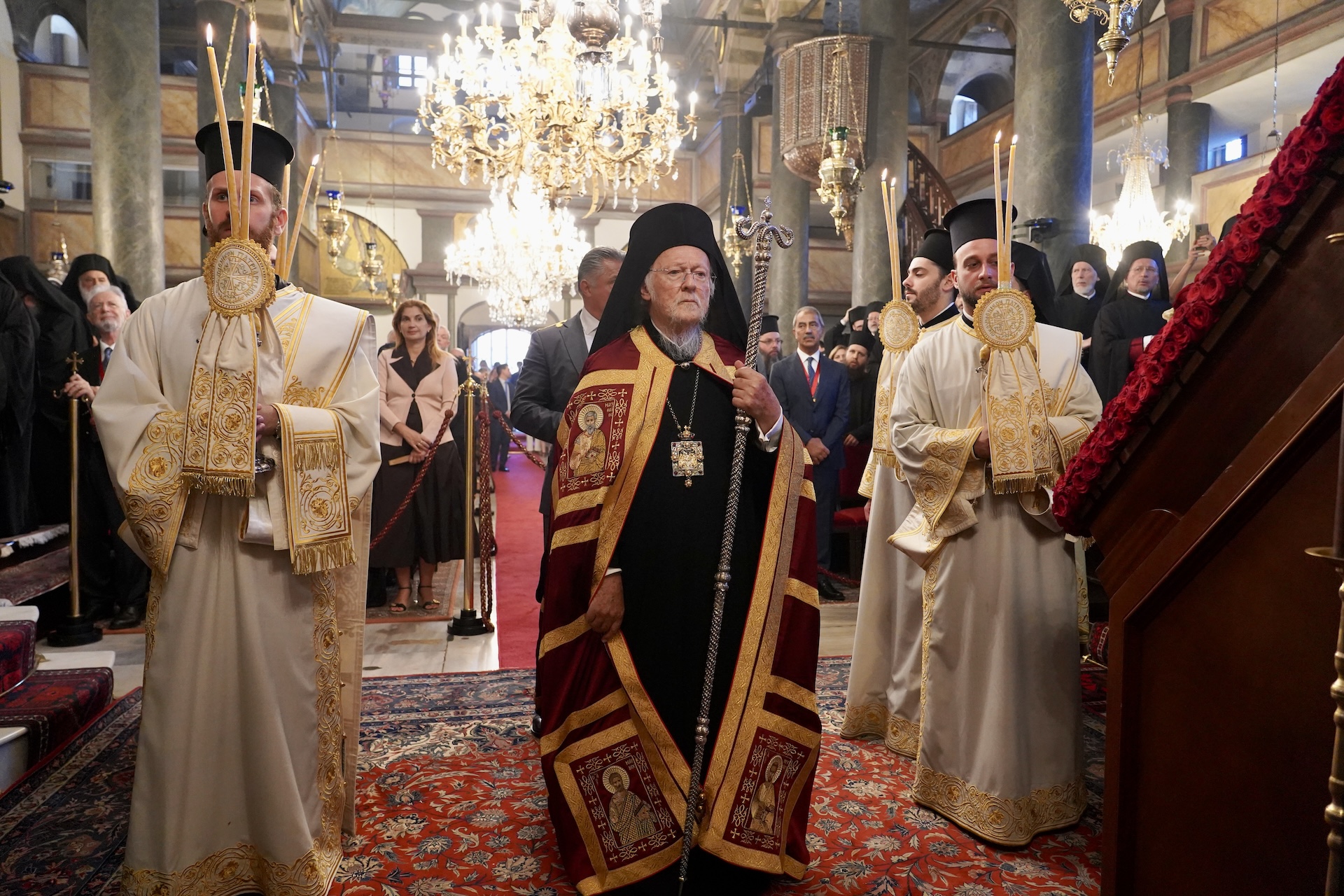
His All-Holiness Ecumenical Patriarch Bartholomew on September 1, 2026 celebrated the beginning of the Indiction, the ecclesiastical New Year, as well as the Day of Prayer for the Protection of the Natural Environment, as Ecumenical Patriarch Demetrios of blessed memory designated it in 1989. On the same day, he issued a Patriarchal Message for the Beginning of the Ecclesiastical Year and the Solemn Day of Prayers for Natural Environment, reiterating his pioneering commitment to the preservation of the natural environment as a core Christian duty, and articulating “new paths and prospects for addressing” this immense challenge.
In that message, His All-Holiness emphasized that the environmental crisis affects all areas of human endeavor: “The multidimensional contemporary ecological crisis is a crisis of human freedom, of our religion and philosophy, of our ethos and our culture.” He explained that “what comes first is the ‘harmful alteration’ of our freedom — our severance and alienation from the Source of Life; what follows is conduct destructive of the natural environment.”
In response to this crisis, the Ecumenical Patriarch said that there was an “imperative need for a ‘Copernican Turn’ in our understanding of the idea of progress and in humanity’s attitude towards nature, as well as in the actions of those engaged in political, economic, and social life, of the Churches and religions, of science and technology, and of those responsible for the education of the younger generation.”
In pursuit of this transformation in the general understanding of the environment and its relationship to human activity, he pledged to “continue, in word and deed, to promote the ecological vision of the Holy Great Church of Christ and the eco-friendly dynamism of the eucharistic, ascetic, and doxological relationship with creation, always underscoring that careful theological work is needed for the elucidation of the authentic ecological message of our Orthodox faith and tradition, for the benefit of creation, which is ‘very good.’”
While the environmental crisis is usually understood solely in utilitarian terms, His All-Holiness stated that “we are convinced that highlighting the religious and ethical dimensions of the ecological threat will lead to an awareness of the pivotal importance of ‘ecological responsibility.’” He declared that “humanity must at last cease acting as though it does not know and definitively cast aside the illusion that planet Earth can in perpetuity withstand the burdens and destruction caused by human activity, or that nature has the power to renew itself of its own accord.”
Once that illusion has been definitively seen for what it is and rejected, His All-Holiness continued, “the ethos of responsibility for the protection of the natural environment must find expression at the global, national, local, and personal levels.” This multifaceted response is an urgent necessity: “We reiterate once again that the cultivation of ecological responsibility is a ‘categorical imperative’ for humanity as it confronts the greatest threat it has ever been called to face throughout the entire course of its history.”
His All-Holiness enunciated a prophetic condemnation of the heedless culture of abundance, saying: “It is abundantly clear that, so long as the dominant anthropological model is represented by the ‘foolish rich man’ of the Gospel (Luke 12:17–21), with his declaration, ‘I will pull down my barns and build greater; and there I will store all my crops and my goods,’ and his words, ‘Soul, you have many goods laid up for many years; take your ease, eat, drink, and be merry,’ humanity will continue to undermine its future and annihilate its own ‘home.’”
Continuing his critique of contemporary attitudes toward the environment, the Ecumenical Patriarch stated: “The ‘sins of modernity’ have created — and continue to create — new divisions and ruptures between humanity and nature. The contemporary ‘man-god’ persists in geocide, disregarding every measure and limit in the name of geopolitical designs and economic interests, of consumerism and of the satisfaction of essentially insatiable needs, but also, on a deeper level, because of an overturning of inner lived experience and values.”
A restoration of rightly ordered inner values will therefore lead to a proper understanding of the need to care for the natural environment. Otherwise, said His All-Holiness, “the consequences of the global dominance of the desire to manipulate, instrumentalize, and exploit nature will prove to be tragic for life on our planet.”
His All-Holiness concluded by stating that “respect for the core pillars of ecological civilization can restrain environmentally destructive tendencies and open the ‘sole ecological path,’ that of sustainable development.” He also once again situated the problem of the environment in a larger context: “More broadly, humanity needs to reach agreement upon a body of common fundamental values which, in a world marked by conflict and polarization, will serve as a compass for the journey towards the future.” He stated: “We regard the principle of solidarity as the central axis of this body of values: solidarity as a source of shared responsibility, dialogue, and sincere reciprocity, together with collective responsibility for the protection of the natural environment. Respect in practice for the sacredness of the human person and care for the integrity of creation are, from a Christian perspective, vital manifestations of the eucharistic realization of the Church and of human being’s call to become the ‘priest’ of creation.”
May we all strive to cultivate that principle of solidarity within ourselves and in our relationships with others.