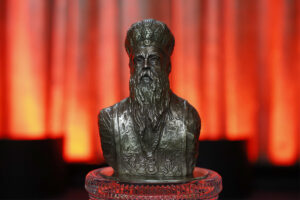

In an address at the 27th International Congress of the Society for the Law of the Eastern Churches at the Fanarion new Orthodox Christian Dialogue Centre in Budapest on Friday, September 4, 2026, His All-Holiness Ecumenical Patriarch Bartholomew spoke on the theme of the Congress, “The Bishop of Rome: Future Horizons from Ancient Traditions for Catholics and Orthodox.” His All-Holiness provided an enlightening overview of how the Orthodox tradition understands the primacy of Rome, and what the prospects are for the restoration of full communion between the Orthodox Church and the Church of Rome.
His All-Holiness recalled the precise formulation on unity between the two Churches of the Roman Catholic theologian Joseph Ratzinger, who would later become Pope Benedict XVI of Rome: “Rome cannot demand from the East more of a doctrine of primacy than what was formulated and lived in the first millennium.” There is a particular bond between the Ecumenical Patriarch and Pope Benedict, for at the historic Institut de France in Paris on Monday, March 30, 2026, His All-Holiness was formally admitted as an Associate Member of the French Academy of Moral and Political Sciences, filling the chair once held by Joseph Ratzinger.
Ecumenical Patriarch Bartholomew explained that “with these words, the future Pope Benedict pointed the way back to the common patristic heritage of the undivided Church as the proper measure and criterion for any contemporary understanding of primacy.”
That criterion is the key to any future restoration of communion between the Churches. His All-Holiness noted that Ratzinger had “specified, moreover, that the essence of this primatial teaching of the first millennium had already been most eloquently expressed by our predecessor of blessed memory, Ecumenical Patriarch Athenagoras, when, on the occasion of the visit of Pope Paul VI to the Phanar, on July 25th, 1967, he addressed the Bishop of Rome as ‘successor to Peter, the first in honor among us, the one presiding in love.’”
His All-Holiness emphasized that the restoration of communion could only come about on this basis: “This felicitous phrase of Patriarch Athenagoras — ‘the one presiding in love,’ an expression drawn from the ancient salutation of Saint Ignatius of Antioch to the Church of Rome — encapsulates, in a few words, the entire Orthodox understanding of the Roman primacy: a primacy of loving service, exercised within, and never above, the communion of sister Churches.”
The Ecumenical Patriarch also noted that this was the original understanding of the Roman primacy within the undivided Church: “Patriarch Athenagoras’ understanding of this primacy was, in fact, inseparably linked to the ancient institution of the Pentarchy of the Patriarchs, within which the Pope of Rome was recognized as ‘first among equals’ — primus inter pares — precisely as the ‘Patriarch of the West.’”
In that Pentarchy, His All-Holiness stated, was the fullest manifestation of the Church’s unity: “The institution of the Pentarchy — the five great ancient Sees of Rome, Constantinople, Alexandria, Antioch, and Jerusalem — constituted, during the first Christian millennium, the very framework within which the unity of the universal Church found its most visible ecclesial expression. It was Anastasius the Librarian, the ninth-century scholar of Rome, who justified this sacred order by a most striking analogy: as the human body is governed harmoniously by its five senses, so also is the one Body of Christ, the Church, held together and rightly ordered through the concord of her five Patriarchal Sees. In the first millennium, this communio patriarcharum — this communion and concelebration of the Patriarchs, each presiding in his own place yet all bound together in the one faith and the one Eucharistic chalice — was, in truth, the most visible sign of the unity of the universal Church.”
His All-Holiness then explained the importance of the Papal title “Patriarch of the West” as showing the path forward, in assuming that “the one Body of Christ, the Church,” was “held together and rightly ordered through the concord of her five Patriarchal Sees.” He lamented Pope Benedict XVI’s removal of this title in 2006, and stated: “It was for this reason that our Modesty did not fail, in the years that followed, to raise this matter directly with Pope Benedict’s successor, the late Pope Francis, of blessed and eternal memory, who received our concerns with characteristic openness and graciousness, and who assured us of his intention to restore the title at the proper and opportune time.”
Finally, in a welcome step toward ecclesiastical unity, the title was restored: “That time came, in God’s providence, after the repose in the Lord of the Pope Emeritus Benedict, at the close of the year 2022; and in the Annuario Pontificio for the year 2024, the title ‘Patriarch of the West’ was discreetly restored to its rightful place among the titles of the Bishop of Rome. We take this occasion to reiterate before you, esteemed friends and fellow laborers in the vineyard of Christian unity, the heartfelt satisfaction with which the Ecumenical Patriarchate received this development — a small but far from insignificant step, eloquent in its symbolism, and encouraging for the continuation of our theological dialogue.”
The Ecumenical Patriarch also said that “our Holy Orthodox Church, like a spiritual vessel navigating under divine protection the waves of history through the centuries, is borne up by these time-honored and elder Patriarchates of the East, which stand as unshaken pillars and unbroken foundations of the Apostolic Tradition, and which, together with the Church of Elder Rome, constituted in the first millennium the five-stringed lyre of the universal Church, actively participating in the Seven Holy Ecumenical Councils and ‘rightly dividing the word of truth.’”
In that context, he added that “we await, by grace and help from on high, the restoration of full communion with the Church of Rome within the one Body of the One, Holy, Catholic, and Apostolic Church, so that the Pentarchy may once again be whole, and the ‘five-stringed lyre’ of the universal Church may again resound in the fullness of its ancient harmony.”
We join His All-Holiness in this prayer and hope.