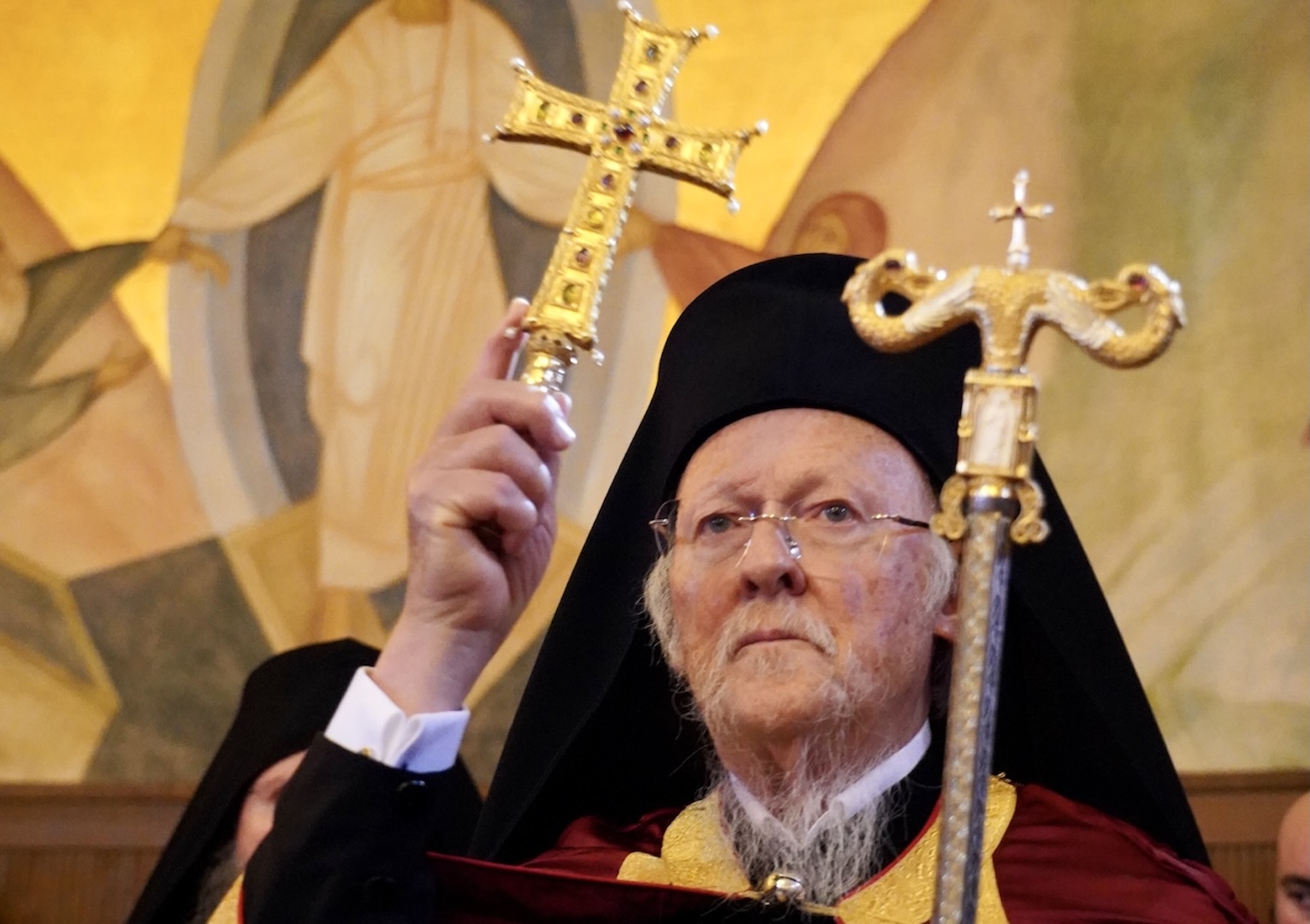
As he received an honorary doctorate at the University of Chichester on September 16, 2026, His All-Holiness Ecumenical Patriarch Bartholomew offered the new graduates of the university, and the world at large, a series of powerful and deeply compelling reflections upon the true nature of freedom and the principles that should guide one’s choices in life.
Speaking to the graduates movingly about his own youth, His All-Holiness stated: “We too, my own generation, were once young, and we lived through the contradictions of our society, its challenges, but also its positive prospects, its disappointments and its hopes.”
His All-Holiness explained that “youth is a period of intense inner crisis for the human person, and the soul of the young person is a sensitive seismograph of developments. The crisis of youth, which is ‘normal’ from an anthropological perspective, is intensified by the external circumstances of each age. Today especially, you young men and women face unprecedented developments in the field of scientific knowledge, momentous changes in the course of history, and continuous ‘digital leaps.’”
His All-Holiness said that like himself and the young people of his age, “you too, the promising young men and women of today, are called to build your present and your future within a civilization which you did not yourselves create.” He admonished the graduates, and all young people, not to neglect the most important questions regarding the meaning of life itself. “Amid the turmoil of human affairs,” he said, “no human being—and certainly not you, young men and women—can push away the ultimate questions about the meaning of existence, about life and death, about happiness and misery, about right and wrong, about good and evil, about the perplexities of our freedom.”
Reminding the graduates that “the human being is not merely a biological entity, nor merely a citizen of the world,” His All-Holiness stated that the human being “is a spiritual being with an exalted vocation. The underestimation or rejection of spiritual values and traditions has gravely negative consequences for every dimension of personal and social life.” He observed that “the fascination with technological achievements leads to the identification of development with technological progress,” and noted also that “the growth of scientific knowledge does not keep pace with the development of the moral sensibilities of the human person.”
This, His All-Holiness, explained, demonstrated the need for religion. “Religion,” he said, “remains of critical importance for contemporary man” because in an age in which the ‘existential vacuum’ is a global phenomenon, amid the pervasive anthropological confusion and the mutually contradictory proposals for the meaning of life, religion is the answer to the ultimate questions of human existence, which stir our minds and souls.” He pointed out that “we cannot imagine a human being who does not ask about the meaning of his life. Religion constitutes ‘a constant of human existence,’ while the suppression of the religious need and its expression provokes profound alienations in the human person.”
The Ecumenical Patriarch also said that “religion is of central importance not only for the personal orientation of life, but also for the identity of peoples and cultures. This became particularly evident at the end of the twentieth century when, after the fall of the Eastern Bloc, the religious self-awareness of its peoples, repressed for decades, re-emerged. Atheist ideology and prohibitions failed to uproot a religious identity bound up directly with the cultural distinctiveness of those peoples. A wholly secularised society, cut off from its religious roots, cannot possibly preserve its humanistic orientation.”
His All-Holiness also pointed out another neglected and often overlooked fact that demonstrates the importance of religion: “Within religious traditions, the greatest achievements of civilization and of particular cultures, their fundamental values, and their ordering of those values were born, shaped, and preserved. With the religions is bound up the great spiritual heritage of humanity. Nothing of significance in the course of human history can be understood without regard to its religious roots. Whatever is most precious among the things that peoples have preserved is connected with their religion or religions. Religious treasures and artefacts fill museums; the religiosity of peoples reveals central aspects of their culture.”
Another “essential function of religion,” His All-Holiness stated, “is its peacemaking power and mission. From Professor Hans Küng comes the phrase: ‘No peace among the nations without peace among the religions. No world peace without peace among the religions. No peace among the religions without dialogue among the religions.’”
“No one can deny,” said the Ecumenical Patriarch, “that today we are living through a profound ‘crisis of freedom.’” He observed that “individual and collective life has become, for the human being, more demanding and more difficult.” Amid these difficulties, “the central question of human existence is the understanding and use of our freedom. Unfortunately, it is proclaimed today with a loud voice that freedom is ‘the art of avoiding commitment.’ The impression has been skillfully planted in our young people that commitment means adaptation to outdated patterns of life, confinement within obsolete schemes. Freedom is very widely identified with the possibility of choice. Yet the truth of our freedom is judged not by the fact that we choose, but by what we choose. The issue that remains is the linking of freedom with responsibility. Freedom understood as responsibility is Ariadne’s thread, which leads us out of our intricate existential labyrinths.”
In line with this understanding of freedom, His All-Holiness told the graduates: “Studying the concept of freedom as autonomy, in the Kantian sense, I came to understand that autonomous freedom does not mean doing whatever I desire; it is not to be identified with a self-sufficient and arrogant self-determination, but is obedience to the moral law, which is the foundation of human dignity, that is, of the absolute worth of the human person. As Kant makes clear, what befits the human being is not the attitude of the arrogant volunteer, who has no need of the idea of duty in order to do good since he does it of his own inclination and initiative, but the attitude of indebtedness and obligation.”
The insight of this philosopher coincided with those of Saint Paul: “We recall here the great theologian of freedom, the Apostle Paul, according to whom the renewal of the human being in Christ is, and is experienced as, liberation and freedom. Freedom, which is a gift from above and not a human achievement, is expressed as the indissoluble unity of faith in God and love for one’s fellow human being, one’s brother.”
His All-Holiness explained that “these two aspects of freedom, the philosophical and the Christian, with their differences but also with their common character as a refusal of the self-deification of the human being and as absolute commitment, together form a robust existential possibility for the creative combination of the identity of the contemporary responsible and free human being with the quality of the believer.” Accordingly, His All-Holiness concluded: “The human being ‘honored with freedom’ has a higher destiny than simply to do ‘whatever he wants.’”
May we all prove worthy of this immense responsibility and honor.