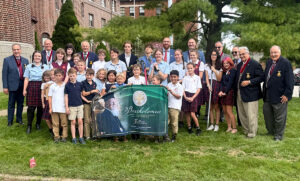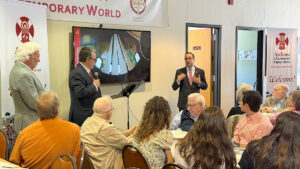
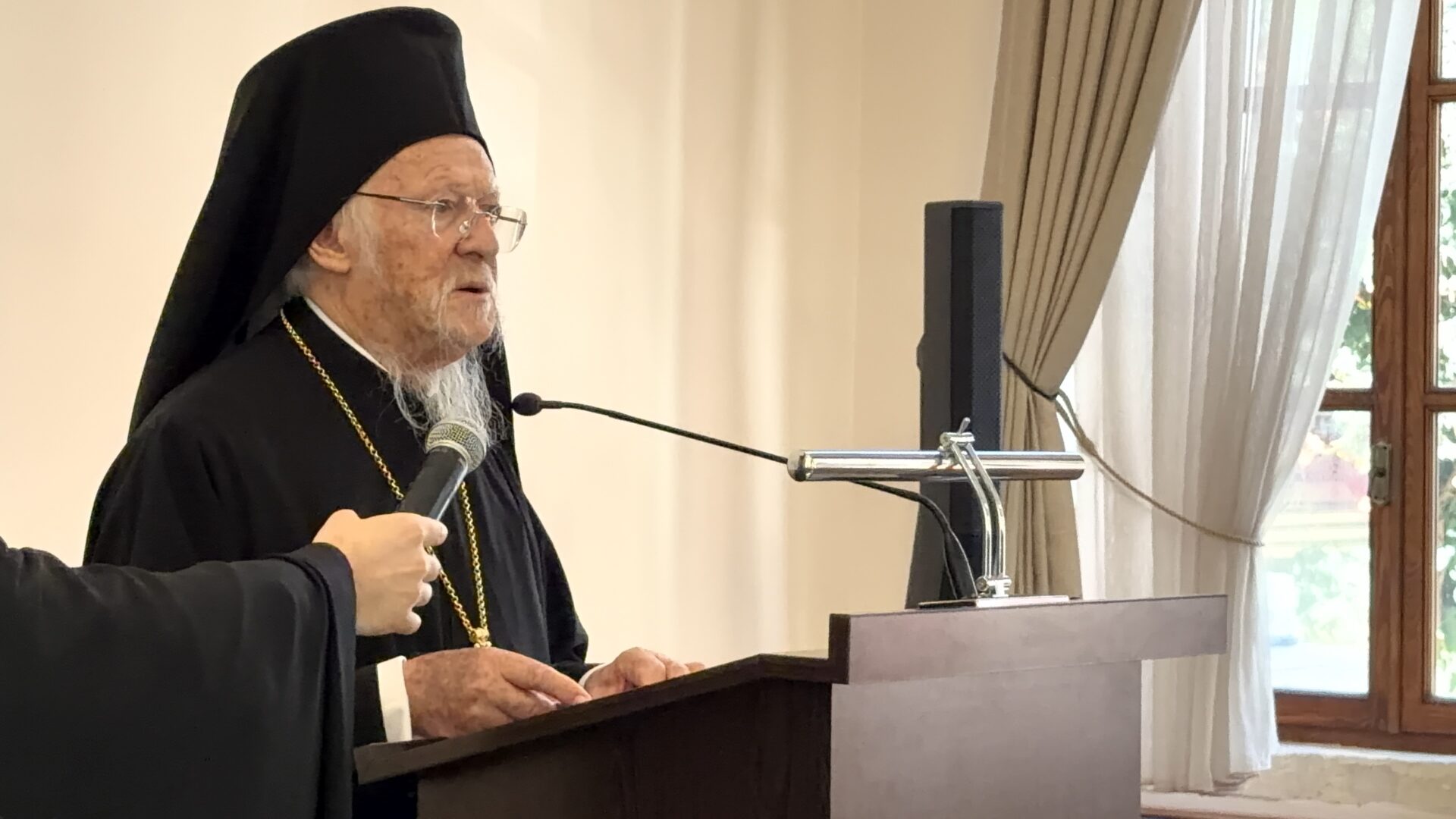
At the Phanar on Friday, September 11, 2026, His All-Holiness Ecumenical Patriarch Bartholomew welcomed a group of pilgrims who were journeying to Prousa and Nicaea as well as Constantinople, and elucidated for them the often-overlooked spiritual value and importance of making pilgrimages to holy sites.
“We believe,” His All-Holiness said, “that healthy religious tourism is never merely a leisure trip.” Pilgrims are not primarily tourists, and are not engaged in simple sightseeing: “The monuments themselves, which visitors enter,” His All-Holiness explained, “do not allow for that.”
His All-Holiness explained that such places do not allow for casual visiting, or draw the casual visitor into a more profound experience than he or she may have expected, because of the spiritual character of these sites, which remains uneffaced even in ruined churches and monasteries. The Orthodox attentiveness to the importance of creating a sacred space makes the experience of visiting these sites far more than just another tourist stop.
“The sanctity of the space of the churches and monasteries,” said the Ecumenical Patriarch, “the works of doxological art, the whole ethos and spirit of the place that houses or once housed a life dedicated to God — all of these transform the visitor into a pilgrim. Quickly, the superficial acquaintance with the monuments becomes a desire to partake in the truth of things, in the historical adventures of the Nation, which are inextricably bound to its Orthodox Christian identity, a participation in our wonderful traditions.”
His All-Holiness pointed out that “it is impossible to imagine that an Orthodox Christian enters a monastery without feeling the ‘good transformation,’ a spiritual upheaval, without sensing that he is in a sanctified place.”
This is because, he continued, “the monuments of our faith are not mere sights. They are places of divine presence, of prayer and supplication, of spiritual and psychic uplift. Everything there exhales a spiritual fragrance, creates compunction, radiates a mystical light, proclaims the beneficent presence and grace of the God of love. All our monuments and pilgrimage sites form a theological and cultural language that reveals the intangible heritage of the Nation, the Orthodox mindset, the truth of art, the priority of relationship, the ‘culture of the person.’”
Addressing the pilgrims, His All-Holiness charged them to be spiritually attentive as they continued on their journey: “On this pilgrimage journey of yours, you too will encounter this same ethos, this same spirit.” He explained why this was true even when the pilgrims visited ruins of ancient Christian sites: “Although the outward ‘grandeur’ of the Nation no longer exists among our monuments, the eternal present of Truth remains. And even if today we no longer find our once-flourishing communities in the sacred Asia Minor land, nor the charitable institutions, parishes, and monasteries, we find everywhere the imprint of Romiosyni, its indelible traces and its seal, bearing witness to and proclaiming a presence of centuries, and granting vital revelations to all pilgrims, however many times they come to this incomparable place.” Romiosyni, or “Romanness,” refers to the religion, culture, and indomitable spirit of the Greek-speaking Christian population of the Eastern Roman (Byzantine) Empire.
His All-Holiness spoke movingly about the spiritual power of these pilgrimage destinations: “It is characteristic that the footsteps of devout pilgrims are drawn to our monuments, as if pulled by a holy force. And when the pilgrims arrive, they taste the waters of eternity, hear unspeakable words, undergo an inner renewal, and feel as though, after a long absence in a foreign land, they have returned to their ancestral home. It is the grace of God, a living and life-giving presence, at work. And the icons that remain in our pilgrimage sites, even if defaced by a profane human hand, express intact the divine loving-kindness, our faith in its entirety, our hope unadulterated.”
Speaking personally, His All-Holiness added: “I declare, before you as well, that with the help of the all-merciful God, as long as I live and breathe, I will not cease to come as a humble suppliant and pilgrim to the divine dwelling-places of the Church and of the Nation in Asia Minor, Mother of Saints, in Pontus, in Eastern Thrace. When we celebrate the Holy Services in our restored or ruined churches, we feel that the souls of our devout ancestors, who rest in this holy soil and await the resurrection of the dead, leap and rejoice together with us, chanting together ‘Christ is Risen’ and ‘Glory to God in the Highest.’ What the pilgrims feel here is not mere emotion and compunction. It is a revelation of divine majesty and compassion.”
His All-Holiness emphasized the responsibility of parents and teachers to impress upon youth the importance of Orthodox traditions: “When we address parents and teachers, we always urge them to teach the new generation the traditions and values of the Nation, so that it may not forget its roots and may feel proud of the most precious things it has inherited from its ancestors. We rejoice when we welcome, here in the City and in the unforgotten homelands, young men and women, always with the certainty that even those who came as visitors will become pilgrims, that the journey will become a sacred pilgrimage.”
May we feel the same pride in the precious gift of our Holy Orthodox Faith, and its foremost exponent today, our beloved Ecumenical Patriarch Bartholomew.