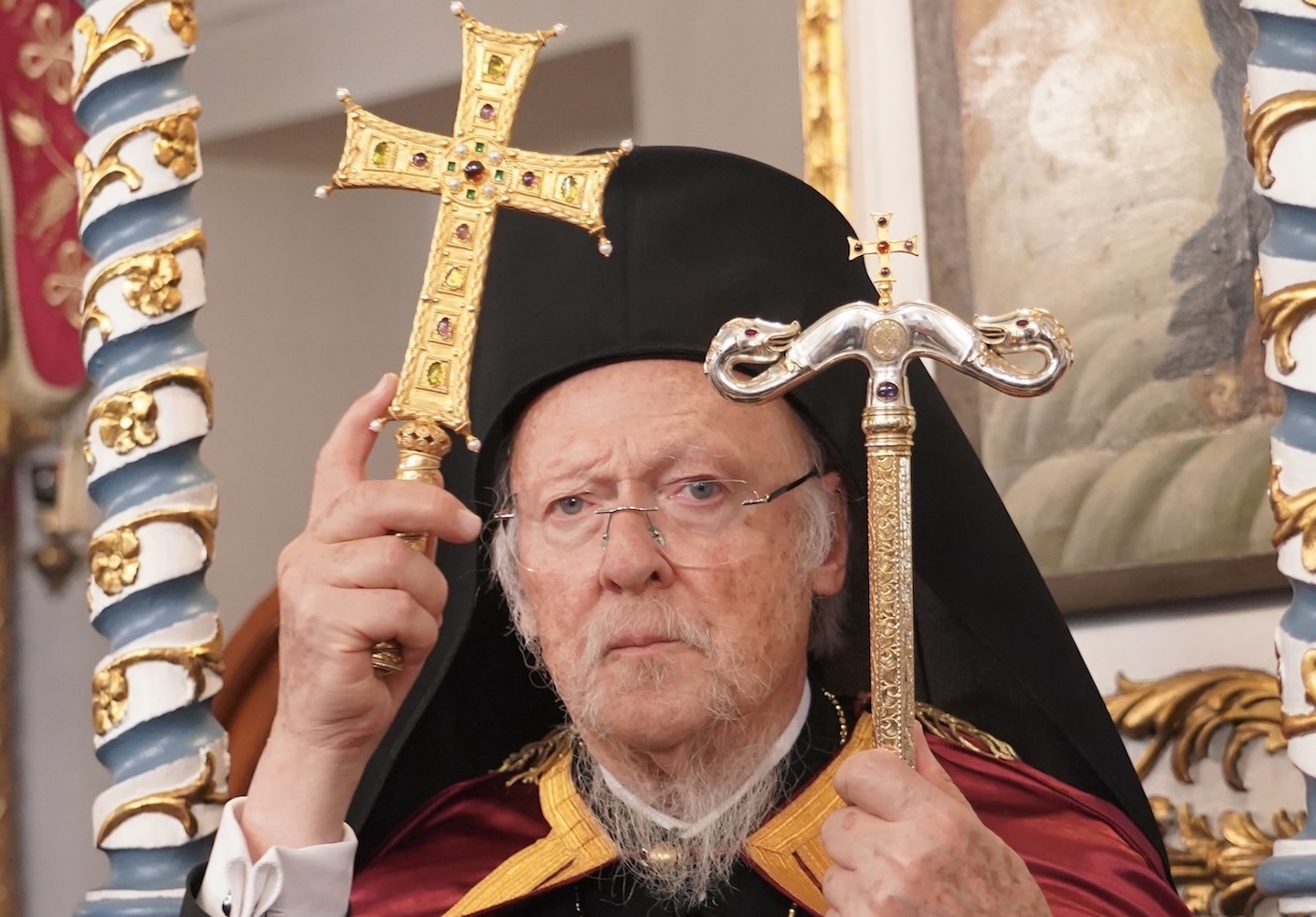
In the historic Church of St. Paraskevi in Constantinople on its patronal feast, July 26, 2026, His All-Holiness Ecumenical Patriarch Bartholomew spoke movingly about the holy martyrs, and reflected upon the grim reality of the persecution of Christians today.
In the course of his remarks, the Ecumenical Patriarch lamented once again that the Russian government is waging an unjust war against its “Orthodox neighbor,” Ukraine, with the full approval of the Moscow Patriarchate, which has even blessed the conflict as a “holy war.” His All-Holiness has warned on numerous occasions that the concept of a “holy war” is incoherent, and that there can never be such a war.
His All-Holiness declared forthrightly that “truth is under attack. The followers of the Risen Lord are once again being persecuted, especially in the Middle East, the cradle of Christianity, which continues to give birth to new martyrs of the faith in our own time.” He noted disapprovingly that some have even dared to wage war in the name of the “Prince of Peace,” and continue to do so today.
It was tragic, said the Ecumenical Patriarch, that “the Orthodox Russian Federation turned against its Orthodox neighbor,” and that the Moscow Patriarchate described this conflict, a product of Russian aggression, as a “holy war,” even going so far as to bless weapons and promise eternal life to Russian Orthodox soldiers who fought against “their Ukrainian brothers.”
On May 20, 2026, His All-Holiness further explained the absolute incompatibility between the concepts of holiness and war: “The new creation bestowed upon us by the risen Lord allows no room for hatred and enmity, only love, love without limits, compassion and understanding. By this shall all know that we are true disciples of the risen one: if we have love for one another and for all people. We must always proclaim peace and brotherhood among peoples and nations, not war, even if we baptize it as ‘holy’ to please an authoritarian secular power. There has never been, nor will there ever be, a ‘holy war’! Holiness and war are, by their very nature, mutually incompatible concepts incapable of coexisting in any form!”
In remarks on March 24, 2026, the eve of the Feast of the Annunciation, His All-Holiness called upon the faithful to beseech the Most Holy Theotokos for an end to wars: “Let us fervently implore the Virgin Mary tonight to drive wars away from our world. May she bring an end to bloodshed, atrocities, violence, and our inhumanity. Her virtue and intercession can restrain human wickedness, for she was deemed worthy by God to take an active part in the salvation of us all. Today, the Theotokos becomes the new earth and the new heaven, from which a new world arises—a world of beauty, virtue, and salvation.”
His All-Holiness added: “May the joy of the Incarnation of the Word of God spread everywhere, so that peoples may advance in harmony and brotherhood and walk together toward enduring love, true justice, and the longed-for peace. Only these bring lasting and inalienable joy to humanity and to the nations of the earth—this is the message proclaimed by the Church: ‘Rejoice, O earth, with great joy; praise, O heavens, the glory of God!’”
The Ecumenical Patriarch concluded with a thoughtful reference to the Feast of the Annunciation: “The Annunciation is a consoling teaching, a voice of optimism, a proclamation of joy—the glad tidings of God’s goodwill and peace on earth.” The peace that the Annunciation brings to the earth is antithetical to the very ethos of war. War is, therefore, fundamentally opposed to the Christian Faith.
“History,” said the Ecumenical Patriarch in August 2025, “is replete with violence and cruelty,” but “never before has humanity been able to destroy so many lives and so much of the planet’s resources simultaneously.” He accordingly called upon Christians to reject war “as a political and national necessity,” saying that peace was “an existential and spiritual demand.”
“Peace,” he said, “always—and ultimately—starts in the heart. It takes time, toil, and tears. Nevertheless, it is our only hope for survival as individuals, as nations, and as a species.”
His All-Holiness reminded his audience of the Lord Jesus’ words: “Blessed are the peacemakers, for they shall be called children of God” (Matthew 5:9). Let us meditate upon these words anew in light of his explanation of them: “To be ‘peacemakers’ is to move away from what serves our own interests to what embraces the rights of others.” To do that consistently and in a thoroughgoing manner would indeed transform the world.