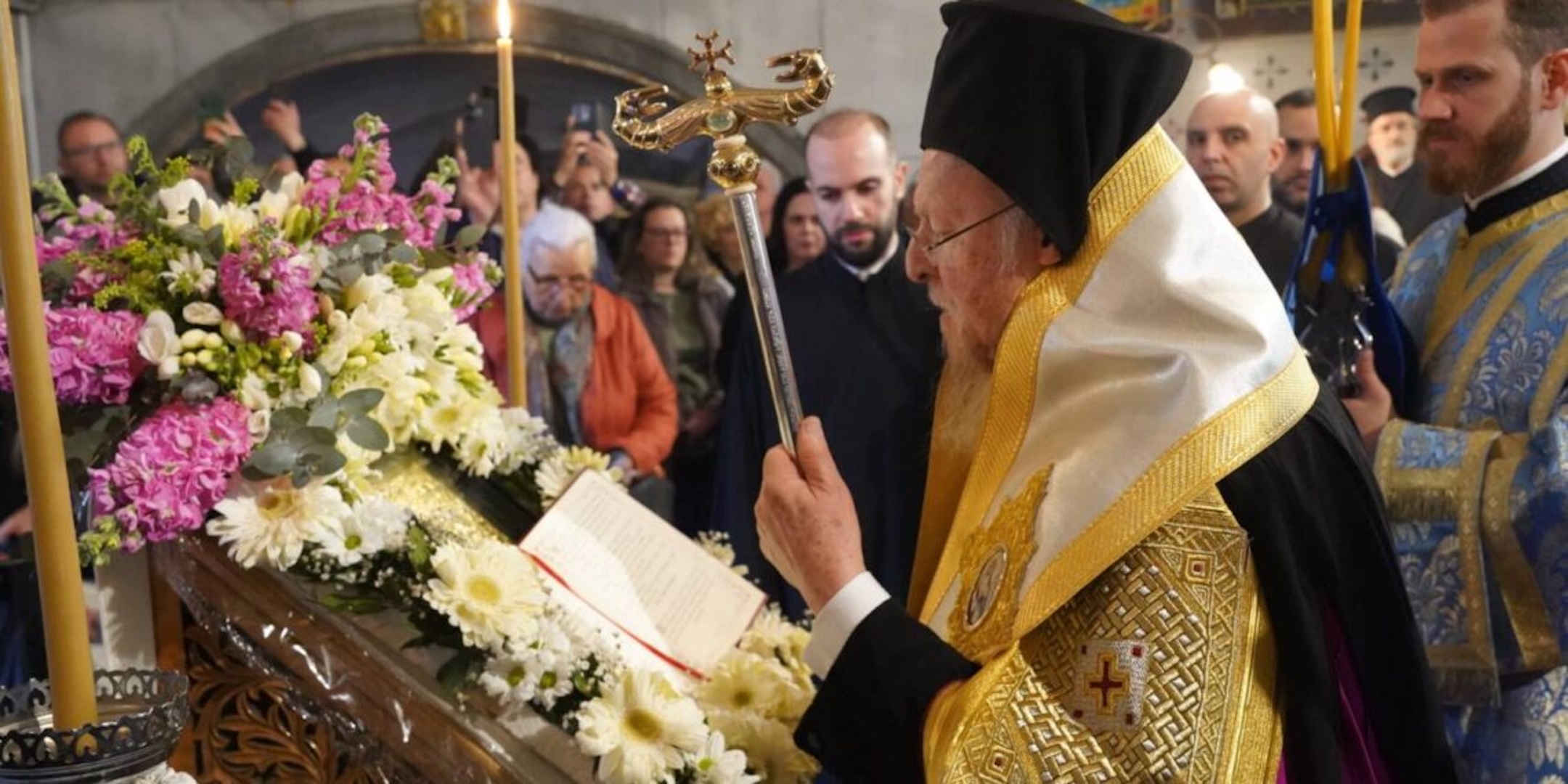
August 7, 2026 marked the 1,400th anniversary of the momentous day when the faithful were blessed to hear for the first time what has become one of the Church’s most beloved hymns. On that sacred anniversary, His All-Holiness Ecumenical Patriarch Bartholomew traveled to the historic Holy Spring at the Church of the Theotokos of Blachernae, the site where the Akathist Hymn was first chanted.
At that church, His All-Holiness presided over the Divine Liturgy and solemnly observed the anniversary of the first appearance of the Akathist Hymn. In a Patriarchal and Synodal Encyclical issued on March 23, 2026, he explained that the hymn was introduced in the Church in order to give thanks to the All-Holy Mother of God for delivering the Christians of Constantinople in a time of grave crisis. The Avars and Persians threatened to overrun the city, and the renowned Emperor Heraclius was far away, traveling with his army in the Holy Land in search of the Precious and Life-Giving Cross of Christ.
Only a token force stood between the inhabitants of the city and disaster. Fervently they beseeched the Theotokos for help, and she delivered them from danger. His All-Holiness explains: “The deliverance of the City of Constantinople and of the entire Empire from the severe assault of the Avars and the Persians, while Emperor Heraclius was absent with the army, striving far away for the recovery of the Precious Cross of Christ, was rightly attributed to the mighty protection and assistance of the Most Holy Theotokos, to whom the founder, Equal-to-the-Apostles Emperor Constantine the Great, had piously dedicated New Rome.”
The city was saved by means of a miracle: “Receiving the heartfelt, unceasing, and fervent supplication of clergy and people, the Mother of God not only strengthened the morale of the few defenders, but also wrought a great miracle: by the sudden turning of violent winds, she brought about the total destruction of the fleet of the besiegers, after which they fled in disorder, and thus the City was saved.”
In gratitude to the Panagia, the Ecumenical Patriarch continued, “the historic Church of Blachernae, where according to ancient tradition a sacred vigil was celebrated weekly in honor of the Mother of God, often even in the presence of the Emperor, on the night of 7 August 626 received the throngs of the God-fearing people who had been delivered, who, in great emotion and with tears of gratitude, ‘offered her veneration’ and chanted the kontakion with its now new prooimion, as due thanksgiving and indebted doxology to God and to her ‘who holds the second place after the Trinity,’ according to the hymnody of Saint Andrew of Crete, the Deliverer and Saviour of the City and of the whole Empire.”
His All-Holiness noted that in the Akathist Hymn, “the faithful at prayer reverently greet the Panagia with repeated invocations of the first salutation addressed to the Full of Grace by the Archangel Gabriel, who announced grace and joy, namely, the word ‘Rejoice’, through which the ‘mystery hidden from the ages’ is revealed and ‘the foundation of our salvation’ is established. The repetition in this hymn of the word ‘Rejoice’ one hundred and forty-four times to the All-Blessed Virgin clearly bears a mystical meaning, referring to the one hundred and forty-four thousand pure saints of the Apocalypse, who sing the ‘new song’ before the Throne of God and ‘follow the Lamb wherever He goes.’”
Therefore, His All-Holiness continued, “as one ‘delivered from dangers,’ the City of the Theotokos fittingly ascribed the hymns of victory to the Panagia, whom it thereafter named its ‘Champion General,’ invoking her again and again throughout the turbulent history of the Nation and continually experiencing the sweetness of her love and her mighty protection.”
To this day, the Ecumenical Patriarch stated, the Akathist Hymn “calls every faithful person to vigilance, to stand upright and steadfast, in humility and prayer, before the great challenges of our age, in these grievous days of many upheavals and wars through which humanity is now passing.”
As we endure the upheavals of our own age, let us fervently beseech our Champion General to deliver us from danger, as she did our forefathers and foremothers fourteen hundred years ago. And let us remember, in all the trials and difficulties of our lives, that the protection of the All-Holy Theotokos, who is so eloquently and lovingly celebrated in the Akathist Hymn, never fails.