The Ecumenical Patriarch is the spiritual leader and “first among equals” of the Eastern Orthodox Church, the senior bishop among all Orthodox bishops worldwide. In practical terms, he does three main things: he convenes and presides over gatherings of the global Orthodox Church, he serves as Orthodoxy’s chief voice in dialogue with other churches and faiths, and he alone holds the recognized authority to grant a church full independence. What he does not do is rule the other Orthodox churches, and that distinction is the key to understanding the office.
The Ecumenical Patriarch is the Archbishop of Constantinople, who by ancient tradition ranks first in honor among the heads of the world’s Orthodox churches. The seat he occupies, the Ecumenical Patriarchate, is the senior see and historic center of the Orthodox world, a line that Orthodox Christians trace back to Saint Andrew the Apostle.
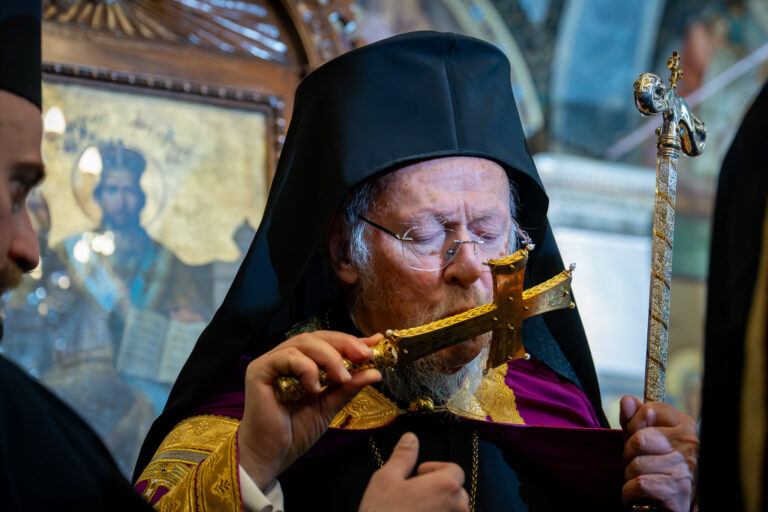
The current officeholder is His All-Holiness Ecumenical Patriarch Bartholomew, enthroned in 1991 as the 270th Archbishop of Constantinople. Born on the island of Imbros in 1940, he is the longest-serving Ecumenical Patriarch in the modern history of the office. Widely known as the “Green Patriarch” for decades of environmental advocacy, he received the 2025 Templeton Prize at a ceremony in New York that fall, an unusual honor for an Orthodox primate and a measure of his global standing.
If he does not govern the other churches, what fills his day and defines his ministry? The role breaks down into three core responsibilities.
Orthodoxy has no central government and no single headquarters that issues binding orders. The Ecumenical Patriarch is the one figure who can call the self-governing churches together and preside when they meet. He coordinates pan-Orthodox councils and consultations, the closest the Orthodox world comes to acting as a single body. When the churches need to address a shared question, it is the ecumenical patriarch who convenes the table and chairs it.
The Ecumenical Patriarch represents the Orthodox Church to the wider world. He leads formal dialogue with the Roman Catholic Church, engages other Christian communions, and builds relationships with other religions entirely. He is also a recognized moral voice on issues that reach beyond church walls, from religious freedom to the environment. When Orthodoxy needs to speak to a pope, a president, or an international body, the Ecumenical Patriarch is the one who speaks.
This is the most consequential power the office holds and the most contested. Autocephaly is the status of full self-governance that makes an Orthodox church independent, able to elect its own leadership without outside approval. By long-standing tradition, only the Ecumenical Patriarch can grant it. In 2019 Ecumenical Patriarch Bartholomew granted autocephaly to the Orthodox Church of Ukraine, a decision that strained relations with the Moscow Patriarchate and reshaped Orthodox geopolitics. We explain the canonical basis for this power in our deeper look at why the Ecumenical Patriarch alone can grant autocephaly.
Beyond his coordinating role, the Ecumenical Patriarch is also the direct ecclesiastical head of millions of Orthodox Christians who live outside the traditional Orthodox heartlands. Many communities in the Americas, Western Europe, Australia, and elsewhere were never part of an existing national church, so they fall under the Ecumenical Throne itself.
The Greek Orthodox Archdiocese of America is the most prominent example. For these faithful, the Ecumenical Patriarch is not a distant figure of honor but their actual spiritual father, the bishop to whom their own clergy ultimately answer. This pastoral responsibility is one of the least understood parts of the office, yet it touches more American Orthodox Christians than any other.
To understand the office, you have to understand what it is not. The Latin phrase that defines the Ecumenical Patriarch’s standing is primus inter pares, or “first among equals.” He presides, he convenes, and he speaks for the whole, but he cannot overrule a fellow patriarch or run another church’s internal affairs.
Two facts surprise newcomers. First, size does not determine rank. The Russian Orthodox Church is far larger by population, yet Constantinople still holds the first throne, because honor follows the ancient order of the apostolic sees rather than a head count. Second, primacy is a duty, not a command. The Ecumenical Patriarch’s job is to keep the communion together, not to direct it from above. If you want the full picture, we unpack what “first among equals” actually means and why it is so often misread.
People new to Orthodoxy often assume the Ecumenical Patriarch is “the Orthodox pope.” He is not, and the contrast is worth drawing clearly. The Pope of Rome holds universal jurisdiction: he can teach, legislate, and act for the entire Roman Catholic Church as its single head. The Ecumenical Patriarch holds a primacy of honor: he is the respected senior figure among independent equals, the first to speak but not the last word for anyone but his own church.
A useful image is a chief executive of one corporation (the pope) compared with the senior chair of a council of independent leaders (the ecumenical patriarch). Both are “first,” but the kind of “first” is entirely different. That single distinction explains nearly every headline you will read about tension within the Orthodox world.
The scale of the Ecumenical Patriarch’s influence is striking precisely because it rests on no worldly force. He is regarded as the spiritual leader of the world’s Orthodox Christians, a communion that the Pew Research Center numbers around 260 million and that the Ecumenical Patriarchate itself often places nearer 300 million, making Orthodoxy the second-largest body of Christians on earth.
According to the Greek Orthodox Archdiocese of America, Orthodox faithful across the Americas, Europe, and Australia fall directly under the Ecumenical Throne. For many readers in the United States, this is not a distant abstraction but the mother church of a parish in their own city.
And yet the man at Constantinople commands no army, no state, and no treasury. His authority is purely spiritual and moral, bearing the weight of being first to speak for roughly a quarter of a billion believers. That weight is also why the office has become a target. The Ecumenical Patriarchate survives as a tiny Christian presence in a majority-Muslim country, holds no legal personality under Turkish law, and has watched its historic Halki theological school sit closed by the state since 1971. A primacy of honor, as the last century has shown, confers no immunity from persecution.
This is where our work as the Archons begins. The office can hold the first throne of a global faith and still be quietly pressured in its own city, which is exactly why a lay order exists to defend it. Understanding what the Ecumenical Patriarch does, and the limits within which he does it, is the first step toward understanding why his religious freedom is worth protecting.
For sixty years, the Order of Saint Andrew the Apostle, Archons of the Ecumenical Patriarchate, has defended the religious freedom of the Mother Church and her Ecumenical Patriarch. If this explanation has shown you why the role matters, the next step is to help keep it standing. See the issues we are fighting and how you can stand with us.
The Ecumenical Patriarch has three core duties: convening and presiding over pan-Orthodox gatherings, representing Orthodoxy in dialogue with other churches and faiths, and granting autocephaly (full independence) to Orthodox churches. He coordinates the worldwide communion as its senior bishop, but he does not govern the internal affairs of the other self-governing churches.
No. The Ecumenical Patriarch holds a primacy of honor, not a primacy of power. He is “first among equals,” able to convene, preside, and speak for the communion, but he cannot overrule another patriarch or direct another church’s internal decisions. Each Orthodox church governs itself.
Autocephaly is the status of full self-governance that makes an Orthodox church completely independent, able to choose its own leaders without outside approval. It matters because the Ecumenical Patriarch alone is recognized as able to grant it, which is the source of both his unique authority and many of the disputes surrounding the office, including the 2019 recognition of the Orthodox Church of Ukraine.
The Ecumenical Patriarch is elected by the Holy Synod, the governing council of senior bishops (metropolitans) of the Ecumenical Patriarchate. Candidates must meet requirements set by Turkish law, including Turkish citizenship, since the office is based in Istanbul. Once elected, the new Ecumenical Patriarch is enthroned at the Cathedral of Saint George in the Phanar district of the city.
The current Ecumenical Patriarch is His All-Holiness Bartholomew, who has held the office since 1991. He is the 270th Archbishop of Constantinople, was born in 1940, and is recognized as the spiritual leader of Orthodox Christians worldwide. He is widely known as the “Green Patriarch” and received the 2025 Templeton Prize.
Strip away the titles and the centuries, and the Ecumenical Patriarch’s role comes down to a simple idea: in a Church with no single ruler, someone must still be first to speak, first to call the others together, and first to carry the name of the whole. For two thousand years, Constantinople has been that voice.
Today it speaks from a city where its own faithful have nearly vanished, which makes the office more vulnerable and more vital than at any point in living memory. Defending it is the work we have given ourselves, and the invitation is open to you.