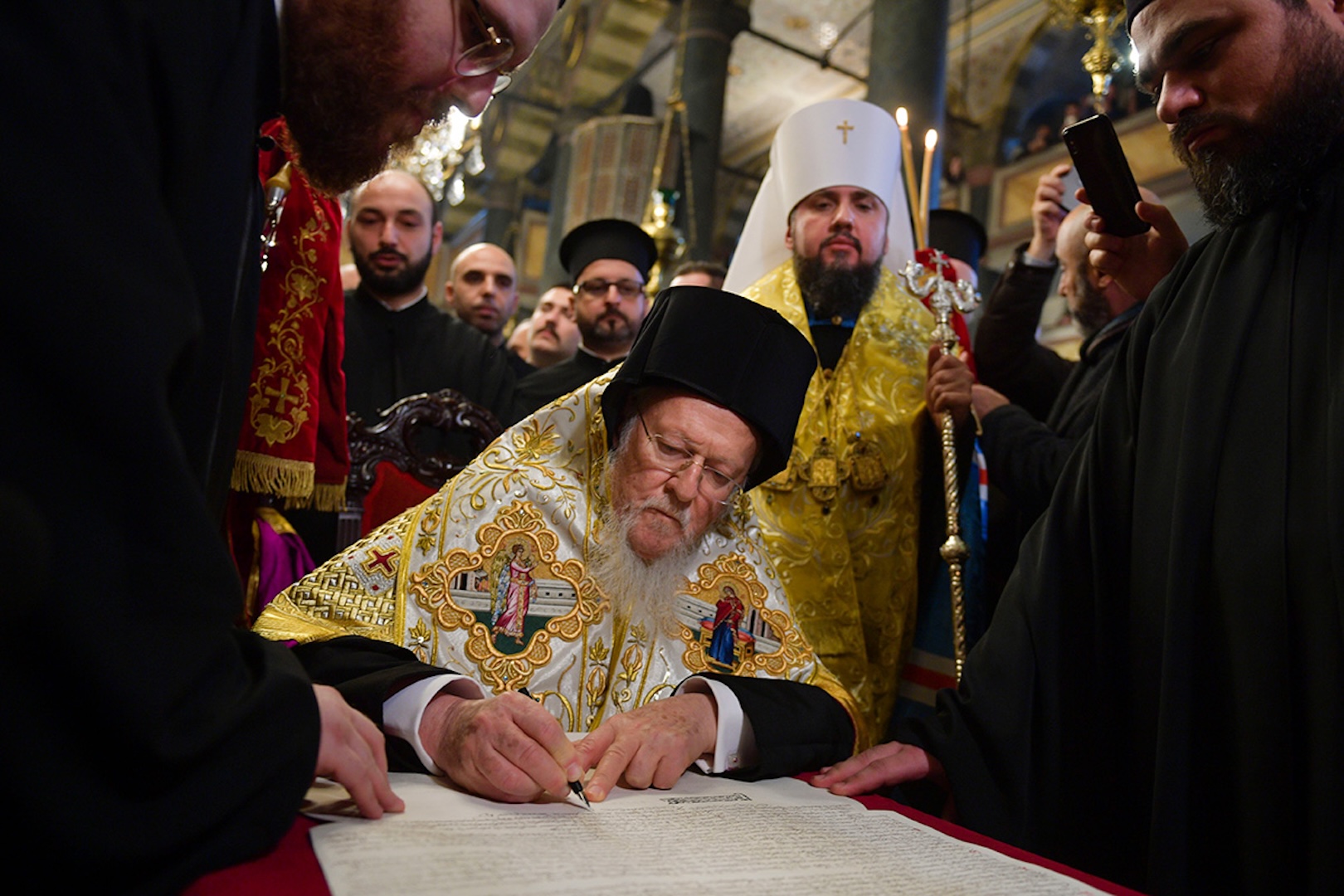
On January 5, 2019, His All-Holiness Ecumenical Patriarch Bartholomew signed the Tomos of Autocephaly (independence) for the Orthodox Church of Ukraine, as His Beatitude Metropolitan Epiphaniy of Kyiv and All Ukraine stood by. Although this courageous step to heal the longstanding schism in Ukraine has been the focus of a great deal of controversy and debate, it was the canonical right and responsibility of the Ecumenical Patriarchate to act to settle the longstanding dispute in Ukraine and grant autocephaly to the Church there.
This unique authority to grant autocephaly, as well as to call together the Holy and Sacred Synod which governs the Ecumenical Patriarchate with the Ecumenical Patriarch presiding, is rooted in the exclusive responsibilities that the Ecumenical Councils granted to the Church of Constantinople.
These responsibilities of the Ecumenical Patriarch of Constantinople derive from Canon 9 of the Fourth Ecumenical Council, which was held in Chalcedon in 451 and stated: “If a bishop or cleric has a disagreement with the metropolitan of the province, let him appeal to the Exarch of the Metropolis, or to the throne of the Imperial City of Constantinople, and let him be tried there.” Canon 17 of the same Council said: “And if any one be wronged by his metropolitan, let the matter be decided by the exarch of the diocese or by the throne of Constantinople, as aforesaid.” Canon 28 added that the Church of Constantinople had “equal privileges” to those of the Church of Rome.
On June 24, 1970, His All-Holiness Ecumenical Patriarch Athenagoras of blessed memory elucidated these particular responsibilities in a letter to His Eminence Metropolitan Pimen of the Moscow Patriarchate (His Beatitude Patriarchate Alexy of Moscow had died on April 17, and so the Moscow Patriarchate was vacant at the time; Pimen would become Patriarch of Moscow on June 3, 1971).
The occasion of the letter was the Tomos of Autocephaly that the Patriarchate of Moscow had granted to its former archdiocese in North America, which is now known the “Orthodox Church in America.” Ecumenical Patriarch Athenagoras explained that the Moscow Patriarchate had not followed the proper canonical procedures for the granting of autocephaly.
In this letter, Ecumenical Patriarch Athenagoras reminded Metropolitan Pimen that he had previously recommended “that the Holy Russian Church refrain from any further activities that might disturb ecclesiastical peace and harmony and bring about a condition that might overturn the established canonical order.” He stated unequivocally that the “alleged right” of the Moscow Patriarchate or “any other Autocephalous Orthodox Church” to “grant the status of autocephaly to another Church… does not correspond either to canonical requirements or to existing practices within the Church.”
Ecumenical Patriarch Athenagoras emphasized that “certainly and incontrovertibly, and in accordance with the canonical conception of the Church, the concept behind the granting of autocephaly belongs to the domain of canonical authority.” He granted that “specific canons exactly characterizing autocephaly are not to be found in ecclesiastical legislation,” but pointed out that “certain general guidelines and provisions, relative to autocephaly, may be gathered from the basic principles of such legislation.”
Those basic principles, the Ecumenical Patriarch explained, establish that “from the very meaning of autocephaly itself as an ecclesiastical act, from which certain changes result relative to ecclesiastical boundaries and to the rise of new jurisdictional and administrative powers that bring about a new order in the Orthodox Church as a whole — it may be concluded that the granting of autocephaly is a right belonging to the Church as a whole, and cannot at all be considered a right of ‘each Autocephalous Church,’ as is stated in the letter of Patriarch Alexis of blessed memory.”
Citing various rulings of the Ecumenical Councils, Ecumenical Patriarch Athenagoras pointed out that the “Ecumenical Councils considered that judgment concerning autocephaly was within their jurisdiction and did not lie outside their competence.” On some occasions, however, without the convening of an Ecumenical Council, “the Holy Apostolic and Patriarchal Ecumenical Throne gave the stamp of autocephaly with the approval of the other Orthodox Churches.” Ecumenical Patriarch Athenagoras said that “the Ecumenical Patriarchate could do this because of its attribute as the Mother Church and its status as the ‘First Among Equals’ in reference to the other autocephalous Orthodox Churches, and because it is at the center of the internal unity of the entire Orthodox Church, helping the other Churches in their needs — a duty that derives from its presiding and excelling position within the family of the Orthodox Churches.”
Consequently, he said, “such decisions cannot be made by each local Autocephalous Church or by a local Synod of a Church from which a Diocese is requesting autocephaly.” The Orthodox Church in Ukraine, even though it was under the authority of the Patriarchate of Moscow, could only be granted autocephaly by an Ecumenical Council or by the Ecumenical Patriarch of Constantinople. As Ecumenical Patriarch Athenagoras’ analysis was rooted in the teachings of the Ecumenical Councils and sacred canons of the Church, it holds true today as much as it did when he wrote it, and will continue to do so for all time.