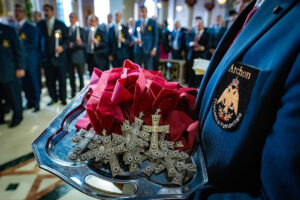
Ask most people who leads the Eastern Orthodox Church, and you will get a blank look or a guess that there must be “an Orthodox pope”; there is not. Leadership in Orthodoxy works on a different logic entirely, and at its center sits the Ecumenical Patriarchate of Constantinople: the senior see of the Orthodox world and the spiritual home of the faith’s first throne. We are the Archons, the laymen and women charged with defending this institution, and what follows is the explanation we wish every newcomer received first.
The office, in one sentence
The Ecumenical Patriarchate is the historic seat of the Archbishop of Constantinople, who carries the additional title of Ecumenical Patriarch and ranks first in honor among all Orthodox bishops. That is the whole institution in a line. Everything else, the history, the powers, and the controversies, flows from unpacking what “first in honor” actually means, because it is nothing like the authority people assume.
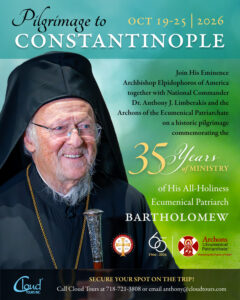
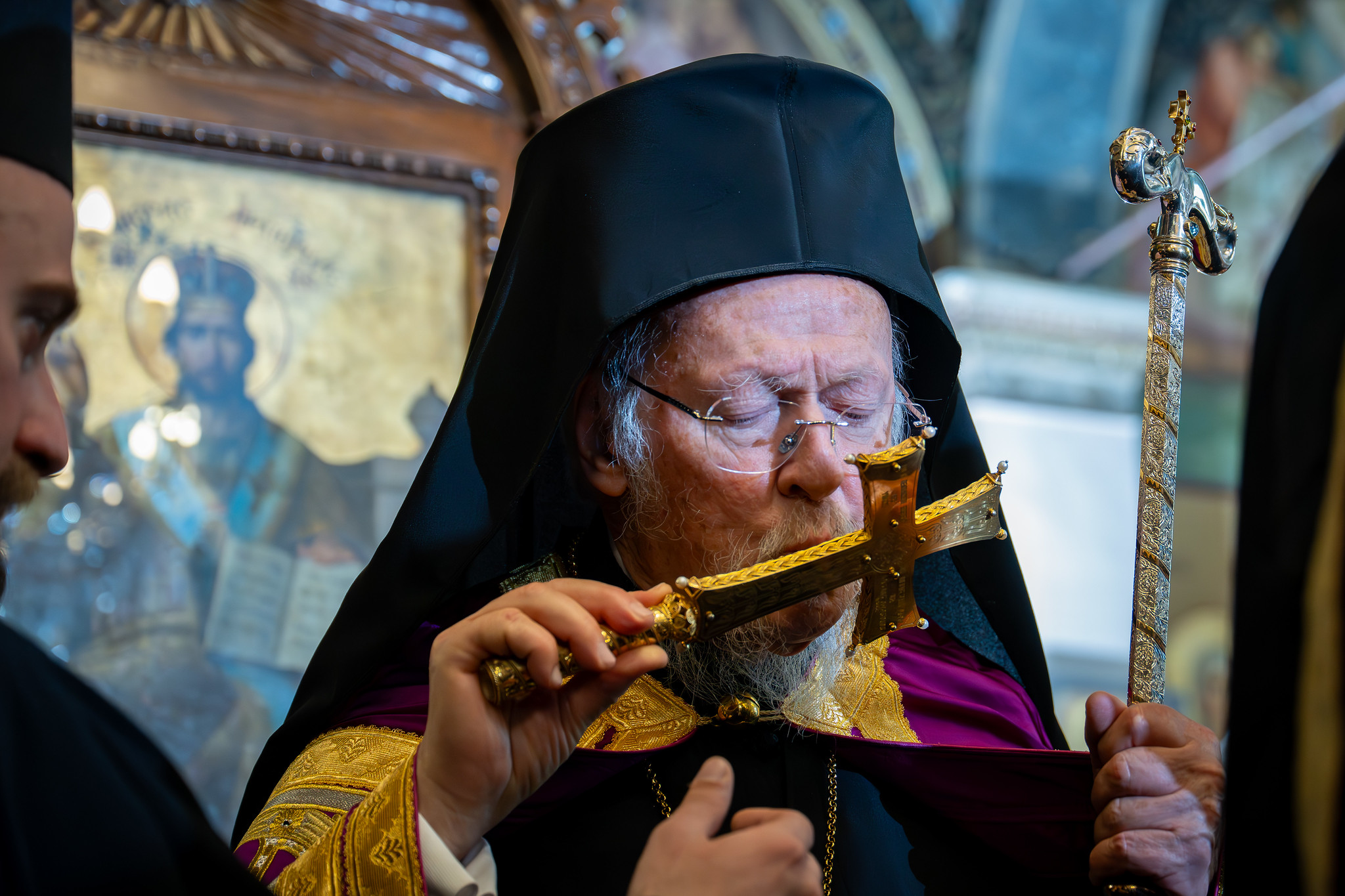
The current holder of the office is His All-Holiness Ecumenical Patriarch Bartholomew, enthroned in 1991. Born Demetrios Arhondonis on the island of Imbros in 1940, he is, by the Church’s reckoning, the 270th Archbishop of Constantinople in a line that tradition traces to Saint Andrew the Apostle. In 2025 he received the Templeton Prize for decades of work linking faith and ecology, the recognition behind his nickname, the “green patriarch.”
Why there is no Orthodox pope
Here is the misunderstanding we correct most often. The word that defines the patriarch’s role is the Latin “primus inter pares,” meaning “first among equals.” He presides, he convenes, and he speaks for the whole, but he does not govern the other churches. Each of the world’s self-governing Orthodox churches runs its own affairs.
Two consequences follow that surprise newcomers:
- Size does not equal rank: The Russian Orthodox Church is far larger by population, yet Constantinople still holds the first throne. Honor follows the ancient order of the apostolic sees fixed by the early councils, not a head count.
- Primacy is a duty, not a command: The patriarch cannot overrule a brother patriarch the way a pope can act for the entire Catholic Church. His role is to coordinate, to call councils, and to keep the communion together.
A useful way to picture it: the Pope of Rome functions like a chief executive over a single corporation, while the Ecumenical Patriarch is closer to the respected senior chair of a council of independent heads, first to speak, last word to no one. That distinction is the key to almost every news story you will read about Orthodox tensions, including Ukraine.
What the Patriarch actually does
If he does not rule, what does the office do? Three things, mainly.
He convenes and presides over pan-Orthodox gatherings, the closest the Orthodox world comes to acting as one body. He serves as the chief voice of Orthodoxy in dialogue with the Roman Catholic Church, other Christians, and other religions. And he alone holds the recognized prerogative to grant autocephaly, the full self-governance that makes a church independent.
That last power is the most consequential and the most contested. As Britannica records, Bartholomew granted autocephaly to the Orthodox Church of Ukraine in 2019, a decision that fractured relations with Moscow. We walk through the canonical basis for that authority in our explainer on why the patriarch can grant autocephaly.
The reach is not only ceremonial. According to the Greek Orthodox Archdiocese of America, Orthodox faithful across the Americas, Europe, and Australia fall directly under the Ecumenical Throne, the Greek Orthodox Archdiocese of America among them. For readers in the United States, this is the mother church of a community in your own city, not a distant abstraction.
It helps to know the scale. The Patriarch is regarded as the spiritual leader of the world’s Orthodox Christians, a communion the Pew Research Center numbers at roughly 260 million and which the Patriarchate itself often places nearer to 300 million. That makes Orthodoxy the second-largest body of Christians on earth after the Roman Catholic Church. The man at Constantinople commands no army, no state, and no treasury, only the weight of being first to speak for a quarter of a billion believers. In a Church with no central government, that voice is the nearest thing to a unifying force, which is exactly why influence over it has become a geopolitical prize.
Where the name comes from
The two words confuse people, so it is worth pausing on them. A patriarchate is simply the office and territory of a patriarch, the bishop of one of Christianity’s most ancient and senior sees. “Ecumenical” comes from the Greek “oikoumene,” meaning “the whole inhabited world,” the term the late Roman Empire used for the civilized world it governed.
Put together, the title signals a ministry of worldwide scope rather than a national one. It is ancient: the Patriarchate’s own records note that the formal style, “Archbishop of Constantinople, New Rome, and Ecumenical Patriarch,” reaches back to the sixth century. That single word still triggers conflict. The Turkish state has long refused to recognize the “Ecumenical” title, insisting the office is merely a local Turkish religious body rather than a global one, a dispute over a word that is really a dispute over standing. We keep a deeper reference on the ecumenical patriarchate for those who want institutional detail.
How a fishing village became the first throne
The standing did not appear overnight. Orthodox tradition holds that Saint Andrew, the “First-Called” apostle and brother of Saint Peter, founded the church of Byzantium. When Constantine moved the Roman capital there in 330 and renamed it, the city became “New Rome,” and its bishop rose with it.
The councils then made it official. Constantinople’s rank was raised in 381 and again at Chalcedon in 451, and the very title “ecumenical” grew out of that conciliar age. The city took its seat among the five great apostolic centers, the Pentarchy: Rome, Constantinople, Alexandria, Antioch, and Jerusalem.
In the centuries after, the patriarchs steered doctrinal disputes and carried Christianity to the Slavic peoples, drawing the religious map of Eastern Europe that survives today. When the Great Schism of 1054 split Rome from the East, Constantinople stood as the leading see of Orthodoxy, and it remains one of the oldest functioning institutions on earth.
Honor without protection: the Patriarchate today
This is where our work begins and where the story turns from history to a live emergency. The Ecumenical Patriarchate commands extraordinary moral weight, yet it survives as a tiny Christian presence in a majority-Muslim country, and Turkish law gives it almost no security.
The hard facts are these. The Patriarchate has no legal personality under Turkish law, leaving it unable to fully own property or defend itself in court as an institution. Numerous properties have been confiscated over the decades. And its theological school, Halki Seminary, has been shut by the state since 1971, choking off the training of future clergy for more than half a century. There is a reason we insist the Patriarchate must remain in Constantinople: an office whose authority is rooted in a specific historic see cannot simply be relocated for safety.
The lesson of the last hundred years, the one that animates everything we do, is blunt. A primacy of honor confers no immunity from persecution. The city’s native Greek Orthodox community, which numbered roughly 135,000 after the 1923 population exchange, has dwindled to only a few thousand today following the 1955 Istanbul pogrom, the 1964 expulsions, and decades of legal pressure. An institution can hold the first throne of a global faith and still be quietly strangled in its own city. That is precisely why a lay order exists to defend it and why we treat advocacy not as charity but as a duty owed to the Mother Church.
Frequently Asked Questions
What does “ecumenical” mean?
It comes from the Greek oikoumene, “the whole inhabited world.” Applied to the Patriarch of Constantinople, it marks a primacy of honor that spans the entire Orthodox world rather than any single country. The title has been in use since the sixth century.
Does the Orthodox Church have a pope?
No. Orthodoxy has no single ruler with universal jurisdiction over the whole Church. The Ecumenical Patriarch is “first among equals,” a primacy of honor rather than power, while every self-governing Orthodox church manages itself.
Who is the head of the Eastern Orthodox Church?
In honor and standing is the Ecumenical Patriarch of Constantinople, currently Patriarch Bartholomew, who has held the office since 1991. He represents and speaks for Orthodox Christians worldwide, but he presides among the other patriarchs as their equal, not their superior.
What is a patriarch?
A patriarch is the bishop of one of the Church’s most senior and ancient sees. In Orthodoxy, patriarchs lead several self-governing churches, such as Constantinople, Alexandria, Antioch, Jerusalem, and Moscow. The Ecumenical Patriarch of Constantinople is first in honor among them all.
How many Ecumenical Councils have there been?
The Orthodox Church recognizes seven, beginning at Nicaea in 325 and ending at the Second Council of Nicaea in 787. They defined the core of the faith, including the Nicene Creed. The Roman Catholic Church, by contrast, counts 21 councils as ecumenical.
The first throne is worth defending
Strip away the titles and the centuries, and the Ecumenical Patriarchate comes down to a simple idea: in a Church with no single ruler, someone must still be first to speak, first to call the others together, first to carry the name of the whole. For two thousand years, Constantinople has been that voice. Today it speaks from a city where its own faithful have all but vanished, which makes the office more vulnerable and more vital than at any point in living memory.
That is the work we have given ourselves. For sixty years, the Order of Saint Andrew the Apostle, Archons of the Ecumenical Patriarchate, has defended the religious freedom of the mother church and her patriarch. If this guide has shown you why the first throne matters, the next step is to help keep it standing. See the issues we are fighting and how you can stand with us.