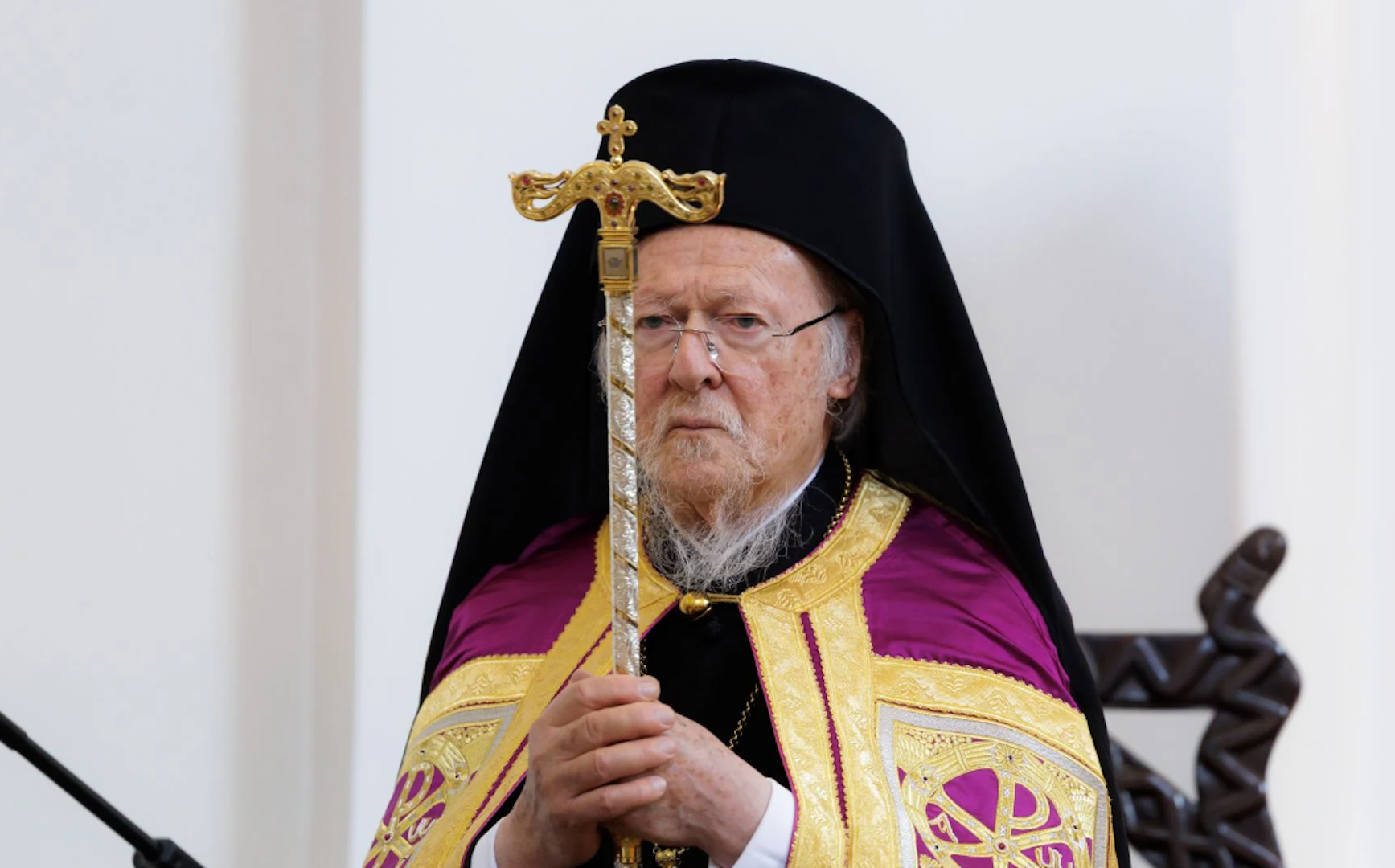
While the world’s attention has recently been focused on His Holiness Pope Leo XIV of Rome’s May 15, 2026 encyclical letter, Magnifica Humanitas, and its guidance on safeguarding the dignity of every human person amid the rapid development of artificial intelligence (AI), it is noteworthy that His All-Holiness Ecumenical Patriarch Bartholomew has been a global pioneer in exploring the spiritual implications of AI, and relating it to the eternal truths of the Christian Faith.
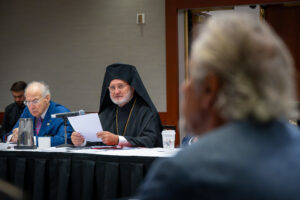
As far back as Dec. 2024, His All-Holiness formally inaugurated the 4th International Ecological Well-Being Conference, “Artificial Intelligence, Technoethics, and Youth,” at the Marasleio School in Athens. In his address, he reminded those attending the conference that “the Orthodox tradition is an inexhaustible source of vital principles and truths for humanity and the world.”
His All-Holiness stated that “we are pleased to see theology engaging with the topic of ‘artificial intelligence.’” He also spoke about the conflict that some see between faith and science, and emphasized that new scientific innovations had to be used in an ethical manner: “The Church, while advocating for the responsible use of artificial intelligence, encourages young people to cultivate ‘spiritual intelligence’ by exploring and embracing the invaluable spiritual and cultural treasures of our Orthodox Tradition.”
Shortly after that conference, in Jan. 2025, His All-Holiness stated that “artificial intelligence has immense potential for positive transformation in environmental protection, education, and healthcare, offering innovative pathways to solve significant human problems. At the same time, from invasions of privacy to rising inequalities and possible compromise of institutions, this great tool also contains inherent risks.”
His All-Holiness emphasized that “implementation of artificial intelligence requires respect of individual dignity, safeguard of fundamental freedoms, and advancement of social equity.” He added that “in this context, the Orthodox Christian tradition would underline moral discernment and direction along with scientific research and development.”
The on May 8, 2026, the Ecumenical Patriarch said: “It is certain that we will speak of the period before and after AI.” He sounded a prophetic warning, stating that “despite the truly astonishing scientific progress of our time, existential fulfillment and humanity are not self-evident or guaranteed. They require commitment and struggle. Education must help children discover and embrace spiritual values.” As AI becomes more common and more sophisticated by the day, he stressed the fact that “real life is more than measurable reality, more than numbers, more than square logic. Life is not digital. The human soul is filled with emotions, empathy, and spontaneous hierarchies of priorities.”
In another address on the same day, His All-Holiness again emphasized that AI cannot ever fulfill the deepest longings of the human soul, and must not be allowed to become a tool to further inhumanity and dehumanization: “Humanity, while making tremendous advances, such as in Artificial Intelligence — whose proper and prudent use we hope for and look toward — nevertheless often continues to fall victim to its own selfishness.”
In an April 2026 address, His All-Holiness pointed to the reality of human suffering that must not be ignored or shunted aside as AI continues to transform our lives. As technology advances, the spiritual wisdom of the Church is needed more than ever. “In the face of these challenges,” he said, “it would be illusory to take refuge in purely technocratic approaches. Behind statistics and economic analyses lie human realities: shattered lives, silent suffering, and uprooted peoples. The fragmentation of the world is not merely a matter of structures; it reflects a deeper anthropological crisis. We are thus confronted with a decisive choice: either we accept division as an inevitability, or we commit ourselves resolutely to building a global order founded on solidarity. In this context, awareness of our interdependence becomes essential.”
This has been a recurring theme of His All-Holiness’ addresses, as he has made it clear that it is the defining issue regarding AI and its proper usage. “In recent years,” he stated in Sept. 2025, “we have witnessed the spread and reach of ‘artificial intelligence,’ considered the pinnacle of technological progress. Its applications extend into all areas of human life… No prudent person can deny the benefits of science and technology. Yet it is indisputable that science cannot provide answers and solutions to the great existential and social problems that afflict humanity—violence, injustice, religious fundamentalism, the deadlocks of human relationships, and above all, the ‘last enemy,’ death. These are addressed only by other powers, with the first being religious faith.”
If these prophetic words of His All-Holiness are heeded, humanity will be spared a great deal of suffering that could result from the wrongful application of AI. We pray that the Ecumenical Patriarch will be heeded at this crucial point in the development of this remarkable new technology.