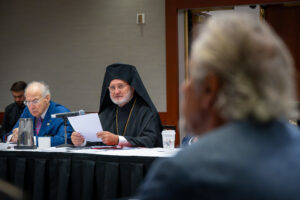
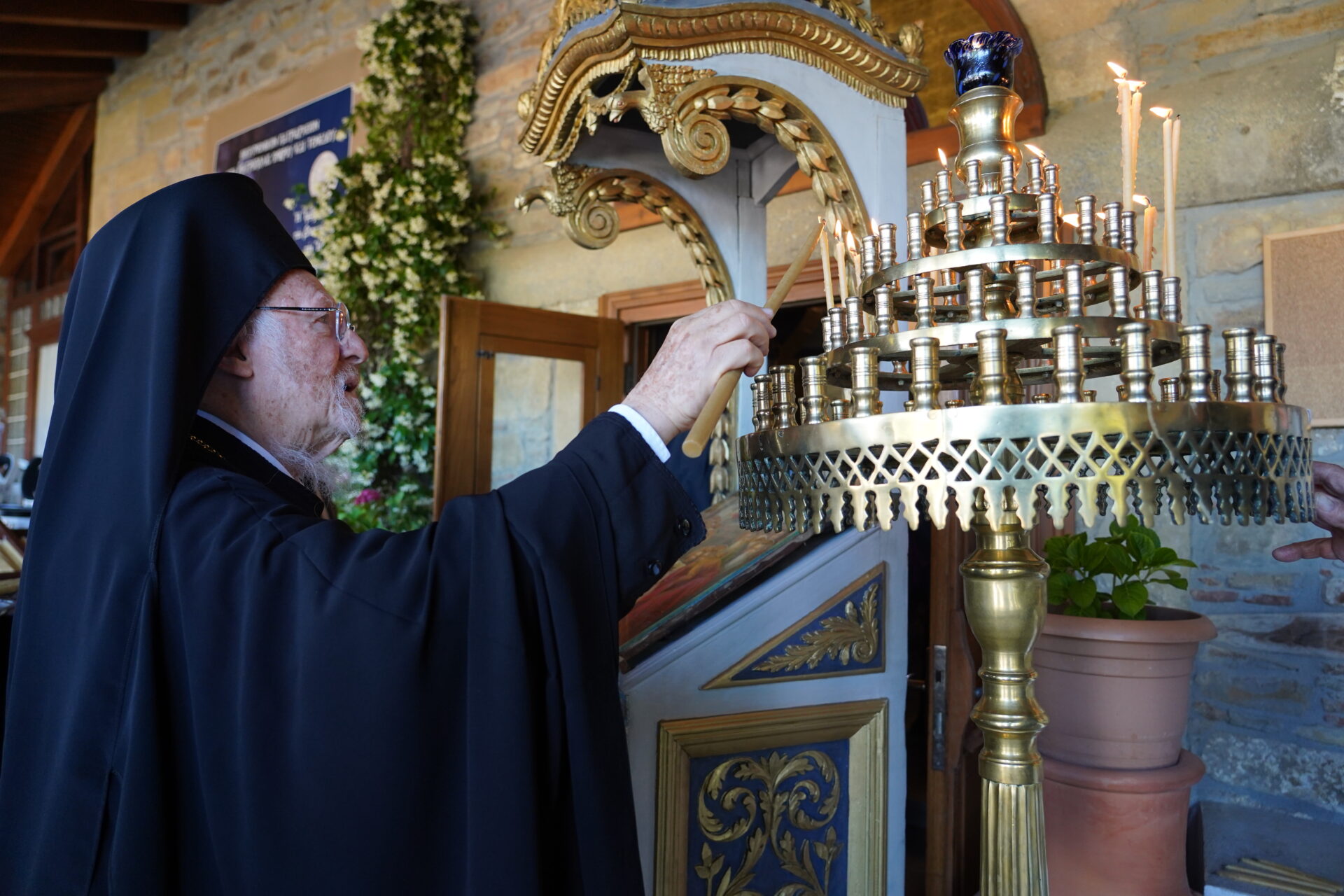
It has now been a full decade since the convening of the Holy and Great Council of the Orthodox Church, as its proceedings began on the Monday of the Holy Spirit, June 20, 2016, in Kolymbari, Chania, on the island of Crete. On June 1, 2026, the Monday of the Holy Spirit, at the Church of the Holy Trinity in the historic Greek Orthodox community of Stavrodromi in Constantinople, His All-Holiness Ecumenical Patriarch Bartholomew spoke of this important anniversary, and of the enduring significance of the Holy and Great Council.
In keeping with its convening on the Monday of the Holy Spirit, the Council’s central motto was adapted from the Kontakion of Pentecost: “He has called all to unity.” The Ecumenical Patriarch explained that this unity was the guiding principle of the Holy and Great Council, despite the last-minute withdrawal of four Orthodox Churches: the Patriarchates of Antioch, Moscow, Bulgaria, and Georgia.
“It was this unity,” His All-Holiness stated, “that the Council in Crete proclaimed, despite the absence, literally at the eleventh hour, of four Orthodox Autocephalous Churches.” Now, a decade later, the Ecumenical Patriarch issued an invitation to these Churches to take a new look at the Holy and Great Council: “To these Churches and to their brother Primates, we extend an invitation to study anew the six texts and decisions of the Council, together with its Encyclical and Message, and to proceed synodically to their adoption.”
The Ecumenical Patriarch emphasized that acceptance of the Council at this point would not only be a powerful affirmation of Orthodox unity, but a simple gesture of respect for those whose selfless labors made the Council a success. The act of accepting the Council’s decrees, he said, “would constitute the only appropriate response and a fitting expression of respect for the labors of their representatives and predecessors, as well as for the sacrifices made over decades by all the Orthodox Churches, with the Great Church of Christ taking the lead.”
Amid ongoing controversies, His All-Holiness once again reiterated that the particular role of the Ecumenical Patriarchate within the Church was not one of privilege and certainly not of some kind of hegemony, but as a God-given and sacred responsibility: “The Mother Church understands her prerogatives not as privileges but as responsibilities of sacrificial service for the unity and stability of the Holy Churches of God. The ministry, sanctification, and salvation of all those who are in various ways ‘weary and heavy laden’ constitute the very reason for the existence of the Mother Church of Constantinople.”
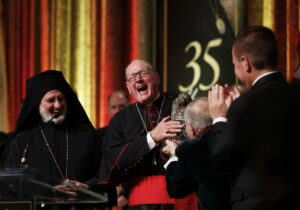
His All-Holiness also reflected upon his tenure as the longest-serving and one of the most consequential Ecumenical Patriarchs in the history of the Church: “By the grace and good pleasure of God,” he stated, “the Holy and Great Council took place and has already become a historical event, for which we take pride and glorify the Giver of all good things. We ourselves personally thank Him because, in His inscrutable will, He called us thirty-five years ago to the Most Holy Ecumenical Throne and entrusted to us as our immediate flock all of you who constitute the Greek Orthodox community of this historic City. Remaining closely united with the Mother Church, we mutually provide one another with reasons for joy and thanksgiving, or, should God so will, for co-crucifixion and common endurance of suffering. Yet such sorrowful moments in our historical journey are followed by resurrection, and we continue our course, ‘never departing from our duty.’”
The Holy and Great Council is one of the most significant fruits of His All-Holiness’ abiding sense of duty and the necessity of sacrificial service. The Economist noted in June 2016, while the Council was still in session, that one of the Conciliar documents, which was not only approved by the Council but “endorsed earlier by the four churches which didn’t attend,” examines the world “through an Orthodox Christian lens, using spiritual arguments to denounce inequality, the arms build-up and the ecological crisis as moral diseases.”
Professor Elizabeth Prodromou, a Visiting Professor in the International Studies Program at Boston College who was one of His All-Holiness’ advisors at the Council and is currently Vice Chair of the Women In Orthodoxy Archon Diakonia Ministry, explained at the time of the Holy and Great Council that it was intended to allow the Holy Orthodox Church to express a “robust theology of global engagement,” as the Primates of the Church enunciated their “responsibility for the transformation of the world in the image of the divine kingdom.”
Ten years later, such a global engagement, and transformation of the world in the image of the divine kingdom, is more urgently needed than ever. As such, the Holy and Great Council’s prophetic voice was both timely and eternal, emanating from the core responsibility of Christians to bear witness to the truth even within an indifferent or even hostile world. We pray and hope that the four absent Churches will heed His All-Holiness and adopt its decrees, and that the message of the Holy and Great Council will, as intended, resound to the four corners of the world.