The reason for reaching out to Christians of other faith traditions and seeking the unity of all believers in our Lord Jesus Christ may seem obvious; after all, the Lord Himself prayed “that they may all be one; even as You, Father, are in Me, and I in You, that they also may be in Us, so that the world may believe that You have sent Me” (John 17:21).
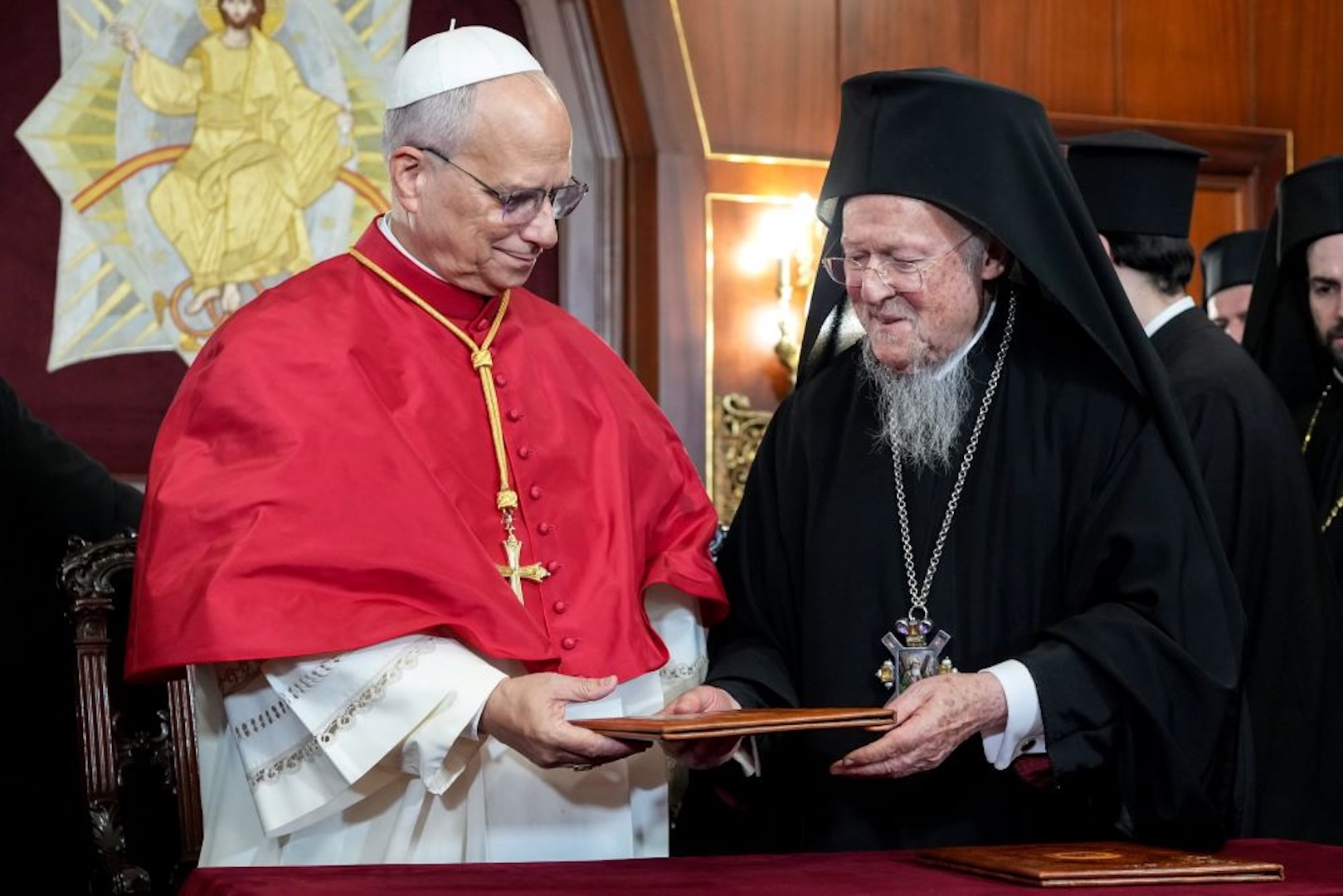
Yet it can further be asked: How can such unity be achieved? And why is it important that the believers “all be one”? What would result from such unity? On May 9, 2026, Ecumenical Patriarch Bartholomew elucidated these issues and more at a Mass celebrated at the Roman Catholic Church of the Holy Spirit in Constantinople, commemorating the first anniversary of the election of Pope Leo XIV of Rome.
His All-Holiness noted the progress that had been made toward unity during the past year, including during Pope Leo’s historic visit to the Phanar: “Looking back over this past year, we can only give thanks to God for the deepening rapprochement that continues to inspire our two Sister Churches of Rome and Constantinople.”
The Ecumenical Patriarch emphasized that this progress toward unity was not an option or a luxury, but was, in fact, “irreversible”: “This irreversible path, which began in 1964 with the prophetic encounter between Pope Paul VI and Ecumenical Patriarch Athenagoras, has profoundly shaped the journey of reconciliation on which we continue to walk with hope, trust, and perseverance in God. The many milestones set by our predecessors along this path of charity and truth have formed a living consciousness of shared vocation and common destiny, which continues to sustain and inspire our dialogue today.”
The Pope’s visit, His All-Holiness pointed out, was “marked by a profound double commemoration: the 1700th anniversary of the First Ecumenical Council of Nicaea, and the patronal feast of the Ecumenical Patriarchate, celebrating the memory of the Holy Apostle Andrew the First-Called.” Going farther, he began to explore the larger significance of this visit: “This raises a fundamental question for our ecumenical pilgrimage: what does such a moment signify for the journey we share?”
His All-Holiness explained that “we speak intentionally of a ‘pilgrimage,’ for it is by pilgrimage that our relationship was renewed in Jerusalem; it is by pilgrimage that we went together to İznik—ancient Nicaea—to proclaim the faith of the Church with ‘one voice and one heart.’” This pilgrimage, he stated, “stands as a moment of profound ecclesial and spiritual significance for the relationship between the Catholic and Orthodox Churches. By returning together to the very wellspring of their shared faith—the confession of the consubstantiality of the Son with the Father—we bear witness to a unity that, though wounded in history, has never been entirely lost.”
The past unity of the Church, then, can provide a foundation for future reconciliation. “This act of common remembrance,” His All-Holiness continued, “is not a mere gesture of historical piety, but a deeply theological affirmation that the Creed of Nicaea remains a living bond of communion, calling both Churches to rediscover one another in the truth they already share.” As such, Nicaea “is not only a memory, but a horizon: a point of spiritual orientation from which the path toward the restoration of full communion can be discerned anew.” It demonstrates that “reconciliation is not an abstract ideal, but a living vocation entrusted to the Churches, so that their unity may become a credible witness to the truth and love revealed in Christ.”
Turning then to the question of what ecclesiastical unity would accomplish, the Ecumenical Patriarch quoted from his common declaration with Pope Leo: “Allow us to repeat what we declared together: ‘The goal of Christian unity includes the objective of contributing in a fundamental and life-giving manner to peace among all peoples. Together we fervently raise our voices in invoking God’s gift of peace upon our world. Tragically, in many regions of our world, conflict and violence continue to destroy the lives of so many. We appeal to those who have civil and political responsibilities to do everything possible to ensure that the tragedy of war ceases immediately, and we ask all people of good will to support our entreaty.’”
Accordingly, “the pursuit of Christian unity is therefore not inward-looking, but profoundly outward-facing: it is a mission for the life of the world. It is a concrete and necessary contribution to reconciliation among peoples, to the healing of divisions, and to the cessation of violence. In a time when war and conflict continue to wound the human family, this shared appeal resounds as both a moral and spiritual summons—to leaders, to communities, and to all people of goodwill—to labor tirelessly so that the tragedy of war may cease.”
His All-Holiness emphasized that “the more the Churches draw closer to one another in truth and love, the more credible and effective their witness for peace becomes. Thus, unity is not only an ecclesial hope, but a path toward the transfiguration of the world, where peace is not merely the absence of conflict, but the fruit of communion, justice, and the grace of God at work in human hearts.”
It is with this momentous goal in mind that we join our efforts toward unity and peace with those of His All-Holiness Ecumenical Patriarch Bartholomew, and strive to implement his prophetic call to reconciliation in all areas of human endeavor.