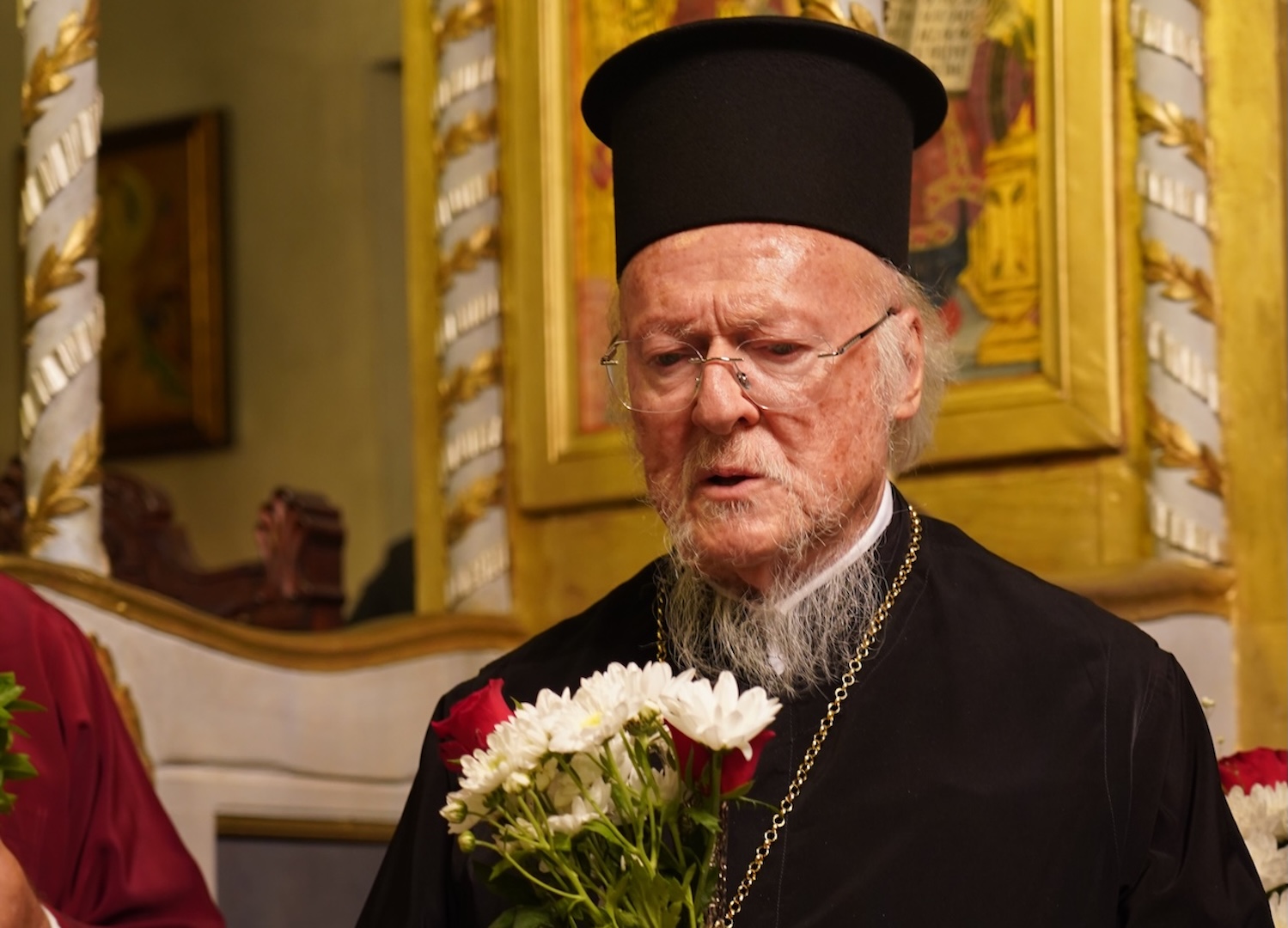
At the conclusion of the Paraklesis Canon at the Church of the Dormition of the Theotokos in Constantinople on Tuesday, August 4, 2026, His All-Holiness Ecumenical Patriarch Bartholomew explained how the Most Holy Theotokos, the Mother of God and Ever-Virgin Mary shows us the true meaning of freedom and the reveals in her person the joy of our salvation.
“In the Orthodox world,” His All-Holiness stated, “‘salvation as joy’ and ‘the joy of salvation’ are experienced above all through reference to the ‘cause of joy,’ the ‘joy of the world,’ the Most Holy Theotokos.” The Virgin Mary is the cause of our joy because through her our salvation comes into the world in our Lord Jesus Christ. That is why, the Ecumenical Patriarch continued, “in our Holy Churches throughout the world, the icon of the Mother of God occupies the foremost place on the iconostasis, to the left of the Beautiful Gate.”
The fact that the icon of the Mother of God can be found in this place of honor on every iconostasis in the world is also a demonstration of the universality of the Holy Orthodox Faith: “Here as well, the honor shown to the Theotokos serves as an expression and symbol of the unity of the Orthodox Church.”
His All-Holiness also explained how the Most Holy Theotokos reveals the profound love of God for human beings: “In the person of the Virgin Mary, the mystery of divine philanthropy is revealed: the love of God for humanity, which surpasses every word and understanding, and the pure faith of humankind toward the Lord of glory, the unwavering certainty that ‘the things which are impossible with men are possible with God’ (Luke 18:27).”
In the Virgin Mary, that statement of the Lord Jesus Christ has its fullest expression, for in becoming a mother while remaining a virgin, she not only gives birth to the Savior of the world, but demonstrates definitively that this salvation is the work of God, not of any human being.
The Ecumenical Patriarch then states that “the Theotokos also represents and reveals the ‘mystery of silence.’ ‘Rejoice, you who gave birth ineffably to the Light; rejoice, you who taught no one how.’ As our late elder, Metropolitan Meliton of Chalcedon, used to say, the Virgin Mary is ‘the personification of silence.’”
She is silence itself, His All-Holiness explains, because she gives us the Incarnate Word, and beyond that ineffable gift, there is nothing to say. Quoting Metropolitan Meliton of blessed memory, His All-Holiness continues: “What is the life of the Mother of God? An endless and profound silence. The Virgin Mary spoke very little. The Evangelists preserved only a few of her words for us, and most of these were spoken before Christ was born. Afterwards, everything sinks into a great silence. And how could it have been otherwise? The Virgin Mary spoke the incarnate Word, the one and only Word, the ‘Word in the beginning’ who was with God and was God. What, after Him? What beyond Him? What more than Him could she possibly have said? What else, except silence?’” (Chalkedonia, p. 450).
His All-Holiness adds that the silence of the Most Holy Theotokos is infinitely more valuable than the noise and chatter that surrounds us constantly in the contemporary world: “The ‘silent Virgin Mary’ sends forth the salvific message of ‘holy silence,’ the ‘silence of holiness,’ and the ‘silence of love,’ a message so relevant in our times, in the ‘age of many words.’”
Above all, His All-Holiness states, the Virgin Mary embodies the true freedom of the human person: “Orthodox theology understands the life of the Mother of God as the revelation of the true meaning of freedom. The word freedom characterizes the vital center of human existence. Directly connected with the way we understand and exercise our freedom are our dignity, our moral character, our witness, our happiness, and our misery. Our Panagia teaches us that true freedom is not the ‘No,’ but the ‘Yes’ to God. Freedom means humility and submission to the will of God—a stance that is not imposed by Him, but flows freely from the depths of our soul. Clearly, freedom is not whatever constitutes our own individual desire and choice. Indeed, enslavement to our own personal will is often described as the harshest form of bondage.”
It is she who offers true and definitive freedom from that bondage: “Let us ask the Most Holy Theotokos to intercede with her Son and God, that He may strengthen our struggle for liberation from our ‘beloved ego’ and grant us the strength to become ‘co-workers with God’ on the journey of His people toward the Last Things.” The Ecumenical Patriarch explains that “the strength of the Church is spiritual. Today, the Holy Great Church of Christ, in the face of the uncertainty of human affairs, the providentialism of economic power and technology, and the idols of isolated self-realization, lives and proclaims the freedom in Christ that is doxological, eucharistic, and filled with love. It distinguishes the Good from mere goods, the One Thing ‘which is needful’ from the many things over which people are troubled, to contribute to the transformation of the world and keep open the gate of heaven.”
Let us beseech the Most Holy Mother of God to intercede with her Holy Son and grant us that one thing which is needful.