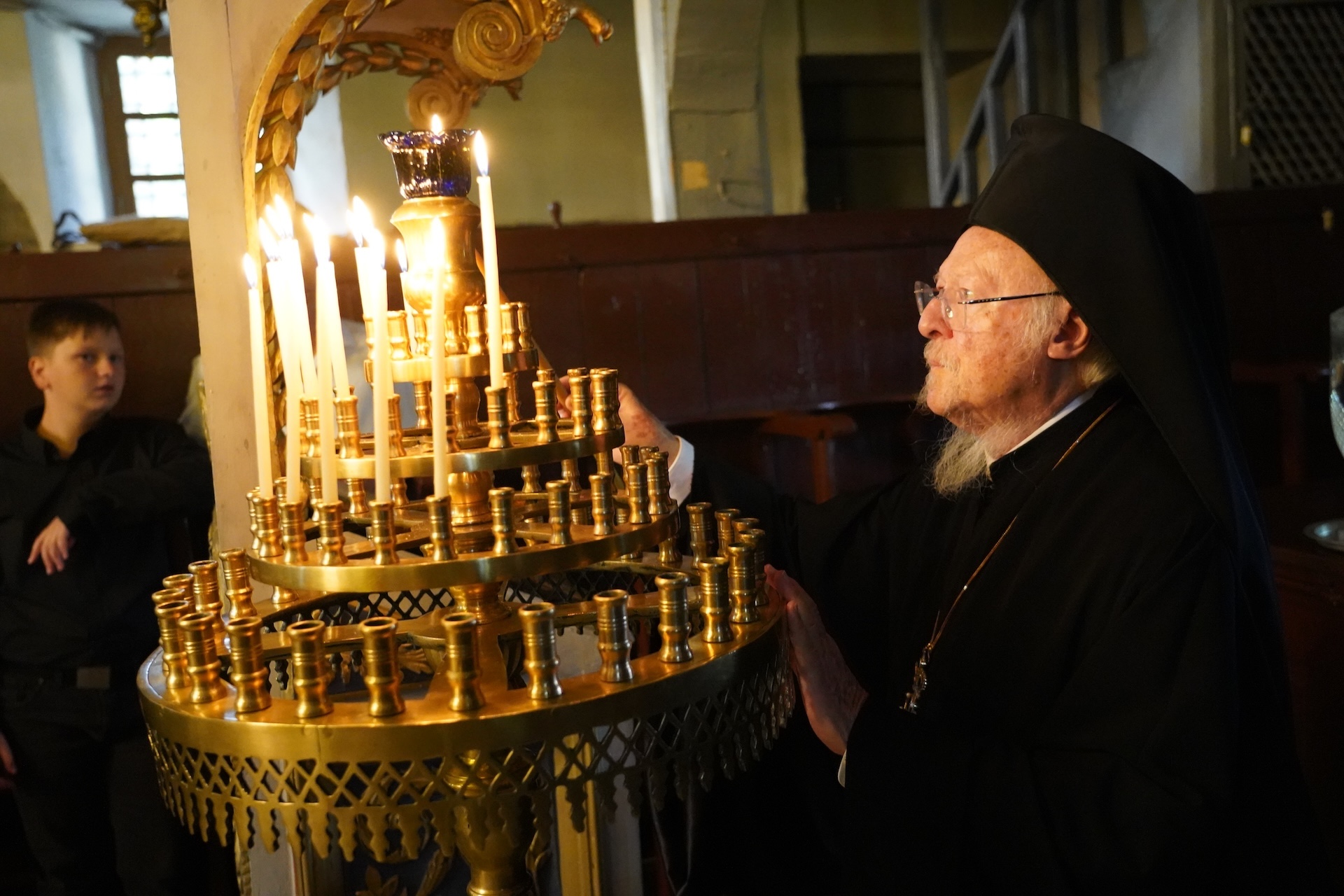
During the Holy Fast for the Dormition of the Most Holy Mother of God, His All-Holiness Ecumenical Patriarch Bartholomew, in the company of His Beatitude Pope and Patriarch Theodore II of Alexandria and All Africa and His Beatitude Archbishop Ioannis of Tirana, Durrës and All Albania, traveled back to the island of Imvros, where he was born on February 29, 1940. On Thursday, August 13, 2026, His All-Holiness observed the 65th anniversary of his ordination to the diaconate and offered a series of reflections on his remarkable lifetime of service to Almighty God and His Holy Church.
Before the dismissal of the Patriarchal Divine Liturgy, over which he presided at the Metropolitan Church of the Dormition of the Theotokos, Ecumenical Patriarch Bartholomew celebrated a Trisagion for the repose of his elder and benefactor of blessed memory, Metropolitan Meliton of Chalcedon. 65 years ago, on August 13, 1961, His Eminence Meliton, then the Metropolitan of Imvros and Tenedos, ordained the 21-year-old Dimitrios Archontonis to the sacred diaconate, and gave him the ecclesiastical name Bartholomew.
Recalling his ordination to the diaconate, His All-Holiness stated that he remembered in particular the words “Jesus only,” from the account of the Transfiguration in the Gospels: “And when they lifted up their eyes, they saw no one but Jesus only” (Matthew 17:8). These words, he explained, have guided him throughout his lengthy and remarkable lifetime of diakonia.
According to Orthodox Times, the Ecumenical Patriarch “spoke warmly of the formative influence of both Imbros and the Theological School of Halki, where his faith, love of learning and appreciation for Orthodox liturgical and theological tradition were cultivated. He also paid tribute to the people of Imbros who remained on the island through difficult decades and preserved its churches, language and identity. Expressing optimism about the island’s future, he encouraged younger generations to contribute actively to maintaining a sustainable Greek Orthodox presence there.”
His All-Holiness spent eight years as a deacon; Metropolitan Meliton ordained him to the holy priesthood on October 19, 1969, and Ecumenical Patriarch Demetrios of blessed ministry consecrated him as a bishop on the Feast of the Nativity of the Lord Jesus Christ, December 25, 1973. On October 22, 1991, the Holy and Sacred Synod unanimously elected him as the 270th Archbishop of Constantinople-New Rome and Ecumenical Patriarch. He was enthroned on November 2, 1991.
On Imvros on August 13, His All-Holiness gave thanks to God for the “supreme gift of the priesthood.” He noted that in his service to the Holy Orthodox Church, his efforts had been “devoted to pan-Orthodox cooperation, inter-Christian and interreligious dialogue, peace and solidarity, the protection of the natural environment, and engagement between the Church and the contemporary world.”
The Ecumenical Patriarch stated: “My entire journey has been a ‘life in dialogue.’” He stressed “that he has always regarded introversion, isolation, self-sufficiency and ‘sterile monologue’ as incompatible with the Orthodox faith.” He explained that as Ecumenical Patriarch, he had always emphasized that Orthodoxy is “fundamentally a call to communion, encounter with others, solidarity and peaceful coexistence.” He added that these convictions “have inspired initiatives aimed at fostering cooperation in addressing the major challenges of the contemporary world.”
The extraordinary 35-year ministry of His All-Holiness as Ecumenical Patriarch has indeed been marked by remarkable initiatives to in building bridges with Christians of other faith traditions, as well as with non-Christians. In his address, His All-Holiness “also emphasized the wider mission of the Ecumenical Patriarchate, insisting that the Church cannot remain detached from the challenges facing humanity.” Throughout his tenure as Ecumenical Patriarch, His All-Holiness has consistently and courageously raised a prophetic voice to meet those challenges, calling upon humanity to care for the natural environment, and to recognize that war causes incalculable loss of lives and property while solving nothing.
His All-Holiness said that “the Ecumenical Patriarchate has never been a spectator of the course of human affairs,” while “rejecting the notion that engagement with the world necessarily leads to the secularization of the Church.”
His All-Holiness also recalled the Lord’s words, “You are the salt of the earth; but if salt has lost its taste, how shall its saltness be restored? It is no longer good for anything except to be thrown out and trodden under foot by men. You are the light of the world. A city set on a hill cannot be hid.” (Matthew 5:13-14). He declared: “We cannot journey toward God while turning our backs on our fellow human beings.”
That is the ethos that has characterized this holy man’s selfless 65 years of service to the Holy Orthodox Church. We are immensely blessed that his ministry continues. Eis polla eti, Despota!