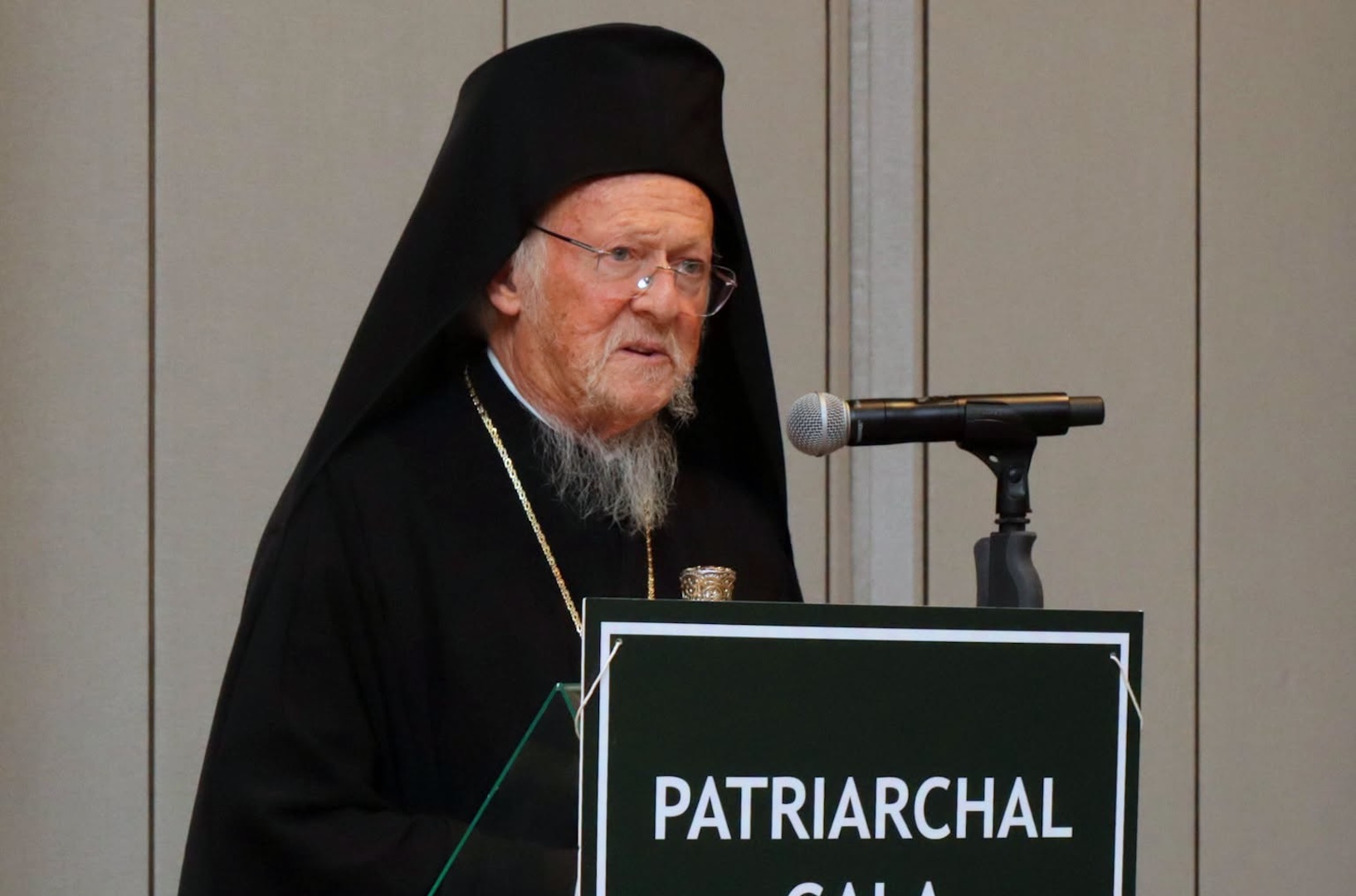
In this age, when many people are struggling with basic questions of identity and meaning for their lives, His All-Holiness Ecumenical Patriarch Bartholomew has spoken on numerous occasions on the most fundamental of questions: what exactly a human being is, what does it mean to be one, and what is the purpose of life on earth. As he does regarding so many other questions of our day, His All-Holiness offers sound, solidly Christian guidance, firmly rooted in the Holy Orthodox tradition, to help young people, as well as people of all ages who are going through a period of questioning and spiritual uncertainty, find an anchor for their lives.
Most recently, in his address on the occasion of his conferral as Honorary Doctor of the University of Chichester in England on September 16, 2026, His All-Holiness observed that “youth is a period of intense inner crisis for the human person, and the soul of the young person is a sensitive seismograph of developments. The crisis of youth, which is ‘normal’ from an anthropological perspective, is intensified by the external circumstances of each age.”
Speaking of his own youth as an illustrative example, the Ecumenical Patriarch recounted: “I lived my childhood years on an idyllic island of the northern Aegean, Imbros, today known as Gökçeada in Türkiye, having bound my life and my dreams to school and the Church. From an early age I experienced education and faith in God as my freedom and future.” In this, His All-Holiness provided the key to understanding the nature and purpose of human life.
“I discovered early on,” His All-Holiness continued, “that, as a believer, I am a member of an ecclesial community whose banner is unshakeable trust in Divine Providence and the service of the human person as a response to, and an extension of, God’s love for humankind.”
His All-Holiness explained that this understanding was paramount as he made important decisions in life: “All this guided my steps to the Theological School of Halki and thereafter to Rome, to Bossey near Geneva, and to the University of Munich in Germany. Throughout my whole life, I have firmly believed that theology is the mighty arm of the Church.”
The Ecumenical Patriarch concluded this series of autobiographical reflections by stating, with overflowing gratitude to God: “I have served the Ecumenical Patriarchate since 1961 as a member of the sacred clergy and, since 1991—for thirty-five years now—as Ecumenical Patriarch. Every day I glorify God for all His blessings, for all that He has granted ‘beyond word and understanding’ to His humble servant, crying out: ‘What do you have that you did not receive?’ (1 Cor. 4:7), and ‘What shall I render unto the Lord for all that He has given me?’ (Ps. 115:3 LXX), and, in the words of John Chrysostom, my predecessor as Archbishop of Constantinople: ‘Glory to God for all things! For I shall never cease to say this always, in all that befalls me’” (PG 52, 610).
Addressing the graduates of the University of Chichester, His All-Holiness called them not to succumb to pessimism about the future of the world: “You too, the promising young men and women of today, are called to build your present and your future within a civilization which you did not yourselves create. The first thing I wish to propose to you, in the words of a wise man of our age, Karl Popper, is to close your ears to the pessimistic voices who proclaim that you are entering a wretched and irredeemable world, the worst world that has ever existed.”
Popper, a famed philosopher of the twentieth century, was not a Christian, but an agnostic; in referring to him as a “wise man of our age” and seeing the value of some of his perceptions and observations, His All-Holiness demonstrates the openness to the world and willingness to engage with differing and even opposing points of view that he has often exhorted Orthodox Christians to display.
His All-Holiness added: “Gerhard Ebeling had urged the theologians of his day not to forget that humanity, even before the modern era, did not live in paradise, and that original sin is older than Descartes, Voltaire or Karl Marx.”
Ebeling was a twentieth-century Lutheran theologian. Descartes, Voltaire and Marx were renowned skeptics, challenging religious faith and, in doing so, helping to form the foundations of the modern secularism that leaves all too many human beings feeling rootless, with their lives devoid of meaning.
Countering their unbelief and materialism, His All-Holiness stated that “the growth of scientific knowledge does not keep pace with the development of the moral sensibilities of the human person.” He stated that “the daily experience and practice of human beings refute the final phrase of Sigmund Freud in his critique of religion, The Future of an Illusion: ‘It would be an illusion to believe that we can find elsewhere what science cannot give us.’”
In religion, His All-Holiness says, is precisely where we find what science cannot give us: “The human being always seeks, outside science, solutions to problems that lie beyond its range, to all of which answers may be given by other spiritual powers.” He declared that “religion is a universal human phenomenon with irreplaceable functions for the human person, for groups, for peoples and for cultures, for the whole of humanity. Without reference to religion, to the diversity of religions and to their role for the present and the future of humanity, no analysis of developments, however scientific it may appear, is in the end adequate. It is no accident that today one speaks not of a ‘post-religious age’ in the course of humanity, but of a ‘post-secular age,’ in which religion claims a public role, a public voice and participation in all significant developments.”
It is in religion that the full meaning of the human being is revealed. His All-Holiness Ecumenical Patriarch Bartholomew shows us the way.