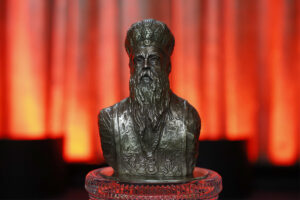
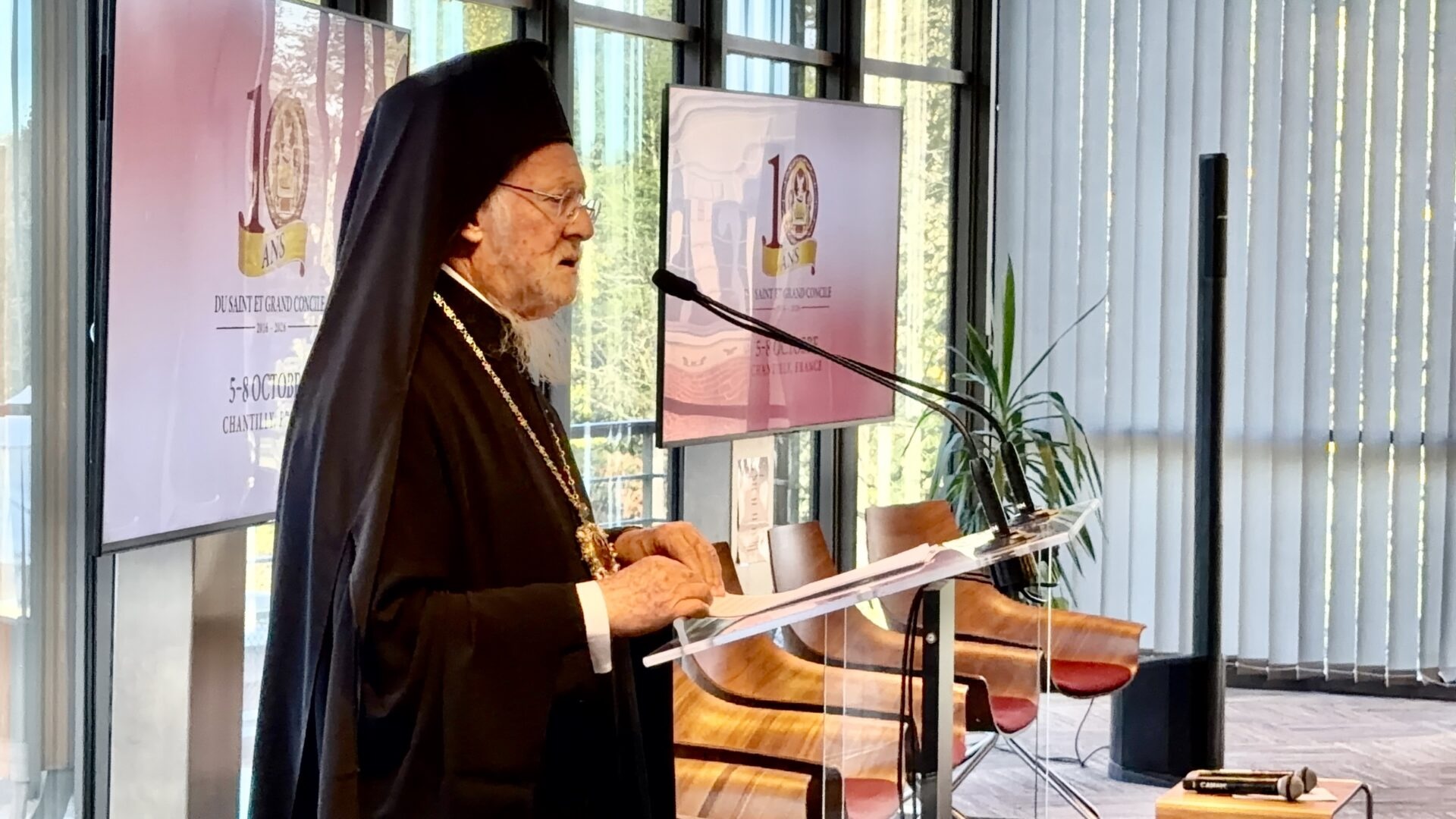
In Chantilly, France on October 5, 2026, His All-Holiness Ecumenical Patriarch Bartholomew delivered a major address touching on the enduring significance of the Holy and Great Council of 2016, and explicating the relationship between Orthodox Christian theology and the contemporary world. He offered these wise and thought-provoking remarks at the Ecumenical Patriarchate’s anniversary conference, “The Holy and Great Council (2016–2026): Assessment and Prospects.”
His All-Holiness observed that “a valuable legacy of the Holy and Great Synod of the Orthodox Church is the practical recognition of the role of theology in the preparation of the texts, in the operation of the Synod, and more broadly in the life of the Church.”
The Synod, he explained, “revealed the power of theology” as the Church “interprets the Gospel of Truth in the face of the signs of the times and gives Christian witness within a constantly evolving, modern and fast changing world.” His All-Holiness emphasized that “theology in dialogue with culture in no way means adaptation to the spirit of the age and association with the world.”
Instead, “the encounter with the world, always in unwavering loyalty to the tradition of Truth, includes the study of the spirit, recognition of the impasses and positive perspectives of the age, knowledge of the cultural context, within which the Church proclaims the Gospel, and its theology interprets the truth of the Orthodox faith.”
As a result, the Ecumenical Patriarch declared that “Orthodox theology must strongly oppose fundamentalism,” which the Holy and Great Council described as an “expression of morbid religiosity,” encouraging both intolerance and violence “in the name of God” and providing rhetorical ammunition to those who deny God’s existence. His All-Holiness stated that “an answer to fundamentalist attitudes is provided by sober interreligious dialogue, which, as noted in the Message of the Holy and Great Synod, ‘contributes significantly to the promotion of mutual trust, peace and reconciliation. The oil of religious experience should be used to heal wounds and not to rekindle the fire of war conflicts.’”
Regarding distortions and misunderstandings of Orthodox theology, His All-Holiness noted that “the very life of the Church constitutes a practical negation of the familiar identifications and distortions of its teaching, whether these are disseminated within its framework or outside it.” He pointed out that “it is characteristic that positions that portray the Orthodox Church as inherently negative towards dialogue with the rest of the Christian world and indifferent to the encounter with modern civilization, as essentially introverted and ethnocentric, are expressed by those inside as praise for its fidelity to its ancestral traditions and as an expression of a genuine Orthodox mindset, while by those outside with a critical slant aimed at stigmatizing the closedness that, according to them, is supposedly dominant in Orthodoxy (‘museum Church’).”
In an address to the professors of the Department of Theology of Aristotle University of Thessaloniki on July 11, 2026, His All-Holiness further explained the proper understanding of theology in today’s world, stating that “theology is not an abstract intellectual pursuit. It is the conscious expression of the Church’s experience and the means by which the message of the Gospel encounters and engages in dialogue with the spirit of every age.” He stressed the fact that “theology not only does not fear dialogue, but serves as a vehicle and expression of spiritual openness. Insularity, a constant defensive posture, and a refusal to engage in dialogue with contemporary culture do not protect the faith; rather, they lead to spiritual isolation and fundamentalist outbursts.”
His All-Holiness said that theology plays a valuable prophetic role as technology advances: “Especially today—in an era when technology is transforming our lives, our modes of acquiring knowledge, working, and communicating, and even human self-awareness itself—theology is called upon to articulate a responsible voice. The technical and practical issues associated with artificial intelligence, biotechnological discoveries, and the new digital reality do not encompass the entire spectrum of existential concerns and social life.”
Theology, the Ecumenical Patriarch said, could supply answers to questions that no technological advance could offer: “Questions such as: ‘What is the human being?,’ ‘What is the meaning and the limits of freedom?,’ ‘What is the relationship between knowledge and faith?,’ and ‘Where do the boundaries lie between the technically feasible and the ethically acceptable?’ …and other similar matters require a different approach.”
In the same vein, His All-Holiness emphasized that “Christian theology consistently upholds the supreme value of the human person. Despite the ‘miracles of science,’ man seeks meaning in life and spiritual orientation; he hearkens to the voice of heaven and senses that science is a ‘great power,’ yet not omnipotent. Faith in God is also a ‘great power,’ representing the truth that our life is not confined to its earthly framework, that man has a transcendent and eternal destiny, and that — in the words of our great theologian, the late Metropolitan John of Pergamon — ‘nothing is more sacred than the person.’” He added that “the human person is always ‘more than what science can grasp.’”
“Nothing is more sacred than the person”: This is key to the relationship between Orthodox Christian theology and contemporary human beings in their search for meaning for their lives.