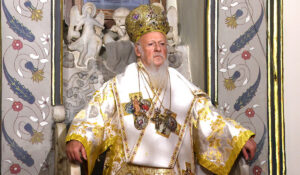
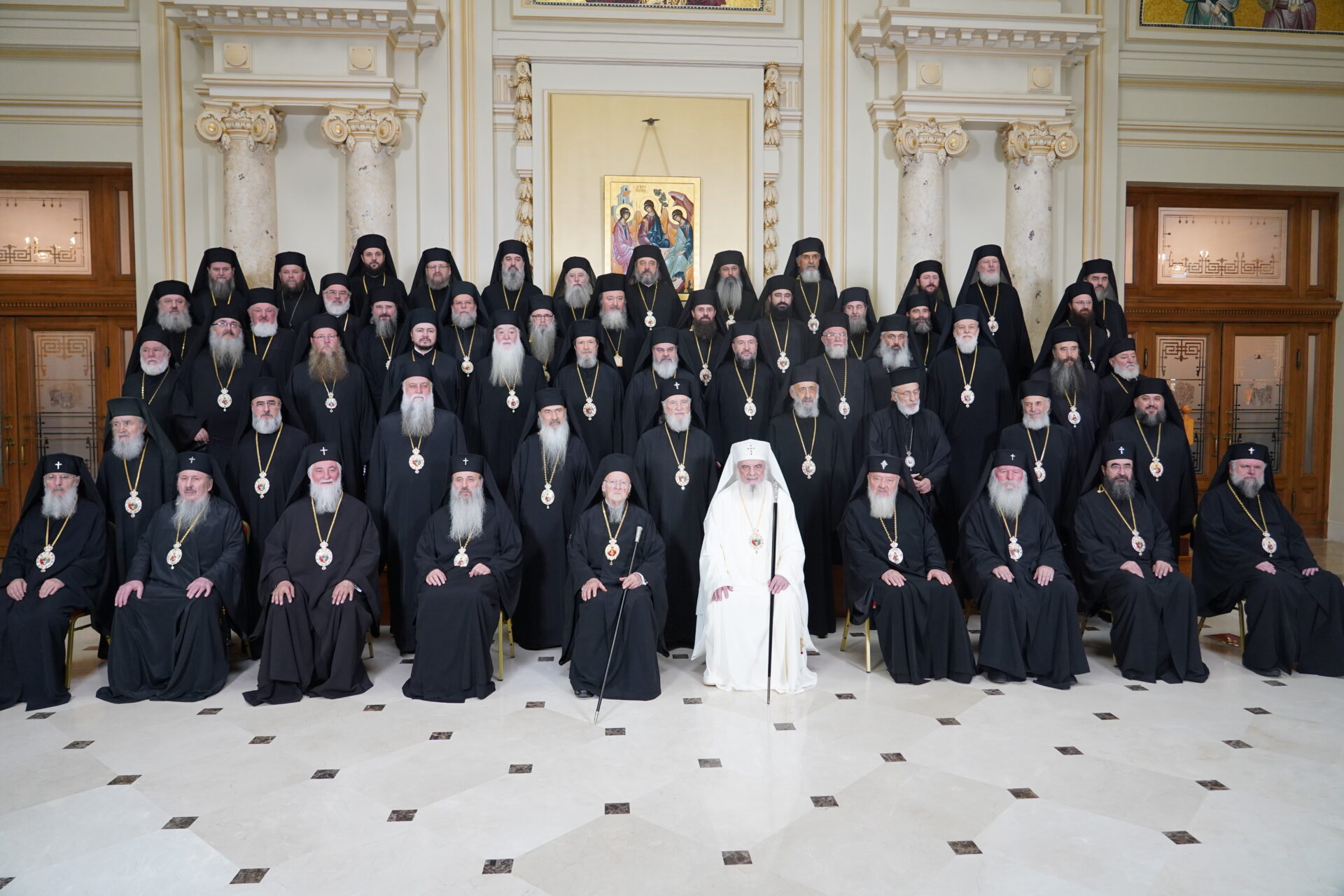
“The Mother Church of Constantinople,” said His All-Holiness Ecumenical Patriarch Bartholomew during the solemn session of the Holy Synod of the Orthodox Church of Romania on Tuesday, October 28, 2025, knows “how to turn bitterness into sweetness, and necessity into a virtue — demonstrating through her patience and forbearance that she truly is and remains the common Mother of all Orthodox Christians.”
This simple and profound truth is important to keep in mind in light of the fact that as the Ecumenical Patriarchate has exercised its canonical authority to resolve disputes between the Churches and provide for the well-being of the Orthodox Church everywhere, some have charged that His All-Holiness Ecumenical Patriarch Bartholomew has papal pretensions — that is, he is acting as if he is, or wishes to be, the Pope of the Orthodox Church. Such charges stem from a fundamental misunderstanding of the nature of authority within the Holy Orthodox Church, and the Ecumenical Patriarch’s canonical role within it.
The Roman Catholic Church teaches that “the Roman Church possesses a pre-eminence of ordinary power over every other Church, and that this jurisdictional power of the Roman Pontiff is both episcopal and immediate.” (First Vatican Council, Pastor Aeternus, 3.2) This means that the Pope has direct authority over every other bishop, and jurisdiction over every other bishop, as well as all the faithful. In the Orthodox Church, by contrast, the Ecumenical Patriarch does not have immediate or jurisdictional authority over Patriarchs and bishops who are not within his canonical territory. He has no authority that the other Patriarchs do not have except the responsibility to act as a court of appeal and settle disputes between the Churches. The fullness of the Church rests in each diocese, as all bishops are equal in the Orthodox Church. Where the bishop presides lies the fullness of the Church.
As the Ecumenical Patriarchate exercises this sacred responsibility, it does so not as an autocratic supreme leader, but as the source and center of the unity of God’s Holy Church. As the Rev. John Chryssavgis explains, “In this ‘one body of Christ’ comprising ‘many parts,’ the Ecumenical Patriarchate serves as the ‘first among equals,’ as mother church to a family of local churches throughout the world.”
The Ecumenical Patriarchate performs its role as the Church’s court of appeal very much as a loving mother. Speaking at the Romanian Synod about the hierarchical structure of the Church, the Ecumenical Patriarch emphasized that “within this sacred order, the Archbishop of Constantinople has been appointed as its servant and minister.” He stated that the Holy Mother Church of Constantinople has “never perceived her role as one of privilege or authority, but rather as a ministry of service dedicated to teaching, nurturing, and strengthening the structures of ecclesiastical life.”
His All-Holiness added that “all this has been done without pride or self-exaltation, for the Church of Constantinople has never felt nor acted as a ruler, but as a true mother to the children entrusted to her by the Church.” It is in this spirit that the Holy Mother Church exercises the responsibility bestowed upon her at the Fourth Ecumenical Council, which was held in Chalcedon in 451. The Council decreed: “If a bishop or cleric has a disagreement with the metropolitan of the province, let him appeal to the Exarch of the Metropolis, or to the throne of the Imperial City of Constantinople, and let him be tried there.”
The Ecumenical Patriarchate, as the First See of the Orthodox Church, also has the responsibility to grant autocephaly (independence) to national Churches when it is no longer appropriate for a particular Church to be under the authority of another. The Ecumenical Patriarchate has granted autocephaly to the Orthodox Churches of Russia (1589 and 1917), Serbia (1920), Romania (1925), Bulgaria (1961), Georgia (1990), Greece (1850), Poland (1924), Albania (1937), and the Czech Lands and Slovakia (1998). Most recently, His All-Holiness Ecumenical Patriarch Bartholomew exercised this authority in granting autocephaly to the Orthodox Church in Ukraine in January 2019.
There is one other significant difference between the Papacy and the Ecumenical Patriarchate. The Roman Catholic Church holds that the Pope is infallible, that is, protected by God from error, when he states that something is a part of the Christian Faith, that all the faithful must believe. The Ecumenical Patriarch does not claim infallibility; as Orthodox Christians, we believe that Almighty God protects His Holy Church from error within the teachings of the Ecumenical Councils only.
As a loving mother, the Ecumenical Patriarchate does play an indispensable role within the Church. His All-Holiness Ecumenical Patriarch Bartholomew has emphasized that “the Ecumenical Patriarchate is the only guarantee for the unity of Orthodoxy. Without the Ecumenical Patriarchate, Orthodoxy will fall into the vortex of nationalisms, into the introversion of self-sufficiency, into the contempt of the modern world.” In its supra-national character, the Ecumenical Patriarchate preserves the unity of the Church as something incomparably greater than a collection of national organizations, as the Church of Jesus Christ for all the nations.
The Archons of the Ecumenical Patriarchate remain grateful to God for the role of the Ecumenical Patriarch within the Church.