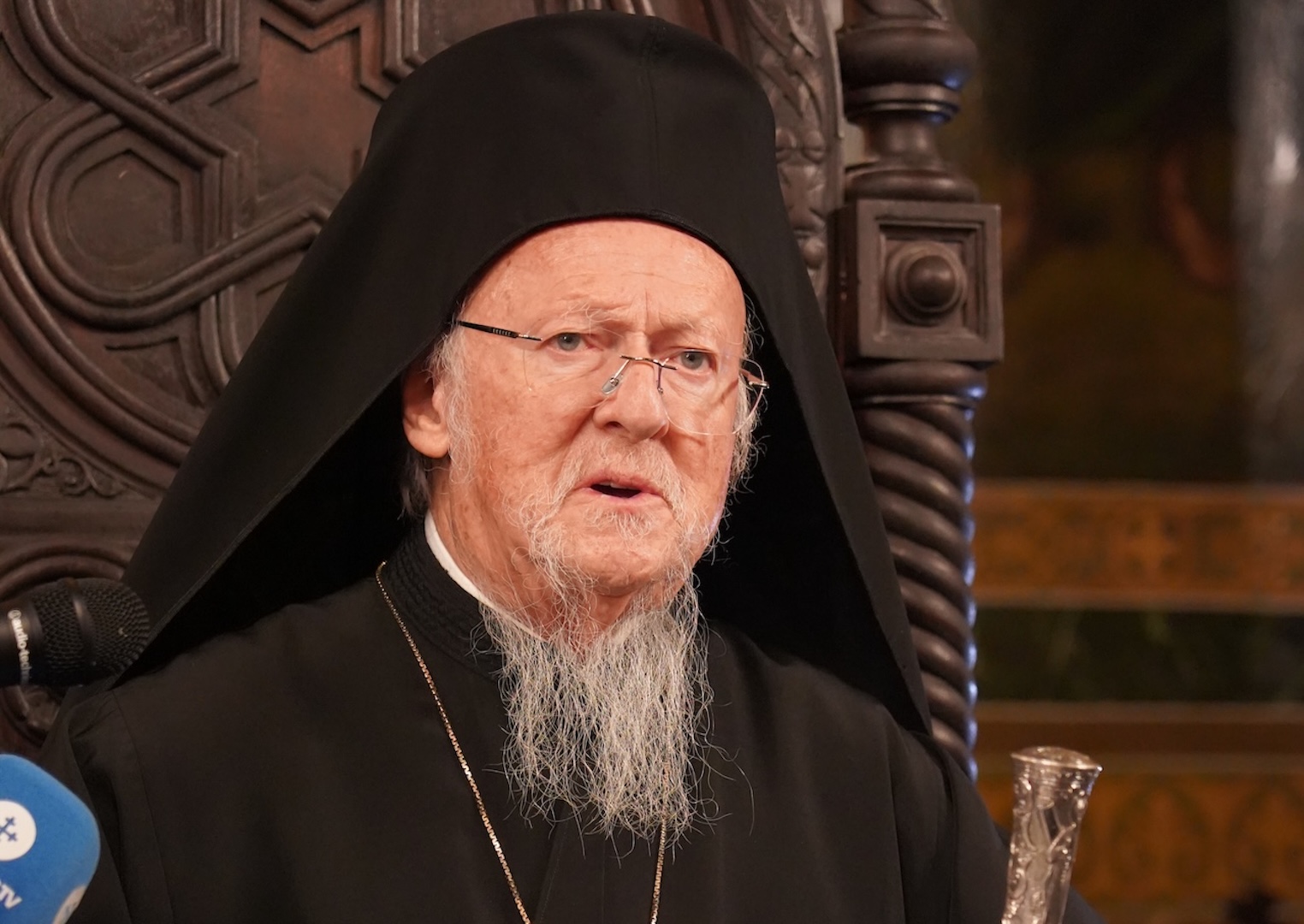
His All-Holiness Ecumenical Patriarch Bartholomew, speaking on October 28, 2025 at the solemn session of the Holy Synod of the Orthodox Church of Romania, spoke with a profound and prophetic voice about the divinely-ordained structure of the Church, shining a light on the truth amid numerous ongoing controversies, including the issue of multiple Orthodox jurisdictions based on ethnicity in the same region.
The Ecumenical Patriarch outlined the Church’s structure, noting that “within this sacred order, the Archbishop of Constantinople has been appointed as its servant and minister.” This role, he emphasized, is not just set out in the Church’s canons, but has been established throughout the centuries in the common practice of the Church. “All this,” he said, “has been done without pride or self-exaltation, for the Church of Constantinople has never felt nor acted as a ruler, but as a true mother to the children entrusted to her by the Church.”
The steady guiding hand of the Holy Mother Church of Constantinople has been especially in evidence in times of crisis, as during the nineteenth century period to which His All-Holiness referred as a time of “hasty changes within Orthodox life.” The Ecumenical Patriarch observed that during this time, the Church of Constantinople “knew how to turn bitterness into sweetness, and necessity into a virtue — demonstrating through her patience and forbearance that she truly is and remains the common Mother of all Orthodox Christians.”
These “hasty changes” included large-scale migration to the West and the establishment of multiple Orthodox jurisdictions within the same region, each serving faithful of a different ethnicity. In connection with this, His All-Holiness spoke of the importance of the autocephaly of various Orthodox Churches, and emphasized that this ecclesiastical arrangement “neither precedes the Church nor stands above her — and most certainly, it cannot exist independently of her.”
His All-Holiness added to this a warning about the multiplication of jurisdictions, saying that “after so many years, it should be clear that nothing positive has come from replacing ecclesiastical criteria based on parishes with those based on ethnicity. It is inconceivable, and in many ways far removed from the spirit of faith, that there should exist so many Orthodox bishops within the same region, all in ecclesiastical communion with one another.”
Dismissing complacency regarding this issue, the Ecumenical Patriarch stated: “We cannot justify the unjustifiable with new terminology or verbal acrobatics. Nor can we pass down to the Church of tomorrow, as though it were tradition, what is in fact an error. True tradition is only what is right and sound — not what must be discarded.”
In a similar vein, His All-Holiness has previously emphasized that the Ecumenical Patriarchate “paid a heavy price for its determining contribution to Orthodoxy, while this contribution and this price is often forgotten, remained and remains supranational. It has never served nationalism, which it considers an alienation of the universality of the Church.”
Ethnophyletism, the practice of determining the governance of local Churches based on ethnicity or nationality, has been condemned as a heresy. His All-Holiness, however, stated that “unfortunately, in the Orthodox world, ethnophyletism, despite the Synod’s condemnation of it as an heresy, continues to be a permanent temptation and ‘thorn’ in the relations of the Orthodox Churches. The continuing friction between the Autocephalous Churches, the intractable problems of the Orthodox Diaspora, and, most recently, the instrumentalization of the Holy Eucharist by the Russian Church and its transformation into a means of exercising ecclesiastical politics in the case of the Ukrainian Autocephalous Church, reveal the truth of the matter.”
The Ecumenical Patriarch stated that “the saint of Pergamos,” that is, His Eminence Metropolitan John of Pergamon of blessed memory “characterizes ethnophyletism as ‘the greatest danger for the unity of Orthodoxy’ and praises the attitude of the Ecumenical Patriarchate on this point and its essential mission in the present and in the future as a supranational centre. The reverend hierarch has written: ‘Without the Ecumenical Patriarchate, Orthodoxy will fall into the vortex of nationalisms, the boasting of the past, the introversion of self-sufficiency, the contempt of the modern world.”
In contrast to this, Metropolitan John continued, “The Ecumenical Patriarchate has proved that it can transform the past into the present, the present into the future, yesterday and today into tomorrow. This is because, beyond its institutional status, it is the bearer of an open mentality, a universality and a sensitivity for the human being of every era. And this is the human guarantee of its future.”
The Archons of the Ecumenical Patriarchate are dedicated to safeguarding the future of the Holy Mother Church of Constantinople and ensuring in every possible way that it can continue to exercise its global mission in perpetuity.