During his Apostolic Visit to the United States in September 2025, His All-Holiness Ecumenical Patriarch Bartholomew delivered a large number of weighty and thoughtful addresses and homilies that provide the Orthodox Christian faithful, as well as Christians of other faith traditions and all people of good will, with enough spiritual nourishment and intellectual insight to last for years to come.
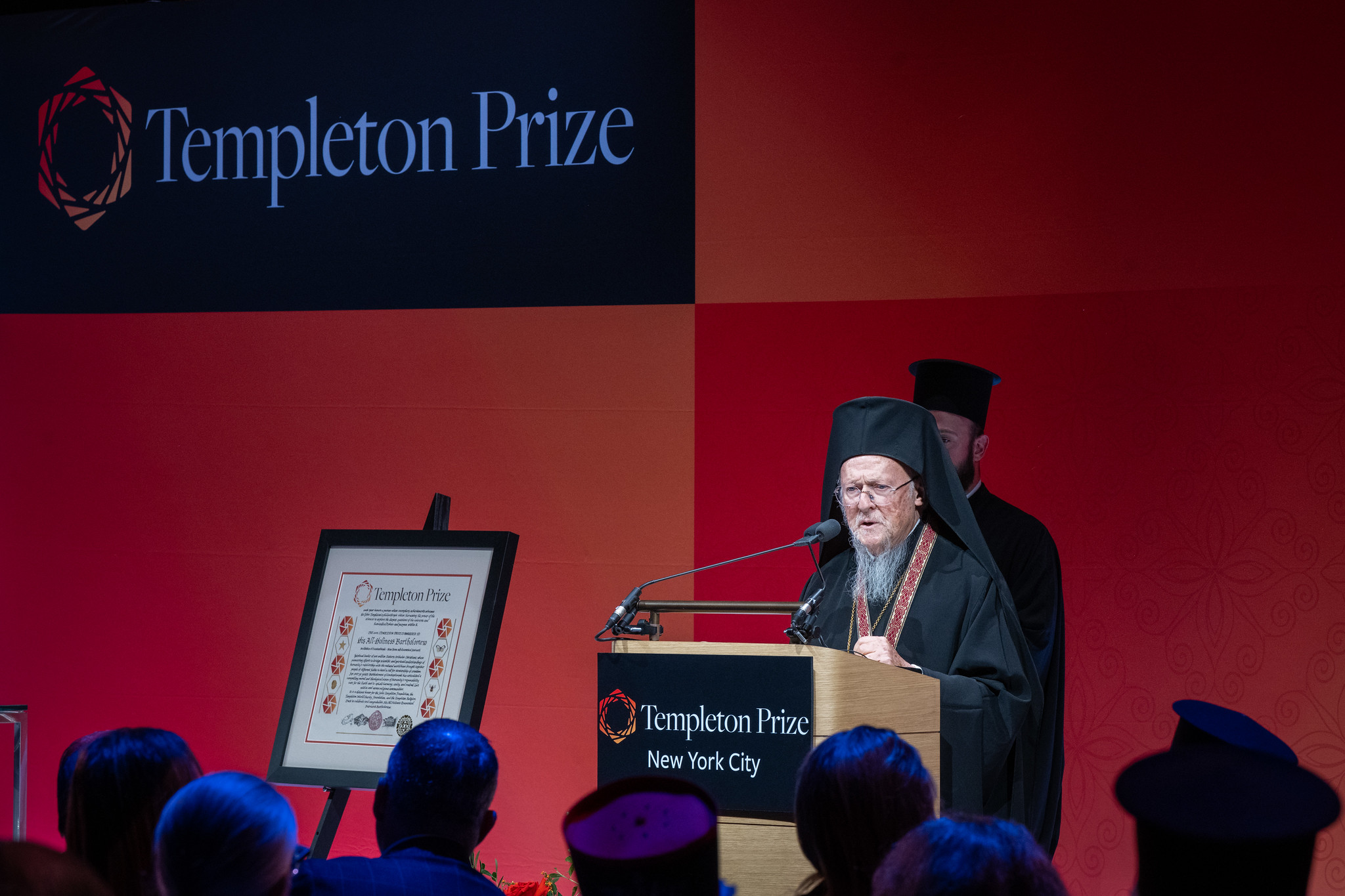
Foremost among these profound addresses was the address that His All-Holiness delivered upon his acceptance of the prestigious Templeton Prize in New York City on September 24, 2025. The Ecumenical Patriarch received this honor in recognition of his “pioneering efforts to bridge scientific and spiritual understandings of humanity’s relationship with the natural world, bringing together people of different faiths to heed a call for stewardship of creation.”
In this remarkable address, His All-Holiness explained in depth, among many other things, how science and faith are not only not at odds, but in a symbiotic relationship with one another. He began this explanation with a thought-provoking reflection on the nature of time as human beings experience it, saying: “We seem to have lost the sacred rhythm of natural time. In religious terminology, this is precisely what the power of prayer entails. Our ancestors understood something we have forgotten: namely, that meaningful growth requires patience, that depth demands duration. Trees do not hurry; stars do not rush their burning; mountains are not anxious about their rising.”
All this, however, is in sharp contrast with the frantic pace of modern life: “Unfortunately,” His All-Holiness continued, “we have created a civilization addicted to acceleration, where the speed of expansion matters more than the wisdom of appreciation, where instant gratification trumps sustainable flourishing. We have forgotten the joy of watching seeds become saplings, saplings become trees that will comfort and protect generations we will never meet.”
The Ecumenical Patriarch pointed out that “this temporal vertigo afflicts especially our young people, who inherit a world where the future feels insecure and uncertain. Recent research reveals a mental health crisis directly linked to environmental anxiety among young people.” This anxiety is not simply a matter of growing upset over current events: “And when our children lose hope for tomorrow,” His All-Holiness stated, “we must recognize this as both moral failure and spiritual emergency. Their fear is not irrational—it is symbolic; it is prophetic. They see what we have chosen not to see: that the world we are leaving them may be unsustainable and even unlivable.”
The antidote to this all-encompassing anxiety, His All-Holiness explained, is found in the ancient and eternal truths that the Church teaches and safeguards: “Against the numbing forces of indifference and despair,” said the Ecumenical Patriarch, “the Orthodox tradition offers the discipline of nepsis—watchful vigilance, the practice of staying alert or attentive to what is actually happening around us. Never has this ancient art been more urgently needed.”
His All-Holiness likewise noted that the Church also offers a way out of the shallow materialism and consumerism of modern life: “The Orthodox Church also speaks of ascesis—not the grim self-denial often associated with the term, but the joyful self-discipline of discovering how much is enough. In a world drunk on consumption, this ancient wisdom offers a profound medicine for healing. Ascesis breaks the vicious circle of unreasonable and unrestrained greed—the endless cycle where more consumption requires more production, which demands more resources, which creates more waste, which necessitates more consumption to solve the problems created in the first place by consumption.”
The Ecumenical Patriarch clarified that “this is not at all about returning to pre-modern poverty or primeval innocence but about rediscovering what the Greek philosophers called metron—proper measure, the wonderful sense of proportion that allows both human flourishing and ecological balance. It is about choosing quality over quantity, durability over disposability, sufficiency over excess and waste. Such discipline ultimately becomes not burden but liberation—freedom from the exhausting treadmill of endless wanting, space to discover the deeper satisfactions that no amount of earthly consumption can provide.”
Above all, His All-Holiness emphasized that “what we desperately need is a ‘theology of inter-connectedness’—a recognition that the health of our planet and the welfare of its people are not separate concerns but aspects of a single reality.” That reality includes the fact that “we cannot heal our relationship with the planet without healing our relationships with each other. We cannot achieve environmental sustainability while maintaining social inequality. We cannot save the earth without practicing justice.”
In that connection, the Ecumenical Patriarch asked a question that all Orthodox Christians and people of faith would do well to ponder: “Will we be remembered as the generation that, despite knowing better, chose comfort over conscience? Or will we be celebrated as the pioneers who, despite enormous challenges, chose transformation over destruction?” He stressed that “the intersection of science and spirituality not as an intellectual exercise but as an existential necessity. The future of our planet depends on our capacity to bring together the precision of scientific method with the perception of spiritual vision, the urgency of prophetic witness with the patience of contemplative practice.”
His All-Holiness Ecumenical Patriarch Bartholomew’s prophetic voice is needed more today than ever. The Archons of the Ecumenical Patriarchate are indefatigably committed to amplifying that voice.