As persecution of Christians worldwide has reached crisis levels, it is important to bear in mind that His All-Holiness Ecumenical Patriarch Bartholomew has on several noteworthy occasions in recent years provided important insight on the spiritual meaning of this suffering, and how it can be endured.
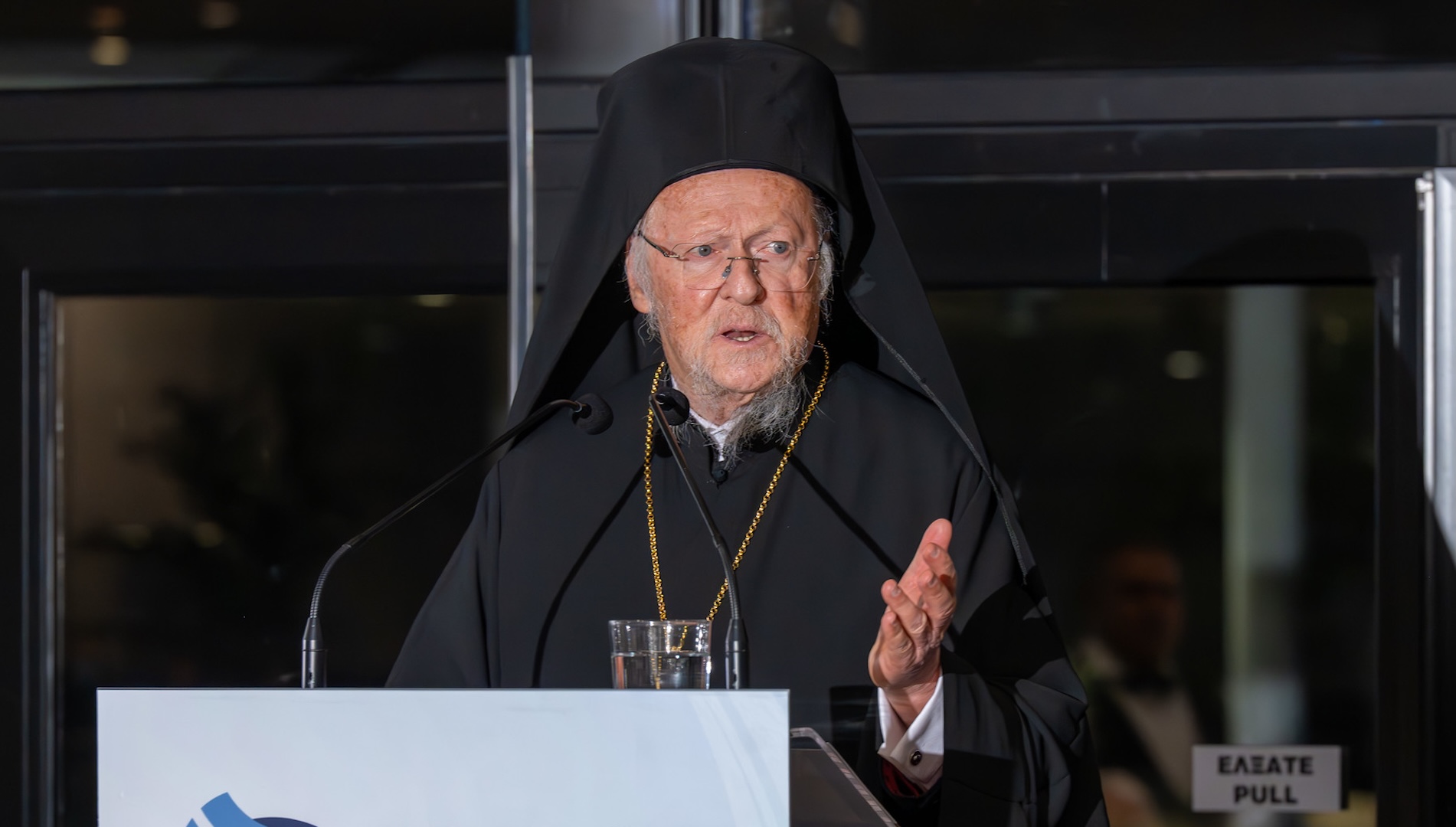
On May 20, 2026, the Ecumenical Patriarch reminded us that as Christians, aggression and violence should never be considered a solution to the difficulties we face. “The new creation bestowed upon us by the risen Lord,” His All-Holiness explained, “allows no room for hatred and enmity, only love, love without limits, compassion and understanding. By this shall all know that we are true disciples of the risen one: if we have love for one another and for all people. We must always proclaim peace and brotherhood among peoples and nations, not war, even if we baptize it as ‘holy’ to please an authoritarian secular power. There has never been, nor will there ever be, a ‘holy war’! Holiness and war are, by their very nature, mutually incompatible concepts incapable of coexisting in any form!”
The global conflicts that involve the persecution of Christians must be seen in light of that fact. The Ecumenical Patriarch spoke movingly on June 30, 2025 about his heartfelt hope for an end to the bloodshed in the Middle East. “The relevance of the apostolic teaching is today felt in a most dramatic way,” he declared, “especially in the long-suffering region of the Middle East, where the Holy Apostles first began to proclaim the salvific and resurrective message of salvation.”
His All-Holiness saw the successors of the apostles walking in the footsteps of their holy predecessors: “At this moment, our thoughts turn to the ancient Patriarchates of Antioch and Jerusalem, and to their Primates, our blessed brothers Patriarch John and Patriarch Theophilos, as well as to their devout clergy and Christ-loving flocks. How closely their lives today resemble those of the Apostles, as described in the apostolic reading we heard this morning! It is as if we can hear our afflicted brothers echoing the apostolic words: ‘To this very hour we go hungry and thirsty, we are poorly clothed, we are brutally treated, we are homeless… When we are cursed, we bless; when we are persecuted, we endure it; when we are slandered, we answer kindly.’”
His All-Holiness added a prayer that the faithful would do well to repeat on a regular basis as global conflicts continue and the persecution of Christians increases: “Together with them, we too supplicate and entreat and implore the Lord of mercy and compassion: to bring an end to the bloodshed, to grant rest in the Land of the Living to the souls of the victims, to comfort their loved ones, to grant healing to the wounded, and to bestow upon all strength, perseverance, and patience in their tribulations, together with the certainty that He will not allow them to be tested beyond their strength, but will also provide with the trial a way out, so that they may endure it.”
Delving deeper into the root causes of this persecution, the Ecumenical Patriarch stated on March 22, 2023 that “after more than three decades of globalization, the spiritual distance between the various communities inhabiting our world has increased. This form of divergence leads towards multi-polarity and fragmentation.” He pointed out that spiritual errors, such as the Moscow Patriarchate’s terming of Russia’s unprovoked, unjustified and fratricidal war in Ukraine a “holy war,” has only exacerbated that fragmentation, and has numerous unforeseen consequences: “Errors in the spiritual and intellectual spheres,” he said, “are not anodyne. They can lead to disasters, as the Ukrainian tragedy demonstrates. Not only is religion not marginal, but it is a determining factor. This important issue is not entirely understood by the political leaders, in spite of the series of crises in the Western Asia and the Middle East since 1979, in most of which the religious factor was instrumentalized for political and geopolitical agendas; also, in spite of the terrorist attacks, in the name of false religion, in Europe and the United States of America.”
In response, His All-Holiness added, “advancing the inter-religious and intercultural dialogue is essential. It can help share perceptions and experiences and contribute to the common search of ideas and solutions, in order to promote peace and understanding.”
Such themes have been a consistent part of the Ecumenical Patriarch’s message for many years. On July 7, 2018, he met with other Orthodox Patriarchs and the late Pope Francis at the Italian city of Bari to pray for the persecuted Christians of the Middle East. At this historic meeting, His All Holiness prayed: “Lord Jesus Christ … inspire good things in the hearts of those who want war and pacify our hearts, too, free us and all men from evil and selfish desires and sow in our and their hearts a spirit of justice, reconciliation and love for all our brothers.”
May each of us, whatever our circumstances in life, every day manifest that same spirit.