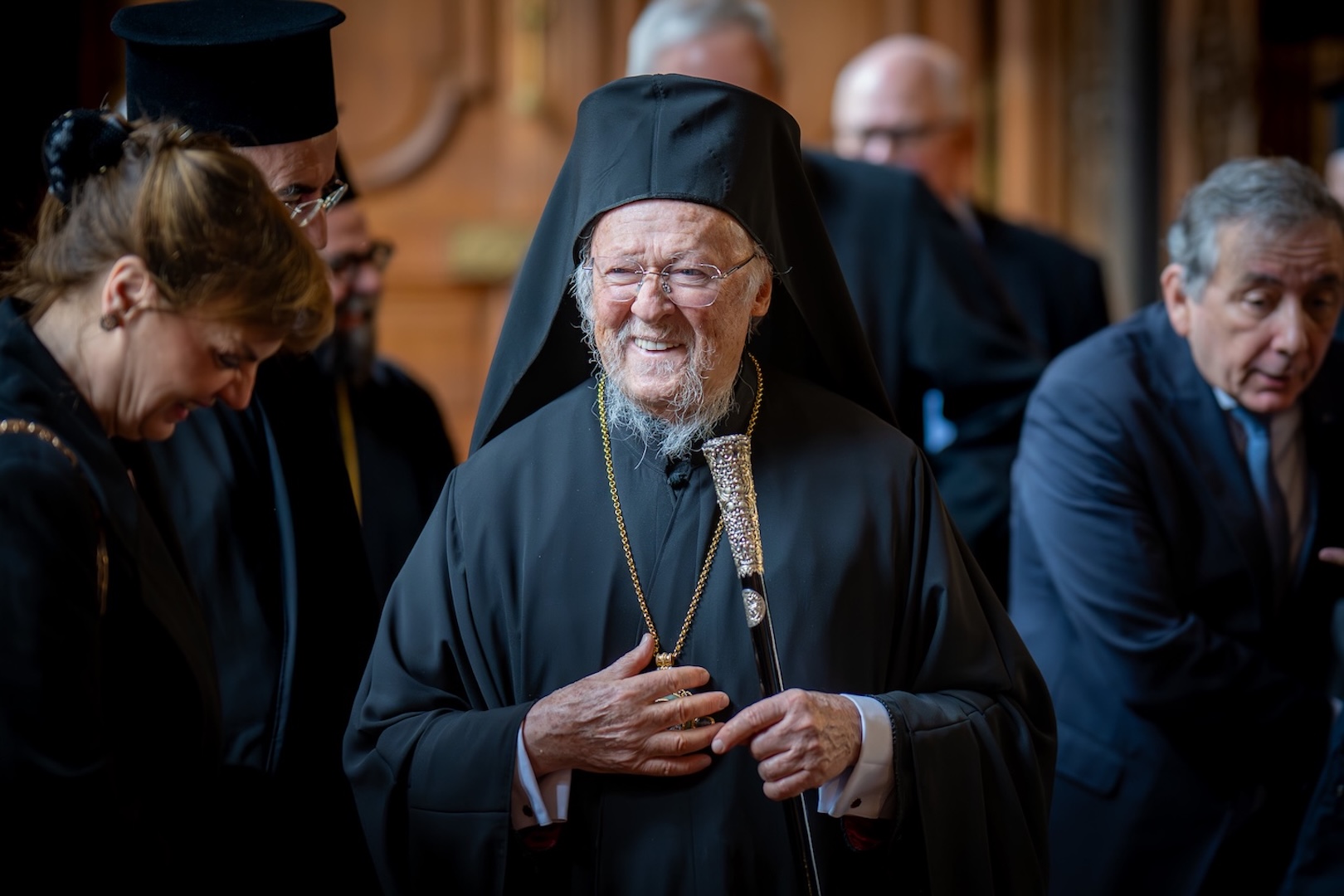
During the Divine Liturgy for the feast of the Holy Glorious Great Martyr Euphemia on July 11, 2026, His All-Holiness Ecumenical Patriarch Bartholomew ordained Archimandrite Isidoros Katsos to the episcopacy. Addressing the new Bishop of Andida, a former Diocese of the Metropolis of Pergis in Asia Minor, His All-Holiness emphasized that “authentic theology and closed-mindedness are contradictory and mutually exclusive concepts,” an axiom that all Christians would do well to keep in mind in these fractious times.
His All-Holiness also stated that theology cannot be authentically understood apart from the centrality of human freedom. “Approaching the human person,” he said, “on the basis of his relationship with God — or, more correctly, on the basis of God’s relationship with him — bestows upon human existence its highest possible value and gives our freedom an unwavering point of reference and a constant direction.”
This is, the Ecumenical Patriarch explained, not simply a matter of treating each person with respect; it is, in fact, a basic principle of theology: the centrality of the freedom of the human soul in its pursuit of God. “The truth of freedom,” said His All-Holiness, “is judged not merely by the fact that we make our own choices, but above all by what we choose.” We are only truly free when we choose Christ and embrace His truth: “Christ’s words remain ever valid: ‘You shall know the truth, and the truth shall make you free’ (John 8:32). ‘No one is truly free except the one who lives in Christ,’ as my holy predecessor John Chrysostom teaches.”
This is the heart of authentic theology: “It is of fundamental importance that the Church be presented as a place of ‘lived freedom’ and that freedom be understood as a central theological concept.” This fundamental respect for the freedom of every individual would preclude any closed-minded and shallow dogmatism that would see theological conclusions in simplistic black-and-white terms.
In a similar vein, His All-Holiness elucidated another important dimension of theology in a May 2021 address, when he said that theology should be conducted not in a vacuum, but in an active dialogue with the world at large. “Theology,” he said, “is an interpretation of the Gospel of Christ, in dialogue with the contemporary world and the signs of our times, an expression of the eternal truths of our faith in the language of each particular historical era. In this sense, theology cannot ignore the culture in which it is called upon to bear witness.”
Once again, therefore, a crude closed-mindedness is not only unwarranted, but actively counterproductive. “A defensive attitude of theology towards the world,” His All-Holiness said, “violates the tradition of our Fathers, who have always argued in relation to the challenges of their time, without hesitating that this dialogue would inevitably lead to the secularisation of theology.” He called upon theologians to make use of “the tradition of the Church and produce a living and contemporary theology which not only rejects this thinking but makes effective use of the possibilities offered by modern civilization.”
Accordingly, the Ecumenical Patriarch stated in December 2024, “it was said a few decades ago… that the theologian and the priest must hold ‘the Bible in one hand and the newspaper in the other.’ This means that, alongside theology, it is essential to stay informed about worldly matters, understand the existential needs and aspirations of modern humanity, address social issues, and remain attuned to the spirit of the age and the trends shaping civilization.”
His All-Holiness observed in this connection that “today, of course, everyone holds the captivating and brilliant smartphone, which contains everything—even the text of the Bible—though it is uncertain whether users will seek it out amidst the overwhelming sea of digital information.” He noted that “what Greek philosophy represented as a challenge to Christian theology for the great Fathers of the Church in the fourth century is, in modern times, mirrored by scientific knowledge and technological progress.”
This challenge should not be understood as a conflict: “The dialogue between theology and science must not be a clash between adversaries but a collaboration between two great forces that serve humanity. It should be a partnership, not a rivalry.”
The Ecumenical Patriarchate, His All-Holiness stated, “has never been an advocate of an inward-looking or closed Orthodoxy, as it follows the words of the Lord: ‘A city set on a hill cannot be hidden’ (Matthew 5:14). It has never conservatively fixated on the past but, with the certainty that Tradition is the very life of the Church in its uninterrupted continuity and cohesion, it has proclaimed the Gospel of freedom in Christ relevantly and timely to the present.”
Let us heed His All-Holiness’ exhortations and ponder his wisdom as we also live out an Orthodoxy that is never inward-looking or closed, as we proclaim the Gospel of freedom to the contemporary world in a way that will be both understandable and appealing.