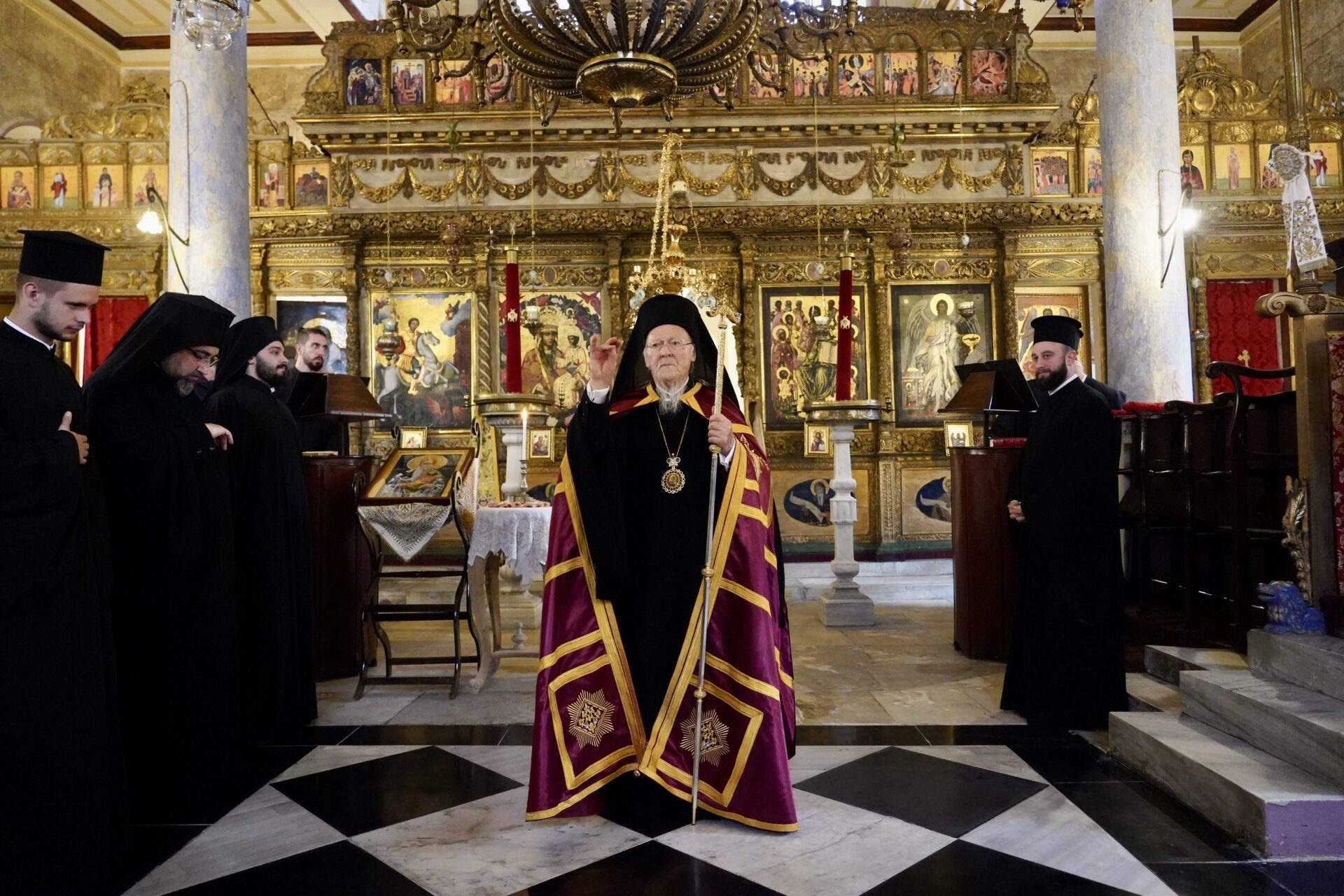
The celebration in Nicaea of the 1700th anniversary of the First Ecumenical Council, which was held in that city in 325, could be the occasion for a meeting that has never taken place before in the entire two-thousand-year history of the Church: all five of the Patriarchs of the Pentarchy, the original Patriarchates of the Church, could be present. This would be a magnificent display of the sacred unity, universality, and continuity of the Church, and His All-Holiness Ecumenical Patriarch Bartholomew is endeavoring to make it a reality.
On October 22, 2025, His All-Holiness reiterated his invitation to His Beatitude Patriarch Theophilos of Jerusalem: “We take this opportunity to repeat our fraternal invitation, which we have already sent in writing to His Beatitude the Patriarch of Jerusalem, to celebrate together on the 28th of November in Nicaea the 1700th anniversary of the convocation of the First Ecumenical Council, along with His Holiness Pope Leo XIV of Rome and our most blessed and beloved brother Patriarchs Theodore of Alexandria and John of Antioch. We shall also honor on November 30, at the Phanar, the sacred memory of Saint Andrew the First-Called, the founder of the Church of Constantinople.”
His All-Holiness emphasized that “this historic event, a tangible manifestation of the unity of Eastern and Western Christianity—of the four Patriarchs of the East and the Patriarch of the West, the Pentarchy of the Patriarchates—cannot be imagined without the presence of the successor of Saint James, the Brother of the Lord. We pray and hope for the positive response of our beloved brother, His Beatitude Patriarch Theophilos, in fulfillment of his sacred responsibility ‘for the unity of all.’”
The Ecumenical Patriarch has made it clear on several occasions that he envisions this meeting with Pope Leo of Rome to be an important element of the ongoing dialogue between the Orthodox Church and the Roman Catholic Church. His All-Holiness stated in July 2025 that “for decades, we have engaged in authentic and courageous ecumenical dialogue, especially with our sister Church in Rome. Not from strategy or weakness, but in obedience to Christ’s prayer: ‘that they may all be one’ (John 17:21). What unites us is far greater than what divides us.”
His All-Holiness has stated that dialogue is essential not only between differing Christian faith traditions, but between Christians and adherent of non-Christian religions as well. He explained: “No one can deny that religions, particularly the Christian faith, are imbued with a set of moral principles and values, such as solidarity, love for one’s neighbor, forgiveness, and justice, among many other positive attributes, which weave together a social and moral framework within which harmonious coexistence of diversities, a communal spirit, a sense of belonging, and a shared identity are promoted.”
Further clarifying the common elements among various religious traditions, His All-Holiness added: “Moreover, the entirety of religious traditions promotes organized charity and mutual aid, not only within the same religious community but indiscriminately to every person in need. Various volunteer initiatives, social work groups, and organized efforts to provide social assistance not only mitigate social and economic disparities but also strengthen bonds among members of the same or different religious groups and foster mutual understanding. Lastly, it is well-known that the teachings of many religious traditions, despite countless contrary examples, reject violence and intolerance while promoting tolerance and mutual understanding.”
Explaining the beneficial effects of dialogue, the Ecumenical Patriarch said: “We, the religious leaders, have a sacred and inviolable duty to promote and enhance what has already been briefly stated, primarily through dialogue and education. Dialogue with others dispels fears and prejudices and alleviates negative social tensions. Likewise, educating the members of a religious community from a young age in the concepts of respect and tolerance is the safest path and method for mitigating prejudices and fanaticism.”
Clarifying potential misconceptions, His All-Holiness explained that “to avoid any misunderstanding or misinterpretation of what has been said, we emphatically state that mutual understanding and respect among members of different religious communities do not, by any means, signify religious syncretism, alteration, or dilution of traditional teachings, as often claimed by advocates of exclusivity and isolationism. Respecting another’s tradition does not, in any case, equate to betrayal of our faith and truth.”
Emphasizing the importance of that respect, and its complete compatibility with our Holy Orthodox Faith, His All-Holiness stated: “This truth has been and continues to be defended with sacrificial love and selflessness by our martyred Ecumenical Patriarchate throughout the ages. The Ecumenical Patriarchate, which fully respects the ancient Tradition and Faith, is ready to engage in dialogue with any well-meaning interlocutor, not, of course, to exchange the principles and values of its Orthodox faith, but to convey the experiential truth of the Orthodox witness and to collaborate with all for the dissemination of fundamental human rights, religious freedom, justice, and peace.”
It is in that spirit that our spiritual father will travel to Nicaea. Let us pray that the historic meeting of the five Patriarchs comes to pass, and bears rich fruit for the unity and strength of the Church worldwide.