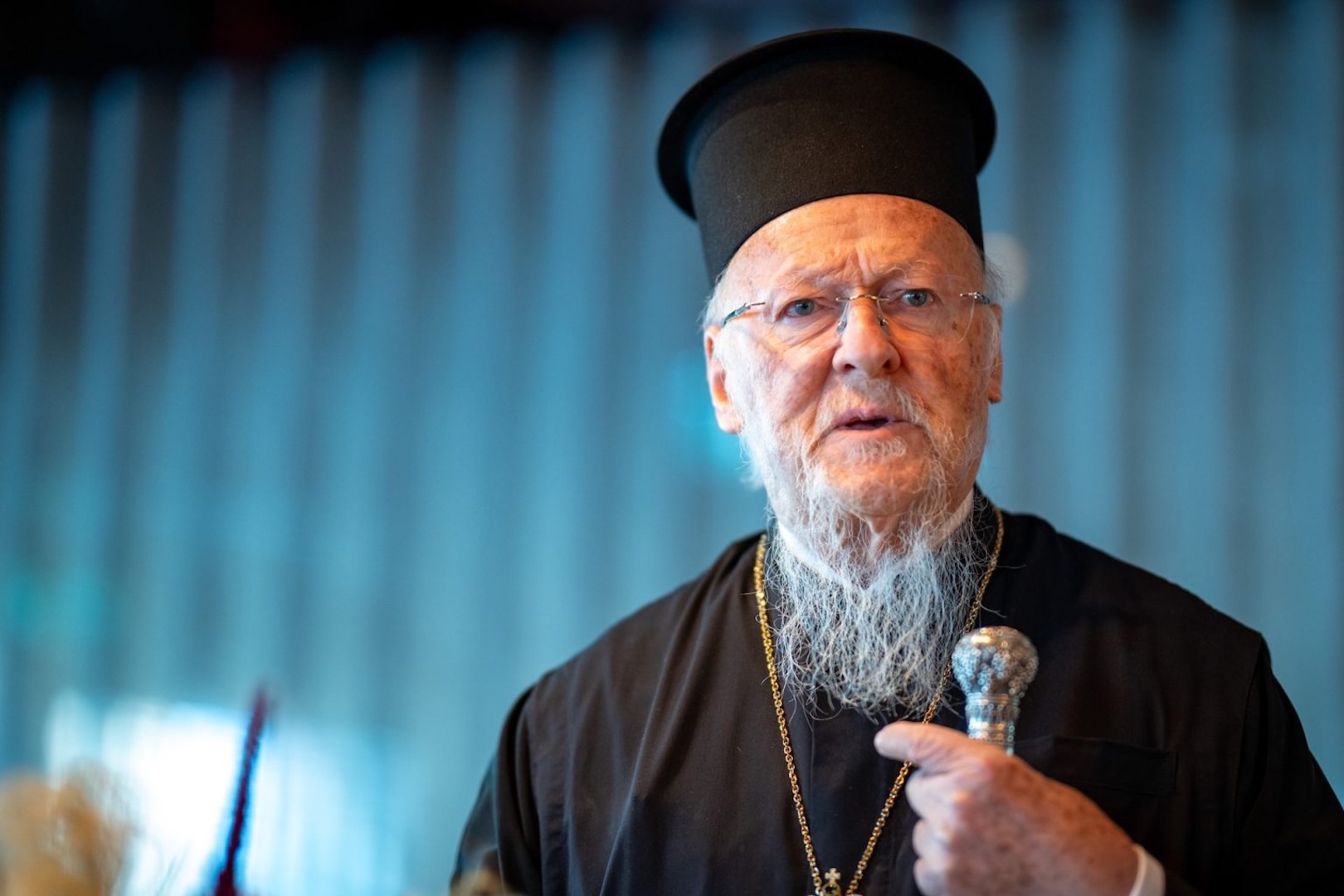
In his message for the opening of the 89th Thessaloniki International Fair (TIF) on September 6, 2025, His All-Holiness Ecumenical Patriarch Bartholomew offered wise and insightful guidance on the proper role of Christian moral principles in the economic sphere.
“The Orthodox Church,” His All-Holiness stated, “proclaiming at all times and in every place that ‘man shall not live by bread alone’ (Matt. 4:4), commends economic activity when it is carried out in truth, serving humanity, justice, and the integrity of creation.” He noted that he had spoken about this in the past, emphasizing that “the economy has a moral dimension.” The Ecumenical Patriarch reminded his audience that “the Holy and Great Council of the Orthodox Church, which convened at the Orthodox Academy of Crete in 2016, wisely declared that the economy ‘must be based on moral principles’ (§3), combining ‘efficiency with justice and social solidarity’” (The Mission of the Orthodox Church in the Contemporary World, VI, §§3–4).
His All-Holiness likewise emphasized that there could be no compatibility between Christian principles and the unrestrained prioritizing of economic growth at the expense of all other factors. “We do not accept,” he declared, “the cynical claim that ‘there is no alternative’ in the economy other than conforming to the dictates of unbridled economism and the principle of maximising profit. We reject the assertion that any departure from these principles necessarily leads to uncontrollable developments and social conflicts. The progress of societies is not identical with technological and economic growth, but is founded on the absolute respect for the human person, on social justice, and on environmental sustainability.”
There could be no truly healthy society, the Ecumenical Patriarch explained, without a strong foundation in humane values that entered into the economic sphere as well as into other areas of life. “Humanity,” he said, “is in need of consensus on a core of common fundamental values, which, despite political, social, religious, and cultural differences, functions as the basis for the common good. The axis of these values is solidarity. We are convinced that the future of humanity is interwoven with the ‘culture of solidarity,’ which guarantees the effective functioning of institutions and promotes peaceful coexistence and prosperity.”
His All-Holiness made similar points in his keynote address at the World Policy Conference 2024 in Abu Dhabi in December 2024. Speaking about the First Ecumenical Council, which was held in Nicaea in 325, he stated that “the wisdom of Nicaea teaches us that global challenges require global responses grounded in shared values and mutual respect. These recommendations come from thorough study of historical precedent and contemporary need, therefore integrating ancient knowledge with present necessity.”
A principle role of the Church in the modern age, he added, was to stand against the unbridled lust for profit and the global crises to which that lack of restraint has led. “With links to climate change and global warming,” said His All-Holiness, “the ecological crisis forces the Church to fully use its spiritual authority to guard God’s creation from the results of human greed, since the roots of this crisis are spiritual and ethical, lying inside each man. Our answer then must be similarly thorough, combining more spiritual rejuvenation with pragmatic steps like the initiative of the Ecumenical Patriarchate for setting September 1st as a day of environmental preservation.”
In that spirit, the Ecumenical Patriarch proposed the “establishment of a permanent ecumenical environmental council directly under UN advisory authority to organize reactions of religious communities against climate change. Acting as a link between spiritual traditions and world government, this group would provide moral direction on environmental policies and support interfaith cooperation on climate action. The council would try to ensure that environmental policies reflect not only scientific understanding but also spiritual insight on mankind’s obligation as carer of creation. The long-standing experience of the Ecumenical Patriarchate in promoting communication between religions and civilizations shows how spiritual insight could guide pragmatic government.”
His All-Holiness also called for the “development of artificial intelligence by means of a global ethical framework comprising religious and cultural points of view from different traditions.” He stated: “The Orthodox Church welcomes its responsibility to spread all truth contained in Holy Scripture and Holy Tradition, which naturally includes offering ethical direction for technological advancement. Based on millennia of spiritual knowledge about human nature and purpose, this paradigm would help to ensure that technological advancement serves rather than compromises human dignity. It would provide guidelines for the evolution of artificial intelligence that respect human uniqueness and optimize technological opportunities for the general good.”
It is central to the mission of the Archons of the Ecumenical Patriarchate to bring the wisdom and values of our Holy Orthodox Faith into every realm of human endeavor. In that great effort, we are grateful to Almighty God for the privilege of standing with His All-Holiness Ecumenical Patriarch Bartholomew.