Ask who is in charge of the Orthodox Church, and most people reach for the nearest Western comparison: surely there is an Orthodox pope somewhere, a single ruler issuing binding decisions for everyone. There is not. Orthodox Christianity is organized on a different principle altogether, one built on shared faith, councils of bishops, and a carefully ordered ranking of honor rather than a chain of command. For newcomers raised on the idea of a central religious headquarters, that can be confusing, which is exactly why it is worth laying out plainly.
We are the Archons of the Ecumenical Patriarchate, the laymen and women charged with defending the senior see of the Orthodox world, so this is a structure we explain often. What follows is the clearest map we can offer: the orders of clergy, the ranks of bishops, how each church governs itself, and where the Ecumenical Patriarchate sits at the head of it all.
One Church, many self-governing churches
The first thing to understand is that the Orthodox Church is not a single organization with branch offices. It is a family of self-governing churches that share one faith, one set of sacraments, and one body of canon law and that remain in full communion with one another. A communion the Pew Research Center numbers at roughly 260 million people worldwide, making Orthodoxy the second-largest body of Christians on earth, is held together not by a central government but by agreement in doctrine and worship.
These independent churches come in two grades of self-rule. An autocephalous church (the word means “self-headed”) is fully independent and elects its own primate; there are fourteen widely recognized autocephalous churches, including the ancient patriarchates and national churches such as Russia, Serbia, Romania, and Greece. An autonomous church governs most of its own affairs but still depends on a mother church for certain matters.
The point that surprises newcomers is that no one of these churches outranks the others in authority. They are equals in communion, and what binds them is the faith they hold rather than an office that commands them. Our reference on the Orthodox Christian Church goes further into that shared inheritance.
The three orders of clergy
Underneath the level of whole churches, the structure rests on three ordained orders that have existed since the earliest Christian communities: deacon, priest, and bishop. Every member of the clergy belongs to one of these, and each is entered through ordination by a bishop, preserving what Orthodoxy calls apostolic succession, an unbroken laying-on of hands traced back to the Apostles.
A deacon assists in worship and serves the practical and charitable needs of the community but does not lead a parish or celebrate the central sacraments alone. A priest, also called a presbyter, leads a parish, preaches, and celebrates the sacraments under the authority of his bishop.
The bishop holds the fullness of the priesthood and is the key figure in Orthodox governance: only a bishop can ordain other clergy, and every parish and priest belongs to a bishop’s diocese. Understanding that the bishop is the basic unit of authority is the key to everything above him, because every higher title in Orthodoxy is still, at heart, the office of a bishop.
Ranks among the bishops
Here is where the titles multiply and confusion sets in. Archbishop, metropolitan, patriarch, Ecumenical Patriarch: these are not higher grades of priesthood. They are all bishops, equal in sacramental order, distinguished by honor and by the administrative scope each one carries. A patriarch is not “more ordained” than a parish bishop; he simply presides over a larger and more senior portion of the Church. The table below sorts the ranks from the ground up.
| Title | What it is | Scope of responsibility |
|---|---|---|
| Deacon | First order of clergy | Assists in worship and service; does not lead a parish |
| Priest (presbyter) | Second order of clergy | Leads a parish and celebrates the sacraments under a bishop |
| Bishop | Third order, fullness of the priesthood | Shepherds a diocese; only bishops ordain clergy |
| Archbishop | Senior bishop by honor | Often leads a prominent or historic diocese |
| Metropolitan | Senior bishop of a principal city or region | Presides over a province or major see |
| Patriarch | Bishop heading a self-governing church | Presides over an entire autocephalous church |
| Ecumenical Patriarch | Archbishop of Constantinople | First in honor among all Orthodox bishops worldwide |
The ordering of archbishop and metropolitan can even differ between traditions, ranking higher in one church than in another, which is a reminder that these are honors and responsibilities rather than rungs on a single fixed ladder.
How each church governs itself: the synod
If no single person rules the Orthodox Church, how does any decision get made? Through conciliarity, the practice of governing by councils of bishops rather than by one head acting alone. Each autocephalous church is governed by its Holy Synod, the assembly of its bishops, and major questions of doctrine, discipline, and administration are settled there together.
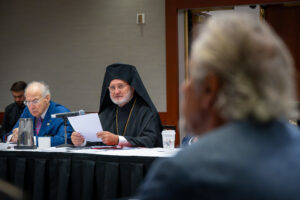
The primate of each church, whether titled patriarch, archbishop, or metropolitan, presides over that synod, but he presides as the first among equals rather than as a monarch. He convenes the bishops, represents the church, and speaks on its behalf, yet he cannot simply overrule his brother bishops.
This same principle, primacy expressed as leadership among equals rather than power over them, operates at every level of the structure, from a metropolitan among his diocesan bishops up to the Ecumenical Patriarch among the heads of all the churches.
The order of honor and the first throne
The self-governing churches are equals, but equals still need an order in which to stand, speak, and be seated at a council. That order is ancient and fixed, recorded in what the Church calls the diptychs, the formal ranking of the churches. Its origins lie in the early centuries, when five great apostolic centers known as the Pentarchy led the Christian world: Rome, Constantinople, Alexandria, Antioch, and Jerusalem. When the Great Schism of 1054 divided Rome from the East, Constantinople became the first throne of the Orthodox Church, the position it holds to this day.
This is where the Ecumenical Patriarchate enters the structure. The Archbishop of Constantinople carries the additional title of Ecumenical Patriarch and ranks first in honor among all Orthodox bishops, a role best captured by the Latin phrase “primus inter pares,” or “first among equals.” The distinction from the papacy is the whole point.
The Ecumenical Patriarch convenes pan-Orthodox gatherings, serves as the chief voice of Orthodoxy in dialogue with other Christians, and alone holds the recognized prerogative to grant autocephaly, the act that makes a church independent. What he does not do is govern the other churches or override their synods. His is a primacy of honor and coordination, not of universal jurisdiction. For the full picture of that office, our companion guide explains what the Ecumenical Patriarchate is and why it leads the Eastern Orthodox Church.
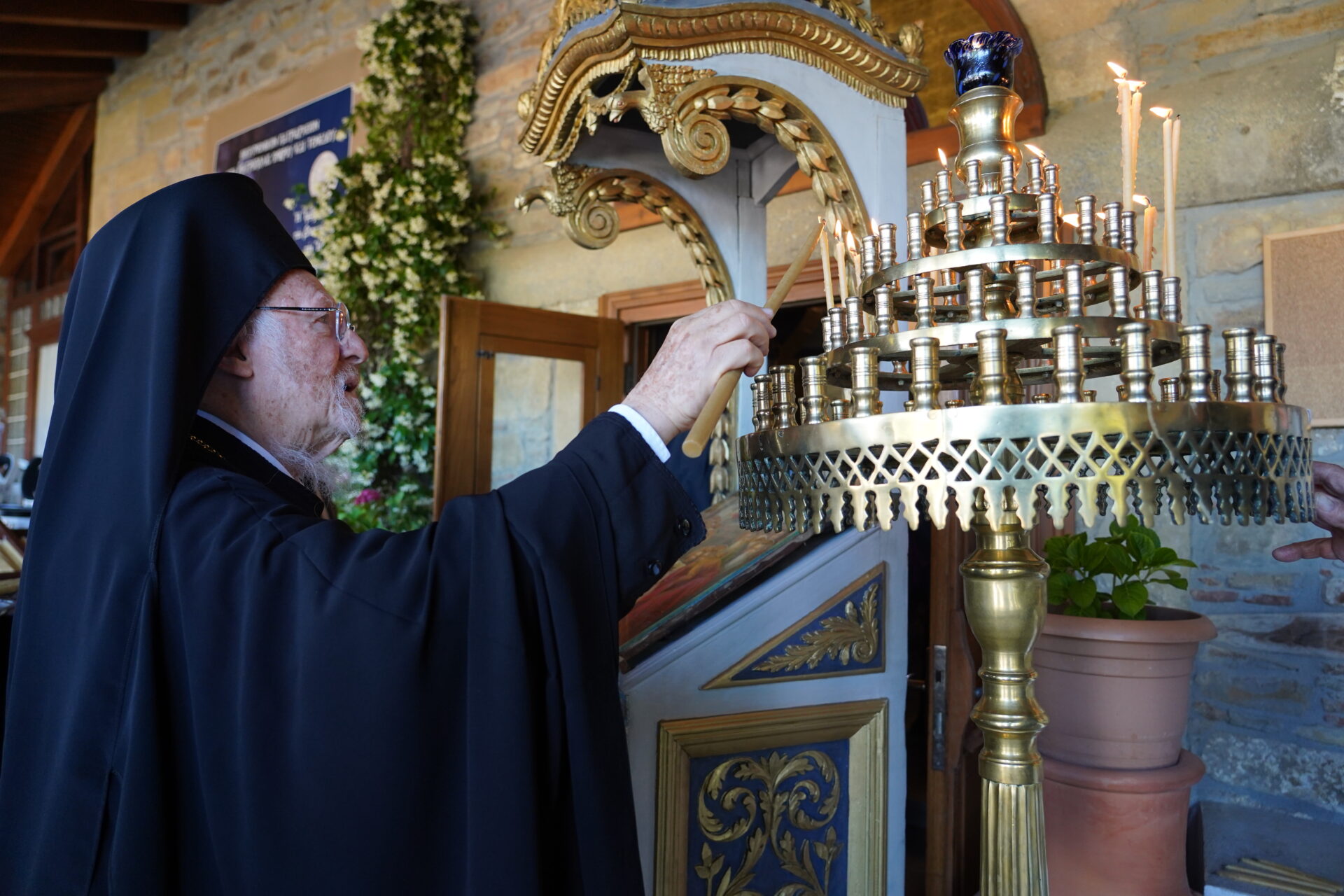
The current holder of the office is His All-Holiness Ecumenical Patriarch Bartholomew, enthroned in 1991 and reckoned the 270th Archbishop of Constantinople in a line that tradition traces to Saint Andrew the Apostle. He commands no army, no state, and no central treasury. His authority is the moral weight of being first to speak for the whole.
How the structure looks in the United States
For American readers, this is not a distant abstraction. Most Greek Orthodox parishes in the country belong to the Greek Orthodox Archdiocese of America, which falls directly under the Ecumenical Patriarchate, making the senior see of the Orthodox world the mother church of a community in your own city. Other jurisdictions answer to other mother churches: the Antiochian Archdiocese under the Patriarchate of Antioch, the various Slavic and other communities under their own primates.
Because so many overlapping jurisdictions coexist on the same soil, the canonical bishops of the United States also gather in an assembly of bishops to coordinate their shared witness. It is the same conciliar logic at work on a national scale: independent churches, ordered by honor, cooperating without any single one ruling the rest.
Frequently Asked Questions
The Orthodox Church has no single ruler with authority over the entire communion. In honor and standing, the Ecumenical Patriarch of Constantinople, currently His All-Holiness Ecumenical Patriarch Bartholomew, holds the first place. He presides among the other patriarchs as the first among equals rather than as their superior, and each self-governing church manages its own affairs.
No. Orthodoxy has no office equivalent to the papacy, no single bishop with universal jurisdiction over the whole Church. The Ecumenical Patriarch is the first in honor among equals, a primacy of leadership and coordination rather than command, while every autocephalous church governs itself through its own synod of bishops.
There are three ordained orders: deacon, priest, and bishop. Deacons assist in worship, priests lead parishes and celebrate the sacraments, and bishops govern dioceses and ordain clergy. Titles such as archbishop, metropolitan, and patriarch are senior ranks of bishop, distinguished by honor and administrative scope rather than by a higher level of ordination.
Autocephalous means “self-headed.” An autocephalous church is a fully independent Orthodox church that elects its own primate and governs its own affairs while remaining in full communion with the others. There are fourteen widely recognized autocephalous churches, including Constantinople, Alexandria, Antioch, Jerusalem, Russia, and Greece.
Not in the sense of ruling them. The Ecumenical Patriarch holds the first place of honor and unique coordinating duties, including convening pan-Orthodox councils and granting autocephaly, but he does not govern the internal life of the other churches or overrule their bishops. His role is to lead and unite, not to command.
The First Throne
Why the First Throne Is Worth Defending
The Orthodox structure has held for two thousand years precisely because it does not depend on one ruler. Authority is shared among bishops, ordered by honor, and anchored at the top by a see that leads without dominating. Yet the office at the center of that order, the Ecumenical Patriarchate, survives today as a tiny Christian presence in a difficult environment, with little legal protection for an institution of global significance.
That is the work the Archons have taken up. For sixty years, the Order of Saint Andrew the Apostle has defended the religious freedom of the Mother Church and the office that anchors the whole structure of Orthodox leadership. If understanding that structure has shown you why the first throne matters, you can see the issues we are fighting and how to stand with us.