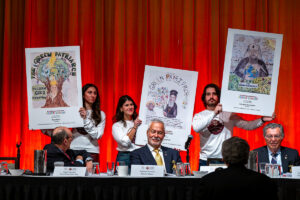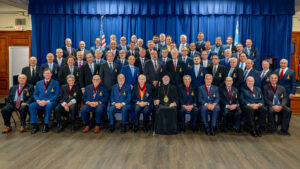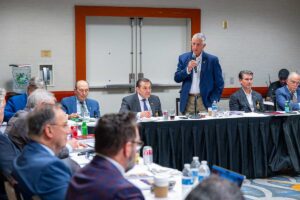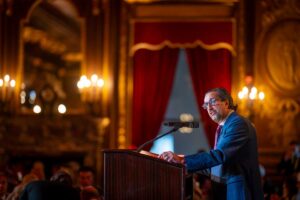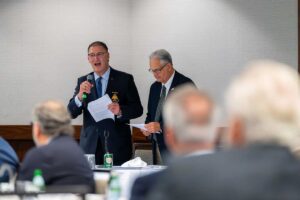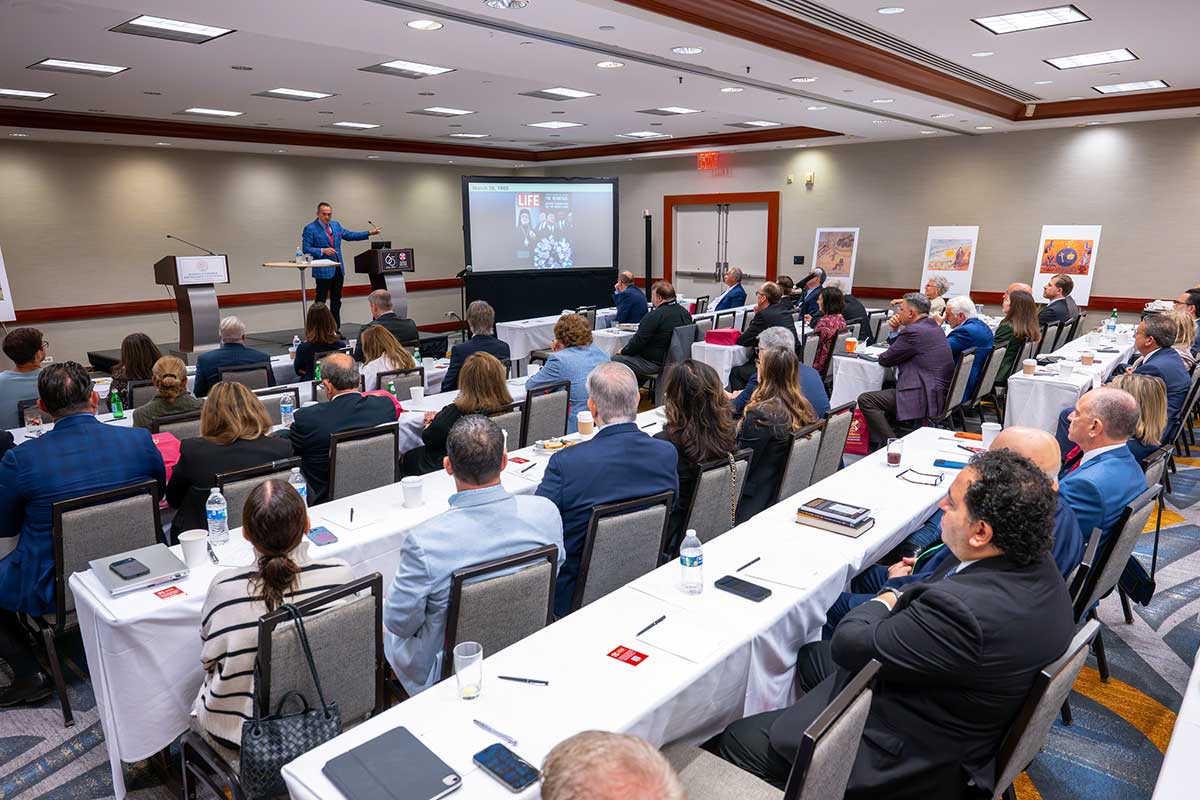
On Friday, October 16, 2026, Archon John Socrates Zavitsanos, along with Archon Gus Pablecas, National Secretary of the Archons of the Ecumenical Patriarchate (AEP); Archon John G. Manos, National Treasurer of the AEP; and Archon Rocky Sisson, Chair of the Communications Committee; addressed Archons-elect on their solemn responsibility to defend the Holy Mother Church of Constantinople amid the extraordinary challenges it faces in the contemporary world.
As in past years, Archon Boot Camp was geared primarily toward the Archon Class of 2026; however, many Archons from earlier classes attended, as each Archon Boot Camp presents a unique and enlightening opportunity for Archons to become fully apprised of the current situation of the Ecumenical Patriarchate, and to revitalize and reinvigorate their efforts to support and defend the Holy Mother Church of Constantinople.
Dr. Anthony J. Limberakis, National Commander of the Archons of the Ecumenical Patriarchate, characterized this year’s class of new Archons as “outstanding,” and noted that the class included former Congressman Michael Huffington and U.S. Army General (ret.) Andrew Peter Poppas. He characterized the AEP as “a beloved band of Archon brothers.”
Dr. Limberakis opened the session by indicating the immense importance of Archon Boot Camp, a primer on the challenges that confront the Ecumenical Patriarchate, and the expected responsibilities that every individual Archon would take on in order to serve the needs of the Holy Mother Church of Constantinople. He offered his gratitude to Archon John Zavitsanos as lead presenter, as well as to Archons Pablecas, Manos, and Sisson.
Archons Pablecas and Manos then explained in depth, as Archon Pablecas put it, “what you can do in the field to be better Archons.” They explained that to be an Archon was to take on a leadership role, and that they must give their time, talent, and treasure in support and defense of the Ecumenical Patriarchate. Archon Pablecas emphasized that Archons are “defenders of the faith, and the last line of defense. There’s no one else out there protecting the Ecumenical Patriarchate other than the Archons.”
Archon Manos stated that “the most important thing is to teach youth about Holy Mother Church. He said that each Archon should come up with his own answer to the question of “What can you do?”: “Start thinking about ideas,” Archon Manos said. “Don’t wait to be asked.” Archon Pablecas added: “There is a ministry called showing up – the ministry of presence.” Archon Manos pointed out that he and his wife plan to be at Archon Weekend every year, and recommended that the new Archons make this a practice as well.
Archons Manos and Pablecas went on to describe various activities they initiated as Regional Commanders for the Metropolis of Chicago in order to raise awareness regarding the Ecumenical Patriarchate. “As Archons,” said Archon Pablecas, “we do something every day for the Archons. You’re not doing it for the Archons, you’re doing it for the Holy Mother Church.” They described the international reach and influence of the Archons, as well as some key Archon initiatives such as the Sprout Program and the Pilgrimage of Discovery.
Archon Manos stated: “Each of us carries the sacred honor and responsibility of being an Archon of the Ecumenical Patriarchate. The world may change, challenges may arise, pressures may mount, but the light of Orthodoxy must never dim. Through our time, talent, and treasure, we ensure that the foundations of our Mother Church remain strong and unchanging. Be the voice that defends our faith when it is tested. We can build a legacy that endures and safeguards Orthodoxy not just for today, but for generations to come.”
Archon Rocky Sisson then explained to new Archons “where you fit into all of this.” He called attention to material that is available on Archons.org and the Archons app, as well as to the Archons’ social media presence, saying: “The Archons.org website has everything you need as Archons for your mission.”
Archon Sisson added: “We won’t accomplish anything unless we educate and motivate those who believe in religious freedom, even if they aren’t Orthodox or even Christians.” Archon Sisson concluded by saying that the Archons’ unofficial motto was: “Don’t wait to be asked.” He explained: “Don’t go home and wait for the phone to ring and be asked to engage. Learn about the Ecumenical Patriarchate, and look for ways that you can involve yourself.”
Archon Zavitsanos began his presentation dramatically, listing the iconoclastic schism, the plague of 900, the Great Schism of 1054, the Istanbul pogrom of 1955, and other cataclysmic events as times when the Church faced existential threats. Then he stated that we are today facing two existential threats to the Church.
“I’m not going to congratulate you,” Archon Zavitsanos stated, “because you have done nothing. We have selected you because we think you can do something. We are the only organization dedicated to defending the Holy Mother Church. We weed out the people who think of this as just a lifetime achievement award.” He explained that His All-Holiness Ecumenical Patriarch Bartholomew personally reviews each prospective Archon’s application, and told new Archons that they are the special forces of the Ecumenical Patriarchate, with a singular focus: to protect the Holy Mother Church.
After detailing some of the singular achievements and distinctions of the Orthodox Church in America, showing how it has a long tradition of standing for human rights and religious freedom, Archon Zavitsanos gave an extraordinary and detailed presentation about the existential threats that Turkey and Russia pose to the Ecumenical Patriarchate.
Archon Zavitsanos pointed out that Turkish President Recep Tayyip Erdogan is remaking his country in a way that should concern all Orthodox Christians. Official textbooks now teach that Jews and Christians are infidels, and that the highest virtue is martyrdom in jihad, and that the U.S. is a state sponsor of terrorism. They include maps of the “Turkish Cultural Basin,” which is essentially a recreation of the Ottoman Empire, including Greece and Cyprus. Meanwhile, the textbooks divide people into three categories: pious Muslims, hypocrites, and infidels.
Archon Zavitsanos explained how Turks in the U.S. use charter schools, privately owned schools that get money from the state, as part of a sophisticated influence operation. There are Turkish charter schools in half the states of the United States, and they educate hundreds of thousands of American children.
The names of these schools give no indication that they are owned by the Turkish government or have any involvement in advancing that government’s agenda, and they maintain high educational standards. Archon Zavitsanos asked what students in these schools would likely think if they heard as adults about claims that Turkey was a human rights violator. “They’re playing the long game,” he said.
Archon Zavitsanos also described Turkey’s efforts to ensure that Armenian-American billionaire Kirk Kerkorian’s film The Promise, about the Armenian Genocide, received an avalanche of negative reviews and closed quickly. The Turks likewise managed to block Famagusta, a drama centered on the Turkish invasion and occupation of Cyprus in 1974, from Netflix.
A large number of senators and members of the House of Representatives, Archon Zavitsanos explained, are members of the Turkish caucus. He explained in detail how Turkish pressure has led politicians at the state and national levels who had supported resolutions to recognize the Armenian Genocide to switch sides. In one David-and-Goliath incident, however, the Greek-American community in Texas was able to overcome Turkish pressure and ensure the passage of the Archons’ resolution calling for religious freedom for the Ecumenical Patriarchate
Turning to Russia, Archon Zavitsanos elaborated upon the close partnership between Russian President Vladimir Putin and Moscow Patriarch Kirill. He explained how the founder of Soviet Russia, V. I. Lenin, had tried to abolish religion in Russia, but had failed. Later, the KGB realized that instead of snuffing religion out, it could co-opt it.
In line with that imperative, Archon Zavitsanos explained, Patriarch Kirill was a KGB agent, as was Vladimir Putin. Putin uses the Russian Orthodox Church as a diplomatic tool: where people may be reluctant to listen to a diplomat, they’ll be happy to receive a man of the cloth.
Archon Zavitsanos explained how the Russian Orthodox Church severed communion with the Ecumenical Patriarchate after His All-Holiness Ecumenical Patriarch Bartholomew granted autocephaly to the Orthodox Church of Ukraine (OCU) in January 2019. When the Patriarchate of Alexandria recognized Ukraine autocephaly, the Russian Orthodox Church violated the canons of the Orthodox Church by invading the African continent, the canonical territory of the Alexandrian Patriarchate, bribing 200 parishes in Africa to switch from the Patriarchate of Alexandria to the Russian Orthodox Church.
The Russian Orthodox Church, Archon Zavitsanos explained, is likewise attempting to make inroads in the U.S. via its Society of St. John, which was founded in 2025. This Society has attempted to pressure the White House and State Department to condemn Ukraine for prosecuting Russian agents operating under the auspices of the Ukrainian Orthodox Church (UOC), which rejected autocephaly in 2019 to remain under the auspices of the Russian Orthodox Church.
Archon Zavitsanos concluded with some practical steps Archons should take to fight against this underhanded and well-funded effort. Above all, he emphasized that while the opposition has immense resources, the defenders of the Ecumenical Patriarchate have the truth on their side.