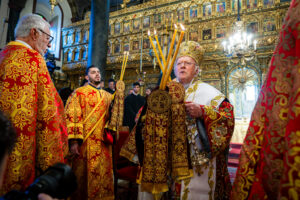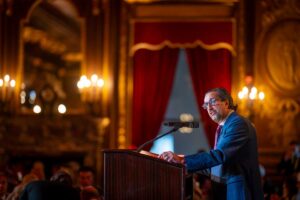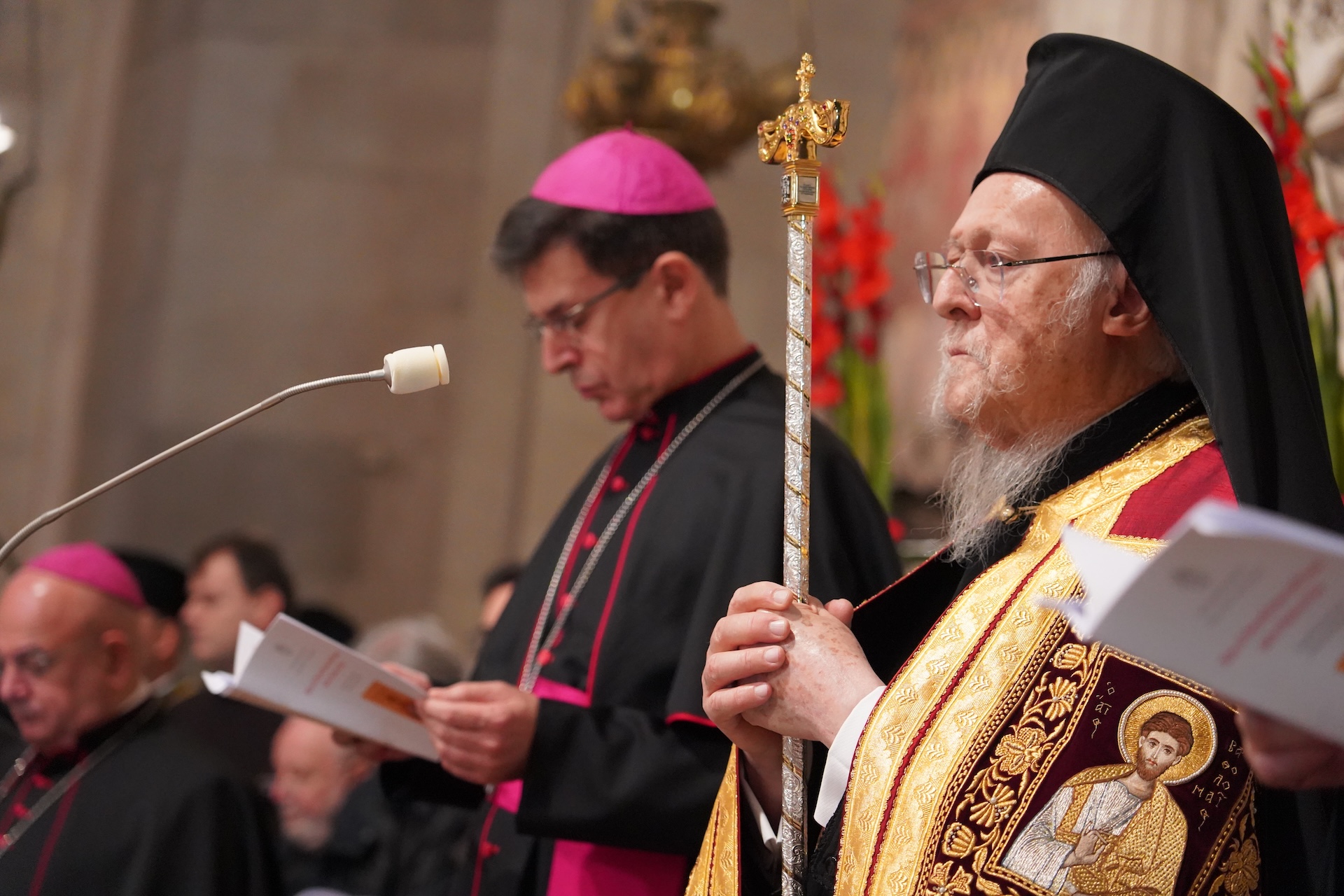
On the occasion of a visit to the Basilica of the Holy House of Our Lady of Loreto in Italy on October 26, 2026, His All-Holiness Ecumenical Patriarch Bartholomew presided over the Akathist Hymn service and explained in profound, moving, and illuminating terms why Orthodox Christians, as well as Roman Catholics and some Protestants, have a special love and veneration for the All-Holy Mother of God and Ever-Virgin Mary.
His All-Holiness stated that devotion to the Virgin Mary is rooted in a full and correct understanding of the Incarnation of our Lord Jesus Christ, and a complete realization of its meaning and significance. The Ecumenical Patriarch began by quoting the Holy Apostle John, who wrote: “The Word became flesh and dwelt among us” (John 1:14).
That single phrase, His All-Holiness said, contains within it the reason why the Most Holy Theotokos is so important to Orthodox Christians. “In these few words,” His All-Holiness explained, “the Evangelist John encapsulates the unfathomable abyss of the Christian faith. He who is eternally with the Father enters into time; He through whom all things were created enters into His own creation; the Invisible becomes visible, the Uncircumscribed allows Himself to be circumscribed, the Uncontainable accepts being contained. God does not merely visit humanity: He truly becomes human, without ceasing to be God. And this ineffable Mystery is accomplished in the womb of a woman.”
The Church honors Mary as part of our worship of her divine Son: “For this reason, when the Church contemplates the All-Holy Virgin, it never approaches her as a reality separate from the Mystery of Christ. Every authentically ecclesial word concerning the Theotokos —the Mother of God — leads necessarily to the Son, and every authentic confession of the incarnate Son illuminates the Mystery of the Mother from whom He received our flesh.”
As a result, His All-Holiness said, the joy that the Church proclaims “does not arise from an autonomous exaltation of the Virgin, but from the advent of Christ. It is the joy of creation, which beholds its own Creator entering into it; it is the joy of humanity, wounded by corruption and death, being reached once again by Life; it is the joy of the old Adam, who sees his own restoration begin in the new Adam. It is here that the distinctively Orthodox depth of the mystery of the Theotokos is manifested.”
The Mother of God receives our veneration and love precisely because she is the Mother of God. “The Mother of God belongs to the Mystery of the Incarnation,” said His All-Holiness, “because, through her, the eternal Son of the Father truly assumes what is ours. Not an appearance of humanity, nor a flesh alien to our condition, but our own human nature. He who, before the ages, is begotten of the Father without a mother, is born in these latter times of a Mother without a father, according to the flesh. It is the same Son, the same Logos, the same divine Person: eternal according to His divinity, and truly become man according to His humanity.”
All of the exalted titles that ecclesiastical tradition has accorded to the Holy Virgin emanate from her singular status as the Mother of God, the one through whom the Creator of the universe entered His creation. “For this reason,” His All-Holiness stated, “the Church has defined her as Theotokos.”
His All-Holiness cleared up a misunderstanding that crops up occasionally among Christians of faith traditions other than Orthodoxy: “Not because Mary is the origin of the divinity — the Son is eternally begotten of the Father — but because He whom she conceives and bears according to the flesh is not merely a man in whom God subsequently came to dwell. He who is born of her is the very Word of God made man. The child she carries in her womb is one of the Holy Trinity. He who is wrapped in swaddling clothes is the One who clothes all creation in light. He who is nourished by a mother’s milk is the One who provides nourishment to every living thing.”
The Incarnation of the Son of God, however, is not an end in itself. The Ecumenical Patriarch explained that “the Mystery of the Incarnation does not consist solely in the fact that God became man. The decisive question is: why did the Word become flesh? The Creed of our faith answers with a simplicity that contains the entire economy of salvation: ‘For us men and for our salvation He came down from heaven, and by the Holy Spirit was incarnate of the Virgin Mary, and became man.’ For us and for our salvation. The Word assumes what is ours in order to heal it from within. He takes on the nature of fallen Adam to restore it to its original beauty—and, beyond that, to communion with the divine life. He assumes man, marked by corruption, so that man might be clothed in incorruptibility. He enters into our mortality so that our mortality may be reached by His life.”
Consequently, “in the womb of the Theotokos, not merely a birth begins, but a new creation. The Word takes on our human nature from Mary and, by truly uniting it to Himself — without confusion, separation, or change — He heals it, renews it, and opens it to participation in the divine life. Indeed, God does not save humanity from the outside; the Son enters into our condition and assumes that which stands in need of healing, so that human nature may be restored and led toward the end for which it was created.”
This is why, His All-Holiness said, the veneration of the Theotokos is so important for every Christian: “For this reason, the Mystery celebrated in the Theotokos concerns each one of us. That which the Word receives from her belongs to us. The flesh He assumes is our own flesh. The humanity that is brought into communion with God is our own humanity. It is precisely here that we understand why the confession of the Virgin as Theotokos is not merely a devotional addition to the Christian faith. It safeguards a truth that is decisive for our own salvation. If the One born of Mary were not truly God, humanity would not have been truly united to God. If what He assumed from Mary were not fully human, our nature would not have been assumed in its entirety. But because the One born of her is truly the eternal Son, and because He truly assumes our humanity from her, in Christ, God and man meet—without confusion and without separation.”
And so, all Christians rejoice in the Mother of God: “For this reason,” His All-Holiness concluded, “the Church never tires of greeting the Mother: Χαῖρε, Νύμφη, Ἀνύμφευτε – Hail, O Bride ever-virgin.’”
Let us join our own praises with those of His All-Holiness, and say with him: Rejoice, O Bride unwedded!