On July 24, 2026, the Directorate of Communications of the Presidency of the Republic of Türkiye marked the sixth anniversary of the conversion of Hagia Sophia from a museum to an active mosque with a public program titled “Hagia Sophia: A Monument of the Conquest, the Heart of a Civilisation That Transcends the Ages.” In remarks delivered at that program, the Presidency’s Head of Communications described the 2020 reconversion as “a powerful expression of fidelity” to the endowment deed of Sultan Mehmed II, and characterized the building’s history in exclusively martial and civilizational terms — as a “token of the conquest of İstanbul” and evidence that Türkiye forms part of a triumphant “Islamic civilisation.”
As National Commander of the Archons of the Ecumenical Patriarchate — the lay order chartered by His All-Holiness Ecumenical Patriarch Bartholomew to defend the religious freedom, human rights, and institutional integrity of the Mother Church of Orthodox Christianity — I issue this statement on behalf of the Archons to place the historical and legal record before the American and international public, and to renew our request that the governments and institutions responsible for the protection of religious minorities take account of what this anniversary program represents.
The Historical Record
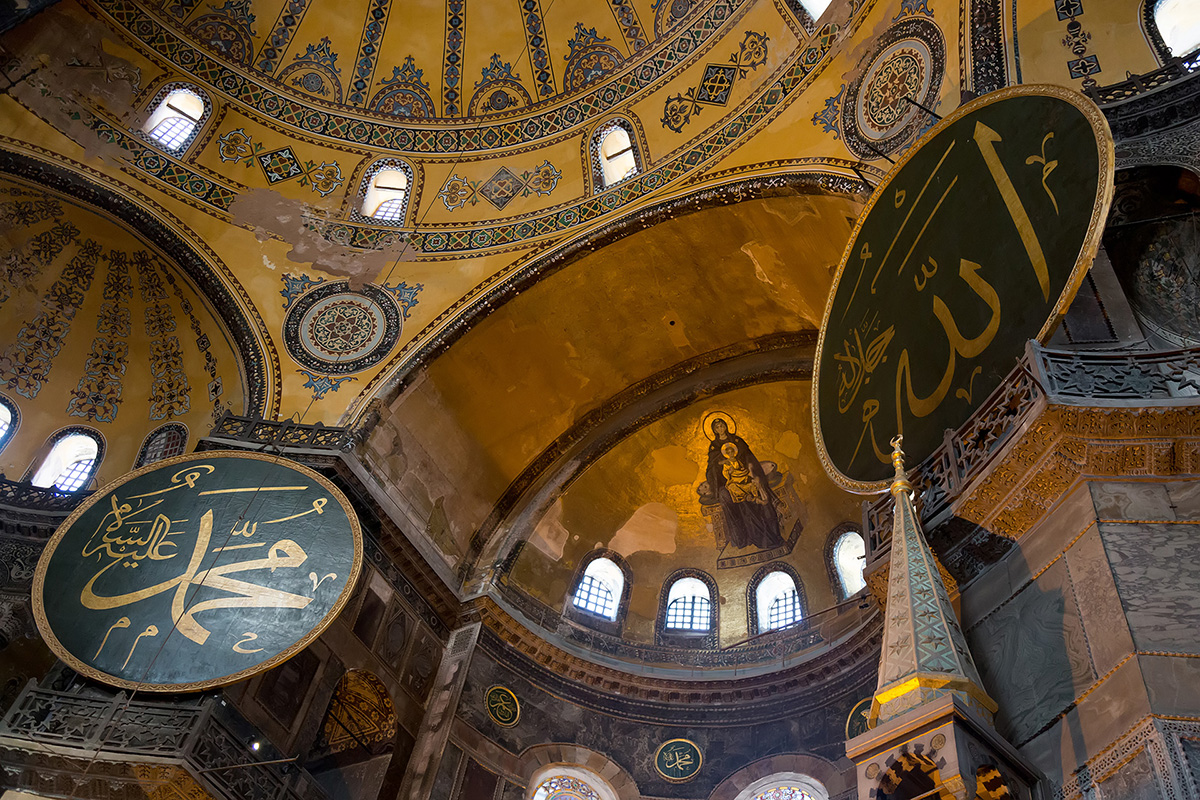
Hagia Sophia was consecrated in the year 537, under the Emperor Justinian I, as the cathedral church of Constantinople and the seat of the Ecumenical Patriarchate. For 916 years — nearly a millennium — it stood as the principal church of Eastern Christendom before the conquest of Constantinople in 1453 brought its conversion into a mosque under Sultan Mehmed II. The building’s Christian identity therefore precedes its Ottoman one by close to a thousand years; the Presidency’s framing of Hagia Sophia as belonging natively to “Islamic civilisation,” with no acknowledgment of the nine centuries that came before, is not merely incomplete — it is a deliberate erasure of the historical record.
In 1934, the Council of Ministers of the Republic of Turkey, under Mustafa Kemal Atatürk, secularized Hagia Sophia and opened it as a museum, holding it thereafter as a shared monument of world heritage rather than the exclusive possession of any single faith. UNESCO inscribed the site on the World Heritage List in 1985 in that same spirit of shared, neutral custodianship. The 2020 decree reversing that 86-year status, issued unilaterally by the Turkish Council of State and the President, was met at the time with formal expressions of concern from UNESCO, the World Council of Churches, and governments across the Orthodox Christian world, precisely because it substituted the private religious foundation instrument of a fifteenth-century monarch for a modern state’s obligations as custodian of a World Heritage Site held in trust for humanity.
It is that same foundation instrument — the vakıf, or endowment deed, of Sultan Mehmed II — that the Directorate of Communications now invokes as if it were self-evidently superior to the intervening decisions of the Turkish Republic itself, to UNESCO’s 1972 World Heritage Convention (to which Turkey is a state party), and to the modern international consensus that shared religious and cultural heritage sites should not be unilaterally reassigned to a single confession. A conquest-era deed of gift cannot be treated as controlling law in a twenty-first century democratic republic without abandoning the basic premise that a state’s constitution and international commitments govern its actions — not the personal will of a monarch six centuries deceased.
This Is Not an Isolated Incident
The anniversary program is consistent with a broader pattern that independent monitors have now documented in detail. The U.S. Commission on International Religious Freedom’s 2026 Annual Report placed Turkey on its recommended Special Watch List, finding that Turkey continues to engage in what the Commission itself has described as systematic and ongoing restrictions on religious freedom. USCIRF’s 2026 findings specifically note that Turkey imposes structural limitations on clergy training, interferes with the internal governance of religious institutions, and maintains barriers to property rights — and that these policies have particularly affected the Ecumenical Patriarchate and other historic Christian communities, contributing to what the Commission calls a gradual erosion of religious pluralism.
Foremost among these structural restrictions is the continued closure of the Theological School of Halki, shuttered by the Turkish government since 1971 under a law nationalizing private higher education. For fifty-five years, the Ecumenical Patriarchate — spiritual leader to roughly 300 million Orthodox Christians worldwide — has been denied the ability to train its own clergy on Turkish soil. USCIRF’s 2026 report notes that dialogue over Halki’s reopening continued in 2025, but dialogue is not the same as resolution, and a sixth-anniversary celebration of Hagia Sophia’s reconversion — held the same year as that dialogue — sends its own signal about the government’s priorities.
The Ecumenical Patriarchate has for decades faced additional constraints that the U.S. State Department’s annual International Religious Freedom Reports have documented: non-recognition of the Patriarchate’s ecumenical title in Turkish law; restrictions on the election and nationality requirements of the Patriarch and Holy Synod; and unresolved disputes over confiscated church properties. These are not historical grievances frozen in the twentieth century — they are live, present-day features of how a NATO ally and EU-accession candidate treats the oldest continuously functioning Christian institution within its borders.
Our Position
The Archons do not dispute Turkey’s sovereignty over its own territory, nor do we ask any government to relitigate settled matters of civil administration. Our concern is narrower and, we believe, uncontroversial among nations that value religious pluralism: a UNESCO World Heritage Site of unparalleled significance to thirteen centuries of Christian history should not be repeatedly and publicly recast, in state-sponsored programming, as a monument to religious conquest with no room in the narrative for the faith community that built it and worshipped there for nine hundred years before 1453. Language describing the reconversion as fulfilling a national “right” on par with the flag and the borders of the Republic treats an act of religious dispossession as an inseparable feature of Turkish sovereignty itself — a framing that leaves little room for the coexistence USCIRF and the State Department have long urged Turkey to practice toward its Christian minority.
We ask the Department of State, the members of Congress who sit on relevant committees, and USCIRF to take note of this anniversary program as it prepares future reporting and diplomatic engagement with Ankara, and to press — through the ordinary channels of bilateral diplomacy — for the reopening of the Halki Theological School, for legal recognition of the Ecumenical Patriarchate’s title and its right to elect Patriarchs and Synod members without nationality restriction, and for resolution of outstanding property claims. We ask our own community, and all people of goodwill, to understand Hagia Sophia’s full nine-hundred-year Christian history as inseparable from its subsequent Ottoman and Turkish history — not erased by it.
The Archons make this statement in the spirit that has always guided our order: the defense of the Ecumenical Patriarchate’s religious freedom and institutional integrity through lawful, diplomatic, and historically accurate advocacy — never through rhetoric that could place His All-Holiness Patriarch Bartholomew or the Christian community of Constantinople at greater risk. It is precisely because we take that risk seriously that we have confined this statement to the documented record and to the avenues of appeal that lawful democracies afford: historical fact, international heritage law, and the sustained attention of the free world’s religious freedom institutions.
Respectfully submitted,
Dr. Anthony J. Limberakis
Archon Grand Aktouarios
National Commander, Archons of the Ecumenical Patriarchate