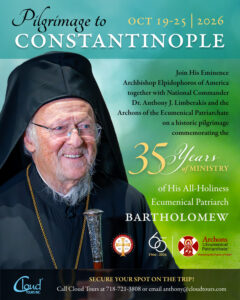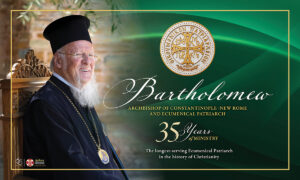
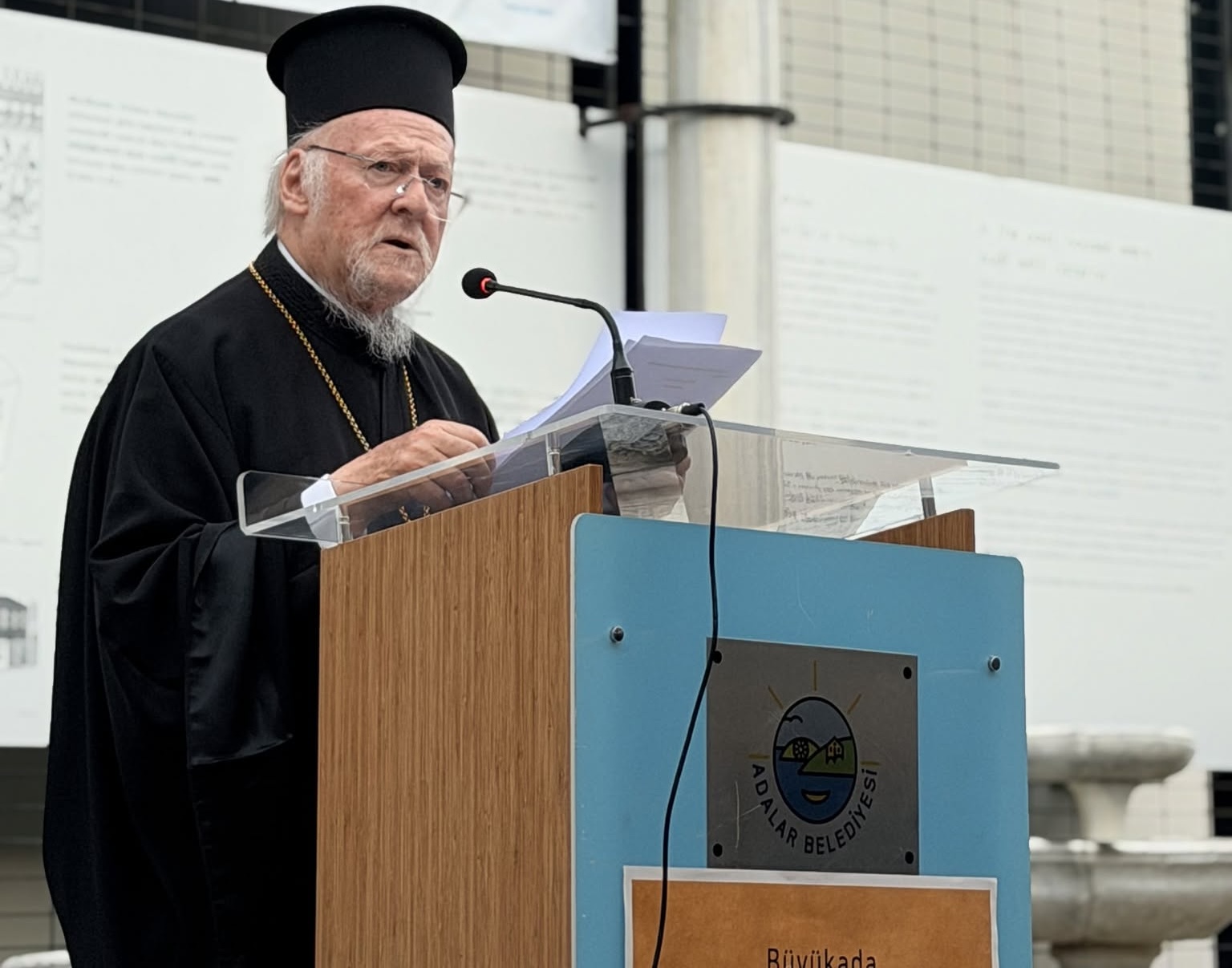
His All-Holiness Ecumenical Patriarch Bartholomew has won renown as the “Green Patriarch” for his prophetic calls to care for the natural environment as an integral aspect of the Christian commitment. In a June 26, 2026 address upon his reception of an honorary degree from the School of the Environment at Ionian University, His All-Holiness once again sounded the alarm about threats to the environment, noting that the dangers of ecological destruction are more urgent than ever.
“Undoubtedly,” the Ecumenical Patriarch stated, “the natural environment is threatened in our time as never before in the past.” He declared that “today, ‘a third world war against nature’ is being waged.” His All-Holiness noted that there were three primary factors chiefly threatening the environment today: a monomaniacal focus on economic development at the expense of all other factors; the rapid advance of “technical and scientific developments” in the absence of ethical considerations, and “the widespread individual and social hedonism.”
His All-Holiness warned that the consequences of this “third world war against nature” could be more devastating than those resulting from any war in human history: “The consequences of the ecological crisis know no borders of states and civilizations, and affect the conditions of survival not only of the human race, but also of life in general on the planet.”
He added that this was not a hypothetical situation, but an imminent threat: “The climate crisis is not a ‘future scenario,’ but a painful reality, with the rapid decline of biodiversity, deforestation, pollution of the atmosphere and seas, catastrophic fires and floods.” Ecological efforts so far have been insufficient: “Despite the reactions and resistance to this threat, geocide continues, while at the same time the unwavering view that nature has the power to renew itself is cultivated. It is not auspicious that humanity is aware of the seriousness of environmental problems and continues to behave as if it were unaware.”
Amid this crisis, the Ecumenical Patriarchate has been leading the world to the awareness of the problem that is the first prerequisite of any action to remedy it. His All-Holiness pointed out that “the Ecumenical Patriarchate is widely known for its ecological initiatives, the beginning of which is marked by the Patriarchal and Synodal Encyclical of the Indiction of 1989, by which September 1 was established as a Day of Prayer for the Protection of the Natural Environment.”
The Ecumenical Patriarch noted that “since then, the Church of Constantinople has been at the forefront of ecological awareness, actively highlighting the ecological potential of the Eucharistic and ascetic ethos of Orthodoxy. During our humble Patriarchate, various environmental actions followed, nine international interdisciplinary and interreligious symposiums on board, seminars and lectures, book publications, declarations on the environment and many others. The ecological initiatives of the Ecumenical Patriarchate inspired parliaments, universities, research centers, the field of education, ecological organizations, and served as a trigger for the inclusion of the ecological theme in the inter-Christian and inter-religious dialogue.”
Yet while the Church has responded to the crisis, its call to care for the environment did not spring from that crisis itself. Rather, His All-Holiness explained that this call emanated from deep theological wellsprings: “We wish to recall that the Church’s interest in the protection of the natural environment did not arise simply as a reaction to the contemporary ecological crisis. It is true that the present ecological problem was the occasion and not the cause of the ecological activity of the Orthodox Church. This was an opportunity for it to develop its teaching on the relationship between man and the natural environment, and to highlight the need to protect the ‘all-good’ creation.”
His All-Holiness emphasized that this care for the environment lies at the very heart of Orthodox Christianity: “The foundation of the Church’s unwavering concern for the ecological crisis is this very identity of Orthodoxy. Church life is ‘experienced ecology,’ practical care for the environment, victory over all the forces from which eco-destructive tendencies emanate. The culture of Orthodoxy is inherently eco-friendly.”
What can be done in the face of this crisis? The Ecumenical Patriarch stated that “the Christian approach to the problem requires repentance for abuses, restraint and an ascetic ethos, which constitute an antidote to overconsumption, and at the same time, cultivating in man the consciousness that he is a ‘steward’ and not the owner of creation.” The Holy and Great Council of 2016, he pointed out, “never ceases to emphasize that future generations also have a right to the natural goods entrusted to us by the Creator.”
Care for the natural environment is therefore an act of love and compassion for our children and our children’s children. May Almighty God grant to each of us the will to heed the warnings and wisdom of our Ecumenical Patriarch. May we be mindful of the environmental crisis in all our actions, and cultivate the determination to extend to future generations this fundamental act of charity.