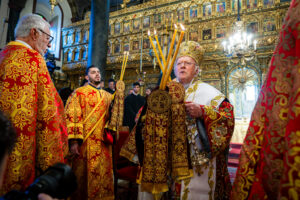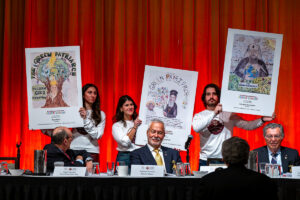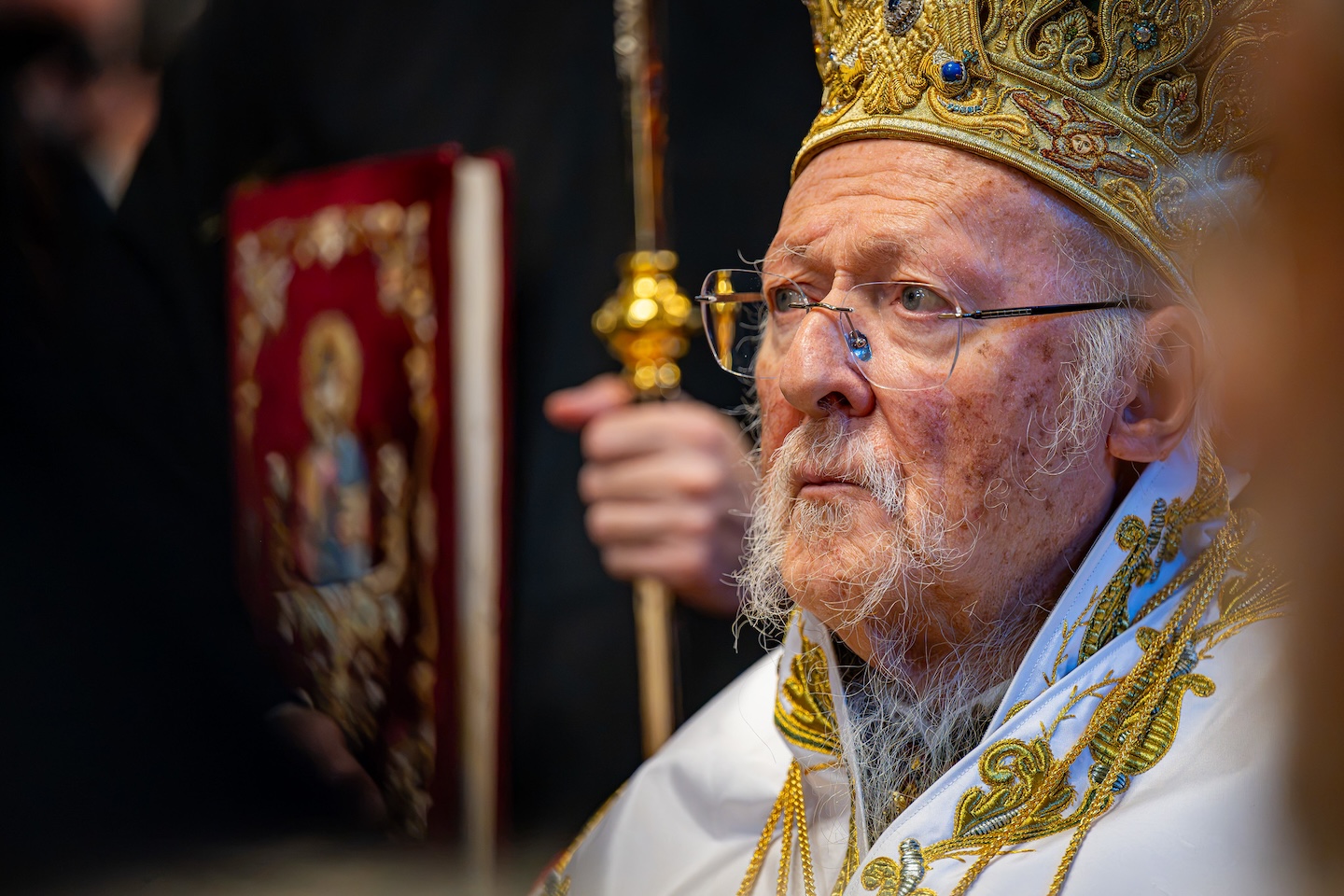
Speaking at the 2026 International Meeting for Peace in Assisi on Tuesday, October 27, 2026, His All-Holiness Ecumenical Patriarch Bartholomew delved deeply into what he termed “a subject that we consider fundamental”: the God-given dignity of every human being.
His All-Holiness quoted the Holy and Great Council (Crete, 2016) stating that “the Orthodox Church confesses that every human being—regardless of color, religion, race, gender, nationality, or language—is created in the image and likeness of God and enjoys the same rights within society.”
Elaborating upon this all-important point, the Ecumenical Patriarch emphasized that “skin color, ethnic origin, language, religion, gender, or social status can neither add to nor subtract from the dignity of a human being created in the image of God.” He explained that “this conviction is rooted in Holy Scripture,” noting the words of Saint Paul, that God “has made from one blood every nation of men to dwell on all the face of the earth” (Acts 17:26). His All-Holiness also quoted Saint Paul’s statement that “there is neither Jew nor Greek, there is neither slave nor free, there is neither male nor female; for you are all one in Christ Jesus” (Galatians 3:28), pointing out that “by affirming their unity in Christ, the Apostle proclaimed a common dignity that transcends the categories and hierarchies of this world.”
His All-Holiness stated that this common dignity has its origin in Christ Himself, Who “opens His arms to embrace all who come to Him. He never asked anyone, ‘Who are you?’ Whoever sought His love received it—a truth we know all the better through the Gospel. We are familiar with His words: ‘Whoever comes to me, I will never drive away’” (John 6:37).
Referring to the Gospel accounts of the Samaritan woman, Zacchaeus the tax collector, the Good Samaritan, His All-Holiness said: “This openness to the other, which runs throughout the entire Gospel, finds its fulfillment on the Cross.” The Ecumenical Patriarch explains that this is because it was on the Cross that “the Lord stretches out His arms to embrace all of humanity, thereby fulfilling the words He had spoken: ‘And I, when I am lifted up from the earth, will draw all people to myself’ (John 12:32). The Evangelist notes that He said this ‘to indicate the kind of death he was to die’” (John 12:33). In the open arms of the Crucified One, the love of God is revealed — a love that knows no exclusion and calls every human being, across all boundaries, to enter into communion with Him.”
Ecumenical Patriarch Bartholomew also emphasized that recognition of the innate dignity of every human being had to be manifested in concrete action in order to be genuine. “In the parable of the Last Judgment,” His All-Holiness pointed out, “there is a single criterion, formulated in the simplest and most direct terms: a plate of food, a glass of water, a piece of clothing, a visit to someone who is sick or in prison. The Lord identifies Himself with the hungry and the stranger—without asking anything about their faith or their origin—and says: “Whatever you did for one of these least of my brothers and sisters, you did for me” (Matthew 25:40).
His All-Holiness then stated that the Holy Apostle and Evangelist Saint John summed up this dictum about serving other others in “a single phrase, ‘God is love (1 John 4:8), and a little further on, he added—with a severity that leaves no room for doubt—that anyone who claims to love God while hating their brother or sister is a liar” (1 John 4:20).
It is in view of these eternal and ineradicable truths, the Ecumenical Patriarch explained, that “the Orthodox Church embraces, without hesitation, the language of human rights as articulated in the 1948 Universal Declaration: ‘All human beings are born free and equal in dignity and rights.’” His All-Holiness added that this principle depends for its power upon the Church’s understanding of the nature of the human being: “The Orthodox theology of the person — and of the deifying communion between God and humanity — provides this language with a solid foundation and an inner depth, preventing it from being reduced to a mere assertion of an autonomous, self-sufficient individual.”
Referring to the martyrdom of the Holy and Great Church of Constantinople through the ages, His All-Holiness said: “Our own history teaches us this: a Church living as a minority learns to appreciate the full value of religious freedom and to advocate for it on behalf of others with the same determination it applies to itself. We defend the dignity of a refugee child just as we do that of an elderly person, and we show equal concern for someone of another faith as we do for someone who does not believe at all — because, in every person, we recognize the same image of God.”
His All-Holiness concluded by noting that “in a globalized world — one that stirs enthusiasm in some and apprehension in others — the ecumenical vision of Orthodoxy offers a path toward understanding and hope: it invites us to broaden our perspective to embrace the entire earth, without ever losing sight of the face of each individual human being.”
This is the great challenge to which His All-Holiness Ecumenical Patriarch Bartholomew calls each and every one of us.