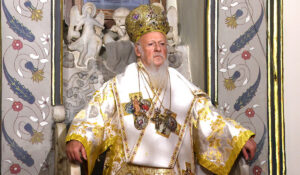
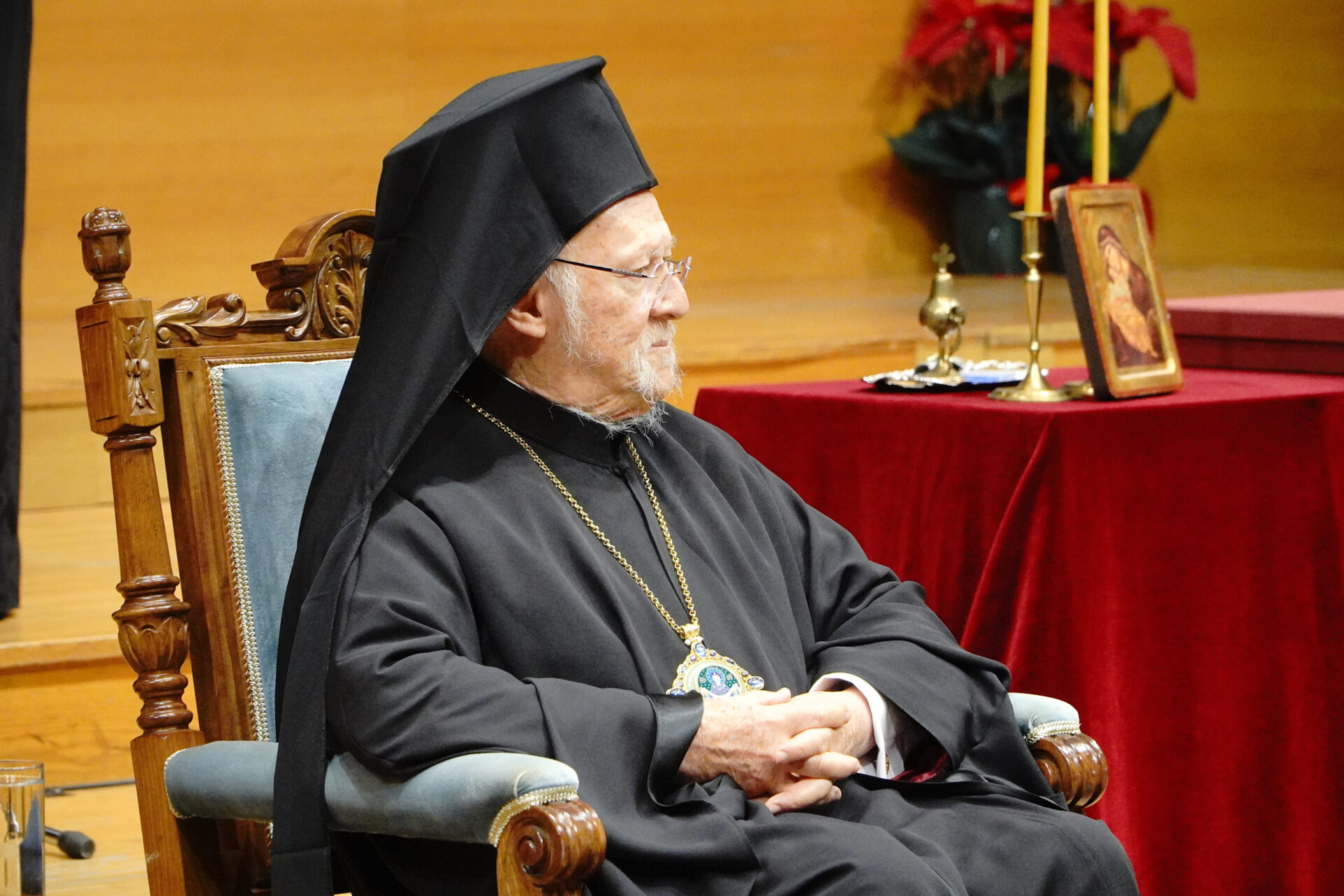
Sunday, February 15, 2026 is Judgment Sunday (Meatfare Sunday), followed by Forgiveness Sunday (Cheesefare Sunday) on February 22. Then, as Holy and Great Lent begins, we would do well to look to the guidance and insights of His All-Holiness Ecumenical Patriarch Bartholomew as to how best to observe this blessed period.
In his message for Holy and Great Lent 2025, His All-Holiness reminds us that this is a time of “fasting and repentance, of spiritual vigilance and journey with the Lord,” culminating in “the veneration of His splendid Resurrection.” This is because “the services and hymns of this season associate the spiritual struggle of the faithful with the expectation of the Lord’s Pascha, whereby the forty-day fast radiates the fragrance of the paschal joy.”
The goal for every Christian is to become “worthy of our own passage from earthly things to ‘that which no eyes have seen and no ears have heard and no human heart has ascended’ (1 Cor. 2.9).” The Christian must take hold of the opportunity that Holy and Great Lent offers to “become conscious of the depth and wealth of our faith as ‘a personal encounter with Christ.’”
This “personal encounter” must be properly understood. His All-Holiness explains that “it is rightly emphasized that Christianity is ‘extremely personal,’ without this implying that it is ‘individualistic,’” an error that those who stress the need for the Christians’ personal encounter with Christ often make, discounting the importance of attendance at divine services.
The Ecumenical Patriarch continues: “The faithful ‘encounter, recognize, and love one and the same Christ,’ who, ‘alone and only, revealed the true and perfect human person’ (Nicholas Cabasilas). He invites all people—and each person individually—to salvation, so that the response of each may always be ‘grounded in the common faith’ and ‘at the same time be unique.’”
His All-Holiness adds that “our experience of faith is ‘unique’ and ‘profoundly personal’ as a freedom given to us by Christ, as something that is at the same time ‘essentially ecclesiastical,’ an experience ‘of common freedom.’”
His All-Holiness further emphasizes that the encounter with Christ must bear fruit in authentic expressions of love. “This most genuine freedom in Christ,” he states, “is expressed as love and applied support to our concrete neighbor, as this is described in the Parable of the Good Samaritan (Luke 10.30–37) and in the passage about the Last Judgment (Mt. 25.31–46), but also as respect and concern for the world and the eucharistic approach to creation.” Consequently, “freedom in Christ has a personal and holistic nature, which is especially revealed during Holy and Great Lent in its understanding of asceticism and fasting.”
That asceticism is not focused on punishment, loss, or an ostentatious and ultimately prideful solemnity. His All-Holiness explains that “Christian freedom, as existential authenticity and fullness, does not involve a gloomy asceticism, a life without grace and joy, ‘as if Christ never came.’” It is always focused on the resurrection which is, at Holy Pascha, the culmination of the entire Lenten period.
A prideful asceticism is a manifestation of the very egoism that the Christian is striving during Holy and Great Lent to overcome. According to His All-Holiness, the fasting that is the most visible characteristic of this holy season “is not only ‘abstinence from food,’ but ‘renunciation of sin,’ a struggle against egotism, a loving departure from the self to the brother in need, ‘a heart that burns for the sake of all creation.’” He emphasizes that “the holistic nature of spirituality is sustained by the experience of Great Lent as a journey toward Pascha and as a foretaste of ‘the glorious freedom of God’s children’ (Rom. 8.21).”
His All-Holiness quotes His Eminence Metropolitan Meliton of Chalcedon of blessed memory, who stated: “As we enter Holy Lent, what awaits us at the end is vision, miracle, and the experience of the Resurrection, the foremost experience of the Orthodox Church. Let us proceed toward this vision and experience but not without having received and offered forgiveness, not with a fast purely from meat and oil, not with a sense of hypocrisy, but with divine freedom, in spirit and truth, in the spirit of truth, in the truth of the spirit.”
This is the glorious freedom of the children of God of which His All-Holiness spoke, and which Holy and Great Lent offers us an opportunity to experience more deeply in our own lives. May all Orthodox Christians and all people who wish to experience that freedom avail themselves of the opportunity to take hold of it now.