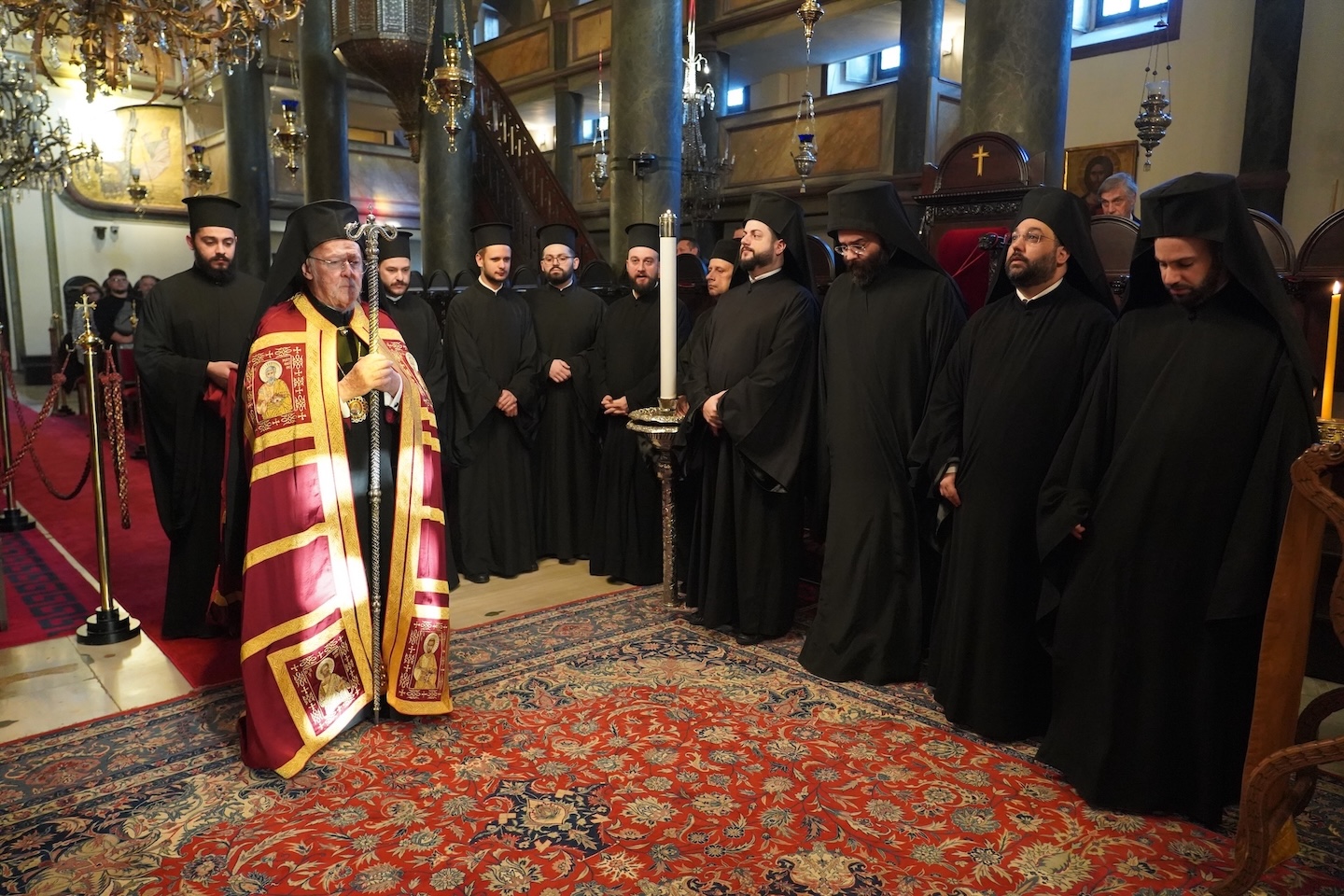
His All-Holiness Ecumenical Patriarch Bartholomew, in his message for Holy and Great Lent 2026, dispels some common misconceptions about the nature and purpose of asceticism, the self-denial and abstinence from worldly pleasures that is the hallmark of this holy season. His All-Holiness offers practical guidance and wisdom suffused with the love of Christ regarding how Orthodox Christians should regard asceticism, and how to take full advantage of the spiritual riches of self-denial and discipline.
Holy and Great Lent, the Ecumenical Patriarch stated, is “the arena of ascetic struggle, the time of fasting and repentance, of humility and prayer, of spiritual vigilance and love.” The focus of all this, however, was not on a prideful sense of accomplishment, or, indeed, on any earthly goal; instead, the faithful should approach the Great Fast “with the eyes of our heart directed to the life-giving Cross of the Lord, which guides us all toward Holy Pascha that opens the gates of Paradise to the human race.”
His All-Holiness noted that Holy and Great Lent gives us “an opportunity to comprehend once more the truth of asceticism according to Christ,” which provides a markedly different view of self-denial from what a worldly perspective offers. The Ecumenical Patriarch emphasized the “inseparable association” of Christian self-denial “with the Eucharistic realization of the Church, whose every expression and dimension is illumined by the light and joy of the Resurrection.”
Christian asceticism is, therefore, not a rejection of the good of this world, but a recognition that all of that good comes from Almighty God and takes on its particularly beauty in the Light of Christ. “Unfortunately, and inaccurately,” His All-Holiness pointed out, “Christian asceticism has been labelled by contemporary thinkers as a denial of the joy of life and as a restriction of human creativity. Nothing could be further from the truth! As release from ‘having’ and from attachment to the possession of things, and especially as liberation from the ego, from ‘seeking one’s own,’ and from the ‘having of our being,’ asceticism is the source and expression of genuine freedom.”
The idea of self-denial as the source and expression of genuine freedom is, His All-Holiness stated, not some alien concept that has been incorporated into Christianity: “The spirit of asceticism is hardly a foreign element introduced into Christianity, nor is it the result of influence by dualistic ideologies outside the Church.” He explained that “asceticism is another word for the Christian existence, connecting it with absolute trust in Divine Providence, with the inexhaustible spiritual gladness of a life dedicated to Christ, with self-transcendence and self-offering, with charitable love and respect for all creation.” The self-denial of Great and Holy Lent is thus fundamentally joyful, an acknowledgment of the fact that in Christ, we “have life, and have it abundantly” (John 10:10).
His All-Holiness also stated that the Church, in her divine wisdom, guides the Christian’s ascetic life and helps him or her guard against excesses and erroneous perspectives. “Asceticism,” he said, “is not a matter of self-willed choices and subjective particularities, but of submission to the rule and the ‘catholic experience’ of the Church. It has been described as an ‘ecclesiastical’ rather than an ‘individual’ event. Life in the Church is indivisible. Repentance, prayer, humility, forgiveness, fasting, and philanthropic deeds are interconnected and interwoven. In the Orthodox tradition, there is no asceticism as an end in itself, for that only leads to an overestimation of individual effort and feeds tendencies of self-justification.”
“Great Lent,” His All-Holiness continued, “is the appropriate time to experience the Church as the place and the manner in which the gifts of divine Grace are revealed, always as a foretaste of the joy of the Lord’s Resurrection, the cornerstone of our faith and the all-radiant horizon of ‘the hope within us.’” He reminded us also of the role of the saints as our intercessors as we travel upon this sacred journey: “It is by divine inspiration that the Church honors on Cheesefare Saturday the sacred memory of saintly men and women who have shone brightly in asceticism, for they are the supporters and companions of the faithful in the long course of asceticism. In the arena of spiritual struggle, we have the benevolence of the Triune God with us, the protection of the All-Holy Mother of God and Mother of us all, and the intercessions of the saints and martyrs of the faith.”
Above all, the Ecumenical Patriarch stated, “healthy Christian asceticism is the participation of the whole human being—as a unity of spirit, soul, and body—in the life in Christ, without undervaluing matter and the body, and without a Manichaean reduction of spirituality. As it has been written, Christian asceticism is ultimately a struggle ‘not against, but for the body’; as the Gerontikon affirms: ‘We have been taught not to destroy the body, but to destroy the passions.’” The Gerontikon is a spiritual treasury of the wisdom of the saints.
His All-Holiness also notes that “our hymnology speaks of the ‘spring of fasting,’ while theology calls Great Lent a ‘spiritual spring’ and a ‘period of joy and light.’” May we all, by God’s grace, partake fully of this joyful springtime.