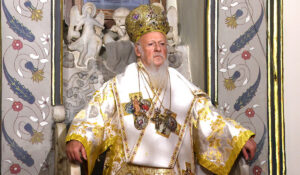
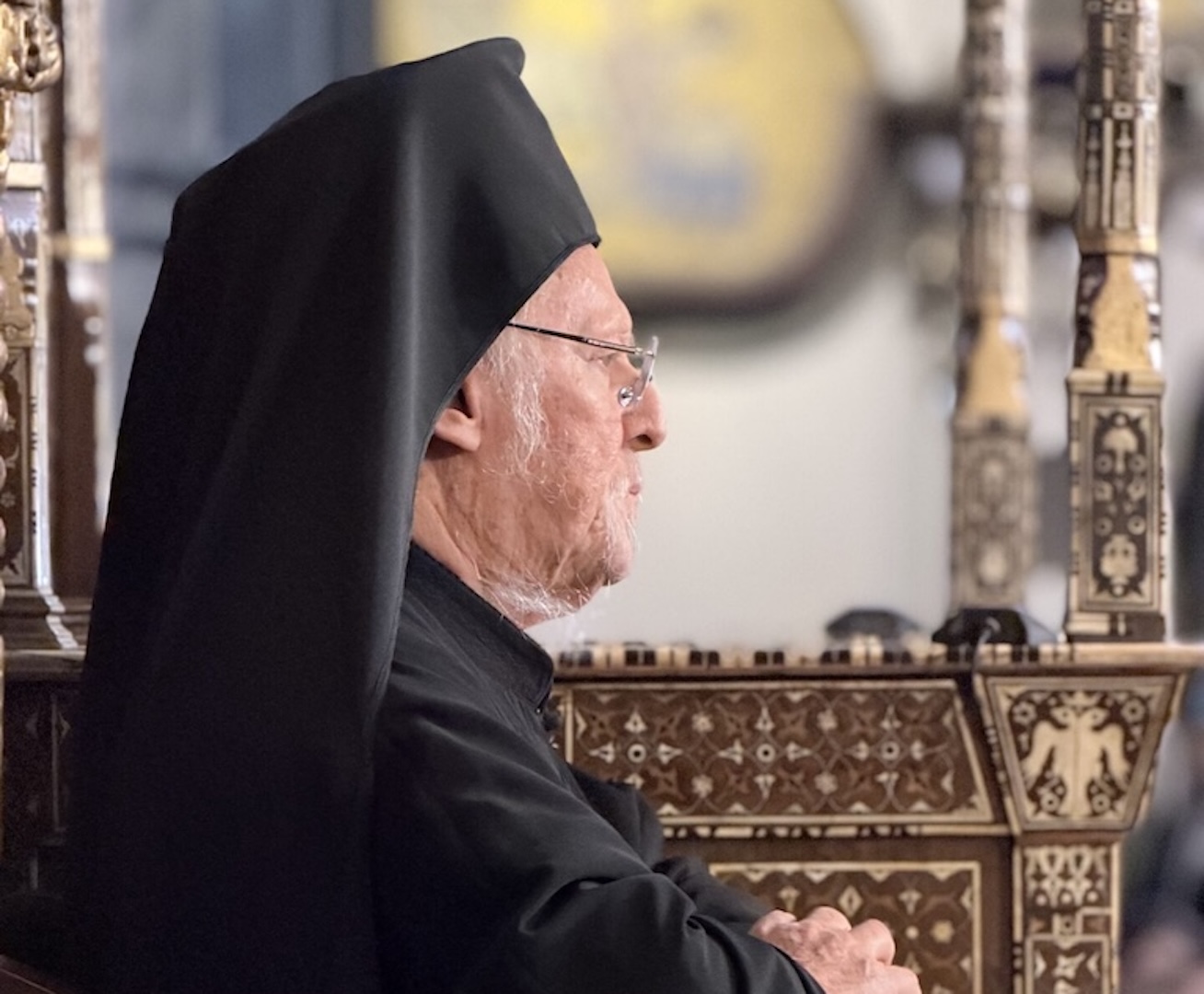
At the Divine Liturgy of the Presanctified Gifts on Clean Tuesday, February 24, 2026, the Feast of the Finding of the Precious Head of the Prophet, Forerunner, and Baptist John, His All-Holiness Ecumenical Patriarch Bartholomew spoke with deep conviction regarding the unprovoked, unjust, and fratricidal Russian war against Ukraine.
His All-Holiness began by noting that in the Liturgy of the Presanctified Gifts, “we receive the Body and Blood of our Lord—gifts already sanctified—not for momentary consolation alone, but that we might carry that sacred life into the world’s shadows. This Liturgy invites us to intercede deeply; it is the Church’s way of breathing through the pain of a wounded world.”
He then spoke specifically of the pain of the world as the Ukrainian people are experiencing it now: “On this same day, another weight rests upon our hearts. Four years have now transpired since the full-fledged armed assault against the sovereignty of Ukraine was unleashed—a relentless campaign that has scarred the land and fractured the lives of countless families. We see the empty chairs at the table: mothers and fathers waiting for children, wives for their husbands, and young boys and girls searching the horizon for a father’s return. Towns that once bustled with life are now silent, their rooftops shattered, and their streets emptied. So many endure displacement, longing for the familiar threshold of a home that may no longer exist.”
The Ecumenical Patriarch spoke frankly about how easy it is for people to become accustomed even to this level of pain and grief, to the extent that they grow cold regarding the suffering of the Ukrainian people: “As the years accumulate, there is a natural human reaction to numbness—a slow blunting of sorrow so that life might simply go on. And yet, we cannot permit the world to view this ongoing tragedy as ordinary or inevitable. Each casualty is not a statistic; it is a sacred life, bearing the unique imprint of God. We must guard our hearts against a hardened indifference, for to forget the suffering of others is itself a form of spiritual impoverishment.”
The lesson of the Feast of the Finding of the Precious Head of the Prophet, Forerunner, and Baptist John, said His All-Holiness, can inspire the faithful to resist that impulse to indifference. “On this holy day, too,” the Ecumenical Patriarch stated, “the Church commemorates the First and Second Finding of the precious head of the Holy Prophet, Forerunner, and Baptist John. He was a herald of truth whose testimony was so unsettling to the powers of his day that they sought to silence him through violence. His voice was stilled, and the instrument of his witness was hidden in the earth. Yet truth could not be confined; it re-emerged, moving beneath the surface until its hour of revelation.”
Relating the enduring power of the truth that the Holy Prophet, Forerunner, and Baptist John to the war in Ukraine, His All-Holiness continued: “This ‘finding’ reminds us that those who bury the truth succeed only in delaying its appearance. This image resonates with the endurance of the Ukrainian people. For centuries, they have preserved their faith, their language, and their cultural heritage amid pressures to disappear into the shadows of larger empires. Attempts to suppress the spirit of a people may inflict deep wounds, but they cannot annihilate the life within them. The yearning for freedom and the ability to live according to one’s own conscience are God-given realities that cannot be expunged by force.”
His All-Holiness then reiterated the Ecumenical Patriarchate’s unstinting support for Ukraine. He said that “suffering anywhere in Ukraine is felt here at the Phanar, for when one member of the Body of Christ is pierced, the whole Body bleeds.” He explained that “what we seek is not a mere cessation of hostilities, but a genuine, just, and lasting peace. A battlefield without gunfire is not always peace; it may be an uneasy silence, fatigue mistaken for tranquility, or surrender masquerading as calm. A true concord requires the restoration of what was violated and the recognition of a nation’s right to determine its own destiny. It is a moral imperative that a people’s future cannot be negotiated in secret or decided without their full and equal participation. Anything less is not peace; it is merely injustice given a diplomatic name.”
Addressing the Ukrainian people directly, the Ecumenical Patriarch said: “The Church will not abandon you. We remain present in prayer and in action, committed to standing with Ukraine through every step toward a day of authentic reconciliation. Just as the John the Baptist’s witness survived the efforts to entomb it, so too shall the dignity of Ukraine emerge from this trial, vindicated and free.”
His All-Holiness concluded: “May the Lord grant you resilience. May He inspire the leaders of nations to pursue the narrow path of justice. And may the light of Christ, which no darkness can extinguish, shine upon Ukraine and upon all the world.” Amen.