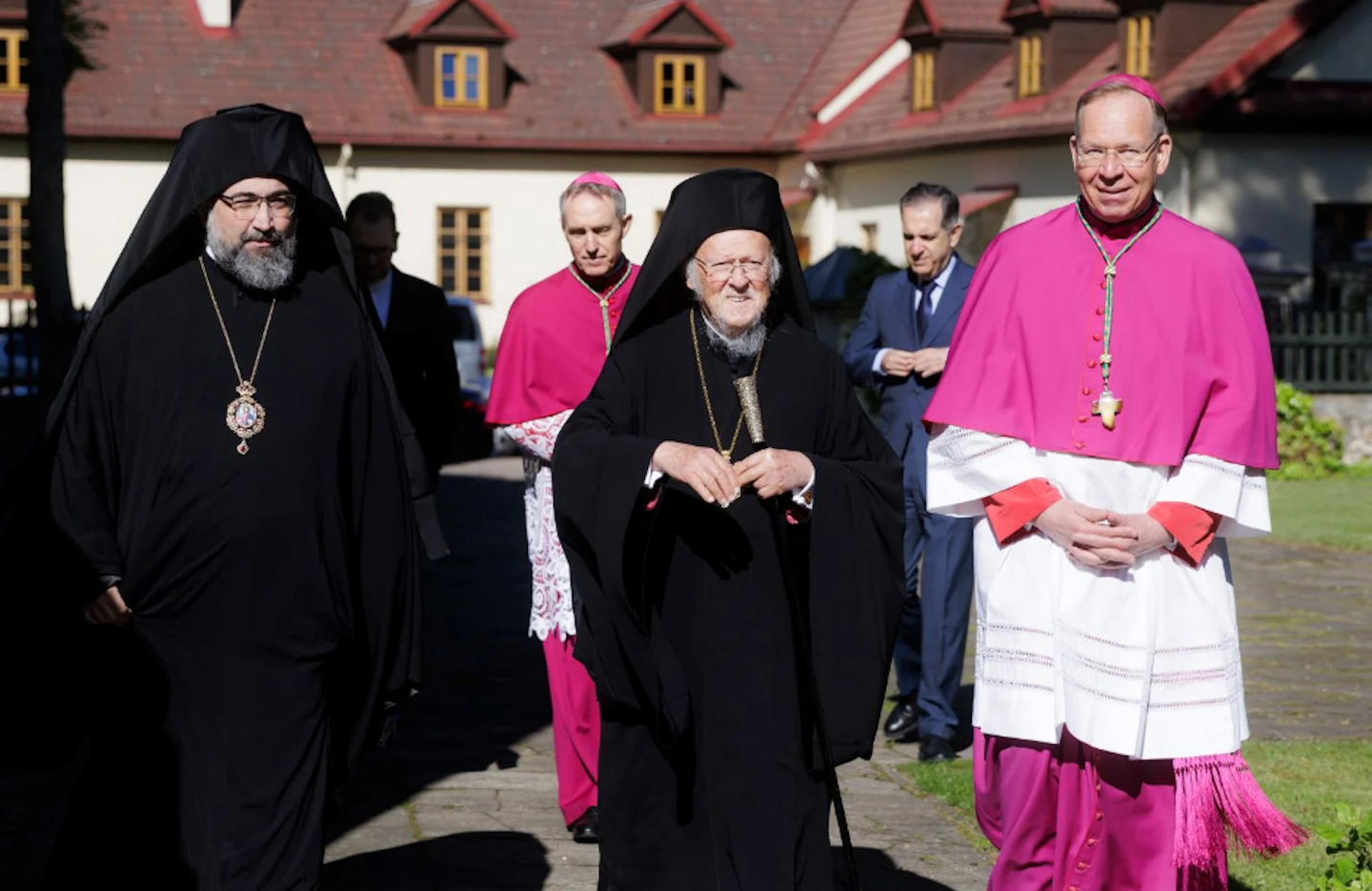
Ecumenical Patriarch Bartholomew delivered a powerful reality check in Lithuania regarding the long-standing divisions within Christianity. Speaking at a Roman Catholic conference this month, at the invitation of Archbishop Gintaras Grušas, the leader of the Eastern Orthodox Church held nothing back. The Ecumenical Patriarch openly addressed what he called “the agony of divided Christianity,” a painful reality that many modern believers simply ignore.
So, how did the Church get so fractured in the first place? According to the Ecumenical Patriarch, the root issues are deeply historical, political, and psychological.
The Weaponization of Faith
Historically, theology stopped being just about understanding God and turned into a political tool. The Ecumenical Patriarch explained that faith became a state ideology. Instead of uniting people, religious teachings were used by rival governments to mark geographical borders and fuel political conflicts. This political hijacking made genuine discussion and compromise practically impossible.
Over the centuries, these political divisions morphed into deep-seated grudges. The Ecumenical Patriarch noted that Christian communities eventually built their entire identities around past trauma.
Instead of moving forward, different traditions began defining themselves by the wrongs others inflicted on them. He even pointed the finger at his own tradition, noting that many Orthodox Christians remain psychologically trapped in the year 1204, when Western Crusaders sacked the city of Constantinople. Meanwhile, he noted, the West remains equally absorbed in its own historical resentments.
This ongoing bitterness completely undermines the Church’s message today. It is incredibly difficult to preach peace to the world when the Church itself cannot heal its own bleeding wounds.
Shift from Guilt to Healing
Fortunately, the Ecumenical Patriarch offered a profound way out of this deadlock, drawing on a beautiful linguistic connection. In the traditional Greek language of the Church, the word for mercy (eleos) sounds almost identical to the word for olive oil (elaion).
This similarity shifts the entire conversation. Instead of focusing on who is guilty, the focus shifts to treating an illness. The Church should look at its divisions not as a courtroom battle, but as a medical emergency requiring soothing, medicinal oil.
To actually achieve unity, Christian communities have to take two difficult steps:
Drop the illusion of innocence: Every tradition must admit it played a role in the split.
Strip away the baggage: Churches need to separate the core, life-giving message of the Gospel from centuries of political and cultural baggage.
By clearing away historical grievances, different Christian traditions can finally talk to one another with authentic mercy and humility, paving a realistic path toward the unity they are called to practice.