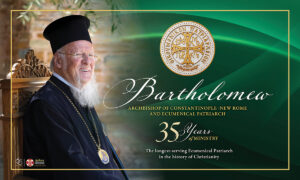
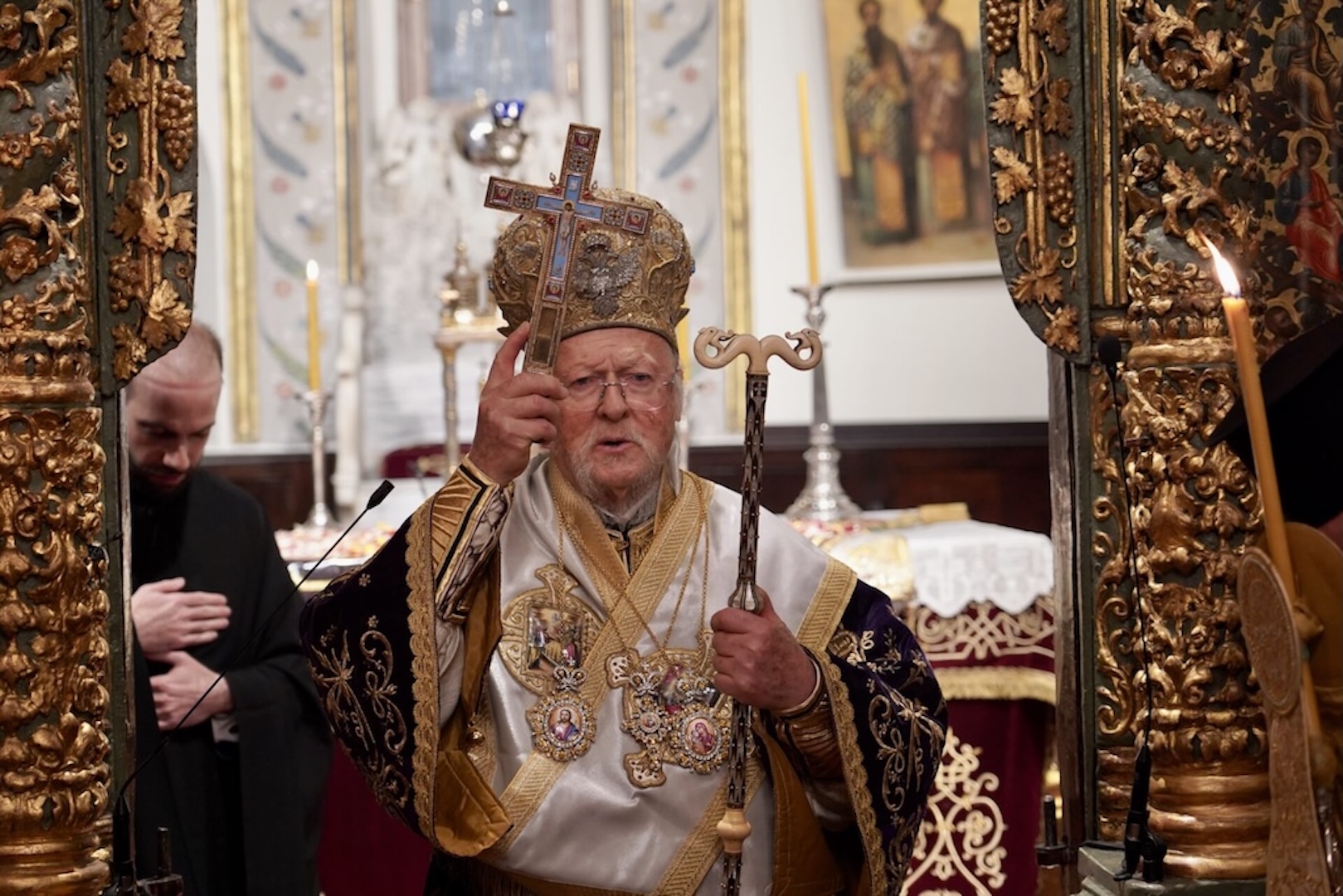
At the historic Institut de France in Paris on Monday, March 30, 2026, His All-Holiness Ecumenical Patriarch Bartholomew was formally admitted as an Associate Member of the French Academy of Moral and Political Sciences. His All-Holiness received this singular honor on April 28, 2025, when French President Emmanuel Macron signed the decree granting to him the Chair of the Academy that Joseph Ratzinger, who later became Pope Benedict XVI of Rome, previously held.
In his inaugural address as an Associate Member of the Academy of Moral and Political Sciences, the Ecumenical Patriarch offered an extended reflection upon the wisdom of Pope Benedict XVI, explaining how much his thought coincided with the Orthodox understanding of Christian theology, thus helping pave the way for the ultimate reconciliation of the Churches of Constantinople and Rome. In this course of these observations, His All-Holiness presented his own profound insights into the nature of the human person, the enduring relevance of the Fathers of the Church, the role of the Church in the contemporary world, and a great deal more.
His All-Holiness explained how Joseph Ratzinger had spent his youth in a Germany that was torn apart by two competing totalitarian ideologies: National Socialism and Communism. Ultimately, the Ecumenical Patriarch continued, “he arrived at an intuition already prepared by the great figures of the ‘New Theology’ and of Orthodox thought: a return to the Fathers that was not a flight into the past, but a rediscovery of the living sources of the faith—attested to, on the Catholic side, by Henri de Lubac and Yves Congar, and on the Orthodox side, by the Russian theologians in exile, Georges Florovsky and Vladimir Lossky, who found refuge in the West and opposed—through both their words and their lives—the totalitarian system of Soviet Communism and its interference in the life of the Church.”
As Pope of Rome, His All-Holiness said, Benedict XVI continued to stress the Church’s answers to the alienation and rootlessness of contemporary society, and countered the modern tendency to reject religion as unscientific. The Pope, said the Ecumenical Patriarch, “bore singular witness to the fact that faith and reason are not opposed, but rather support and enlighten one another. In his trilogy Jesus of Nazareth, he offered a Christocentric reading of Scripture, charting a path where scholarly inquiry and faith do not exclude one another, but instead meet.”
The Ecumenical Patriarch noted one key correspondence between the thought of Pope Benedict XVI and that of the Holy Fathers: its consistent Christ-centeredness. “His theological work—at once biblical and patristic—is entirely oriented,” His All-Holiness explained, “toward this fundamental conviction, which he never ceased to reiterate: truth is not an abstract idea, but a person—Christ himself, ‘the Way, the Truth, and the Life.’ In fidelity to the shared heritage of the Church Fathers of both East and West, he affirmed that the Incarnate Word constitutes the principle of intelligibility for both the world and history.”
Ecumenical Patriarch Bartholomew further elaborated on the significance of this emphasis on the centrality of Christ, particularly for our rootless and confused age, stating: “That is why Benedict XVI believed that the current crisis of our societies is not primarily a moral crisis, but a crisis of truth. His analysis of relativism touched upon both anthropology and epistemology: when truth is reduced to an arbitrary construct, faith itself is reduced to a subjective experience. His response rested upon an ontology of the Logos—understood as the historical encounter between divine revelation and human reason, elevated, transformed, and brought to fulfillment through the Incarnation.” His All-Holiness added “on the pastoral level,” Pope Benedict “forcefully reminded us that the spiritual crisis of our time finds its origin in the forgetfulness of God, and that the rediscovery of the transcendent dimension of human existence is an essential prerequisite for the dignity of the human person and for world peace.”
Once humanity removes Christ from its search for meaning in the world, that search becomes fruitless and misleading: “Without being rooted in truth, liberty becomes arbitrary, equality devolves into mere leveling, and fraternity becomes a mere moral exhortation devoid of any unifying power. In this sense, Benedict XVI’s thought reminds us that these ideals find their ultimate foundation not merely in social conventions, but in the truth of man himself—created in the image of God and called, through theosis, to become a reflection of the divine within history.” The Ecumenical Patriarch called for “the tireless pursuit of a truth that does not divide, but unites; that does not dominate, but serves. For only such a truth can establish a just order and open up the horizon of a future in which liberty, equality, and fraternity are not merely proclaimed, but truly lived.”
These remarkable reflections of His All-Holiness call for, and reward, a great deal of careful thought. Just as he paid tribute to Pope Benedict XVI of Rome at the Academy of Moral and Political Sciences, let us pay tribute to Ecumenical Patriarch Bartholomew himself, and thank our loving God for bestowing this extraordinary and holy personality upon His Holy Church in our age.