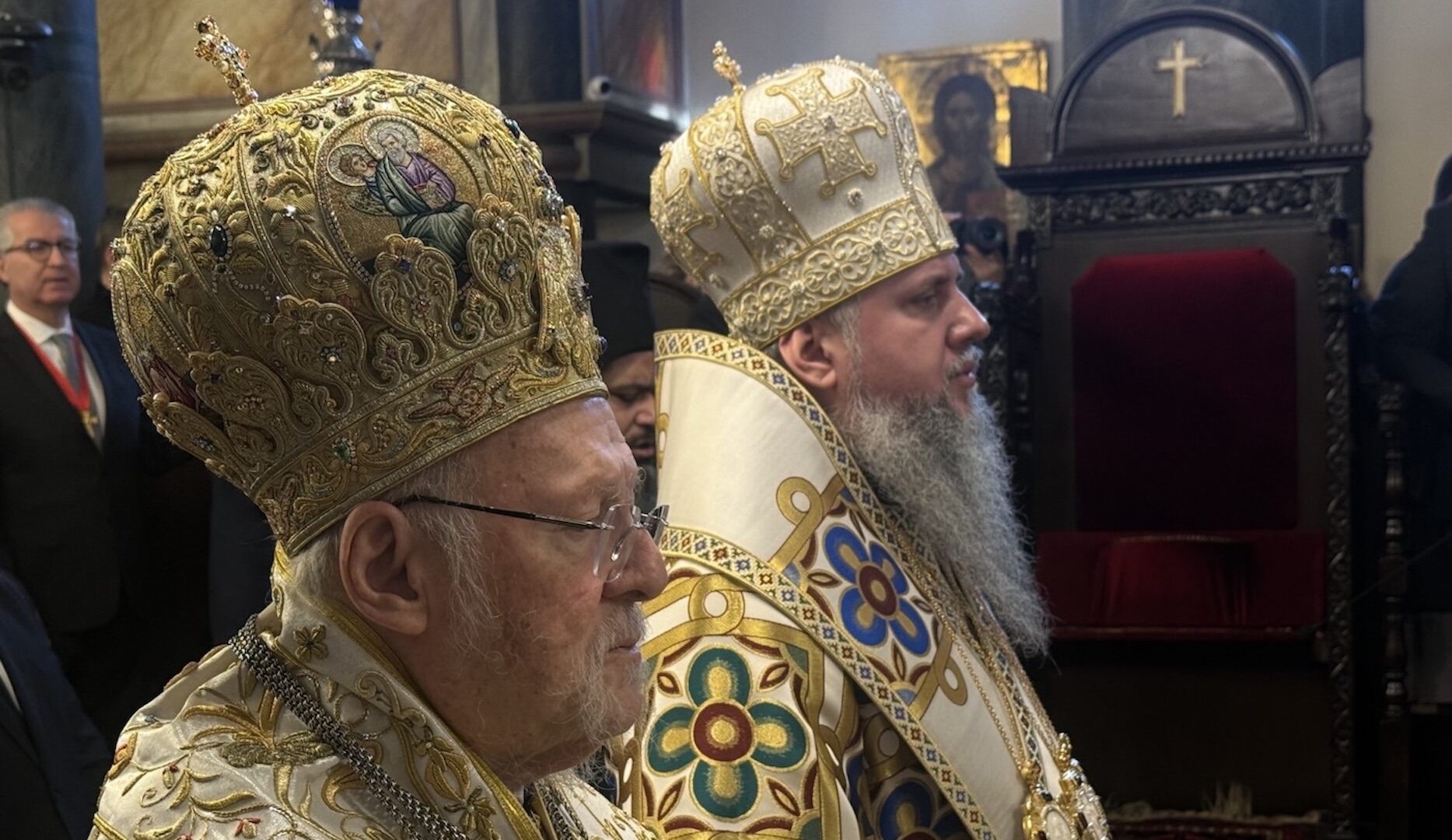
His All-Holiness Ecumenical Patriarch Bartholomew on the Feast of Theophany, January 6, 2026, issued an appeal to the Ukrainian hierarchy under Metropolitan Onufriy to reconsider its stance against unification of the Orthodox Christian faithful in Ukraine, and explained once again the reasoning behind his grant of autocephaly to the Orthodox Church in Ukraine on January 5, 2019.
“Our motives,” His All-Holiness said, “were entirely ecclesiological. We were not guided by expediency, nor did we make a hasty or superficial judgment on this long-standing issue, as some have accused us. As was our duty, we received the repeated urgent appeals submitted to us. Even before receiving these appeals, and beyond the responsibility derived from the urgent nature of the matter, we took the initiative to mediate and bring peace to all parties.”
In a September 2025 interview, the Ecumenical Patriarch explained in detail the ecclesiological reasons behind this decision: “At that time, our Patriarchate took this decision, believing, on the one hand, that it was the rightful claim of the Church of Ukraine to obtain her autocephaly, following repeated petitions to the Ecumenical Patriarchate—not only in recent years, but far earlier, at least as early as 1919–1920, perhaps even earlier.
And when Ukraine became a sovereign, independent state after the dissolution of the Soviet Union, its bishops requested autocephaly from Russia. That was a mistake—they should have addressed their petition to the Ecumenical Patriarchate. And you will know that the request they submitted to Moscow for autocephaly was signed by Metropolitan Onufriy, though not at that time as Metropolitan of Kyiv; he then held another title.”
His All-Holiness continued: “According to the Ecumenical Patriarchate, Ukraine has the right to obtain autocephaly, and every sovereign state has the right to have its own independent local Church. On the other hand, it is the Ecumenical Patriarchate alone—and none else—that possesses the authority to grant autocephaly, as it has done for all the Churches I have mentioned, beginning with the Church of Russia in the 16th century and continuing through the 19th and 20th centuries with all the Churches of the Balkans.” He emphasized: “We did what was self-evident—that the Ukrainians should have their own Autocephalous Church. We exercised the canonical right that belongs to us, and to us alone, to bestow that autocephaly.”
In light of that, His All-Holiness called upon Orthodox Christians in Ukraine, both those who recognize the jurisdiction of His Beatitude Metropolitan Epiphaniy and those who recognize the jurisdiction of Onufriy, “to unite, not only theoretically but in the practical realities of daily life, to become one local Church and to be recognized by all the other sister Orthodox Churches. I believe this will happen, sooner or later. We must not be impatient, expecting it to occur overnight.”
Reminding his audience of the lessons of history, the Ecumenical Patriarch stated: “Let us remember that the autocephalies of other Churches were not recognized immediately either. There was always a period before they became a matter of common acceptance among the other sister Churches. I am convinced that, with God’s grace and the goodwill of our Orthodox brethren, this will happen in the coming years, or perhaps decades. In any case, the Ecumenical Patriarchate will never retreat, nor revoke the autocephaly it has granted to Ukraine—and in this I wish to be perfectly clear.”
In his Theophany 2026 address, the Ecumenical Patriarch renewed this call for unity, recommending that all of those involved abandon “the obsessive certainty that each side alone possesses the absolute truth.” He added: “As the Church’s experience teaches us, such cases require sacrifices to find a golden mean. In ecclesiastical life, justice always favors the weak. The Church’s approach to justice differs from that of the secular system. In our faith, the strong are the weak—those who recognize their errors with a sincere intent to repent. Recognizing past events, we forgave the wayward and restored the canonical order in Ukraine as defined by the Great Church of Christ before it was violated.”
His All-Holiness also prayed for an end to Russia’s unprovoked and unjustifiable fratricidal war in Ukraine: “We pray to the Lord to end this monstrous and inhumane state of war. Once again, as we have done many times before, we call upon the Ukrainian hierarchy under Metropolitan Onuphrius to reconsider its stance.” Condemning extremism in Ukraine “wherever it comes from,” he reiterated: “We are offering one more opportunity and inviting unity, while apologizing if our silence gave the impression to some that we held any perspective other than an ecclesiastical one regarding this entire matter.”
The Archons of the Ecumenical Patriarchate pray and hope that His All-Holiness’ prophetic call for unity will be heeded.