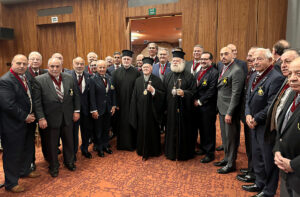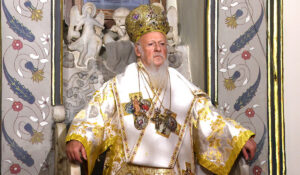
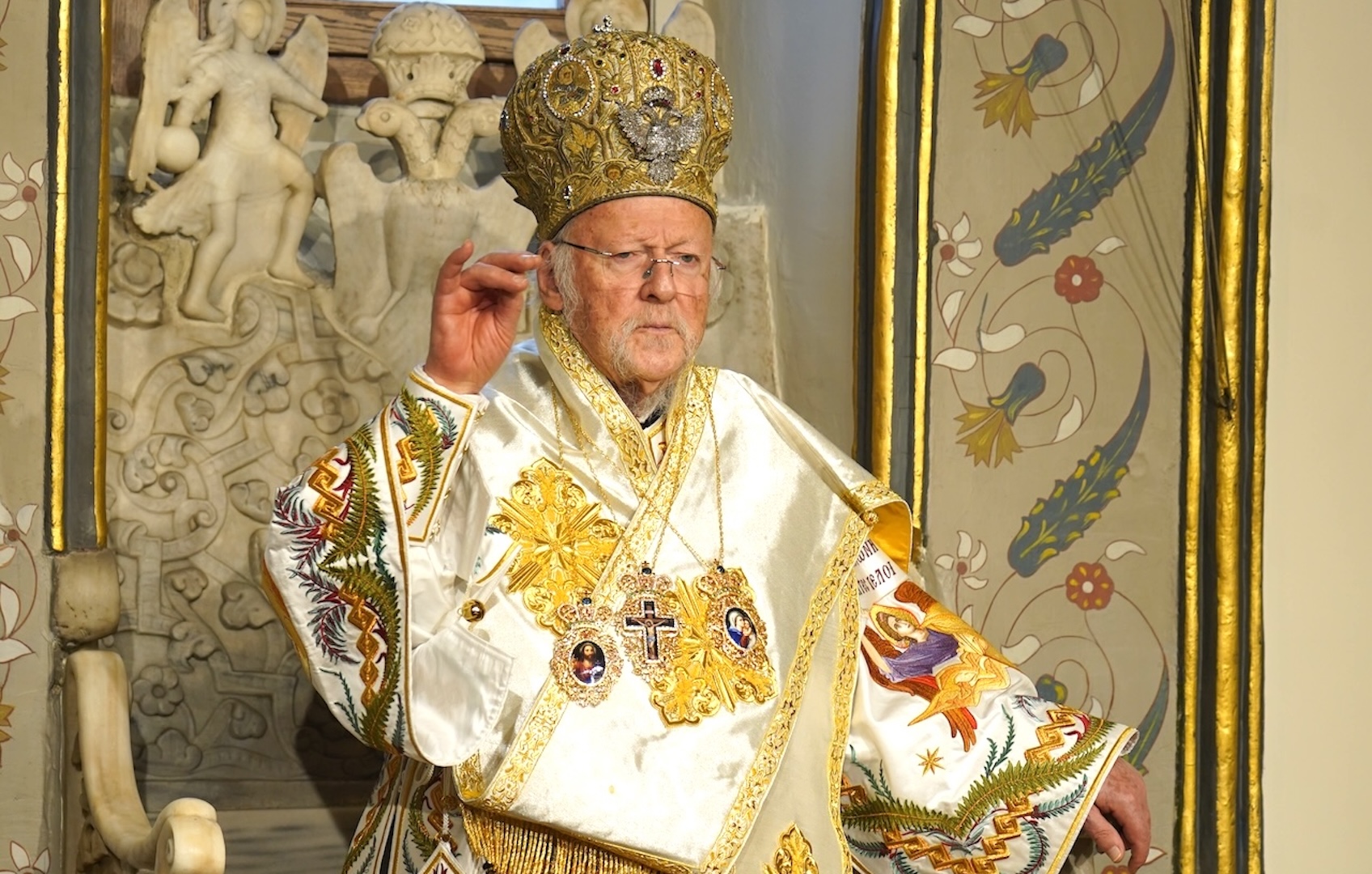
On Sunday, March 1, 2026, the Sunday of Orthodoxy, His All-Holiness Ecumenical Patriarch Bartholomew offered a series of reflections on the profound significance of this feast of the triumph of Orthodoxy, explaining how it is much more than just an observance of the historical fact of the restoration of the use of holy icons in the Church’s worship, after a period in which the sacred images were wrongly rejected. His All-Holiness emphasizes that the Sunday of Orthodoxy is a celebration of the sanctification of the entire creation, as demonstrated in the Incarnation of the Lord Jesus Christ, and then in the deification of matter that the holy icons reflect.
His All-Holiness said that “on this great feast of the triumph of Orthodoxy, the Church resoundingly confesses the truth of the Incarnation of God the Word.” This is because, he explained, the Sunday of Orthodoxy is “by no means confined to a picturesque or dry commemorative remembrance of the restoration of the holy icons, nor does it constitute a simple aesthetic event, but rather it constitutes the foundational anthropological and dogmatic proposition that matter itself becomes henceforth capable of containing the uncreated grace, that the human person is sanctified in its entirety and that history does not constitute the closed and inescapable space of condemnation.” This is the fundamental truth of the divinity of Christ, as well as in the sacredness of the holy icons.
“Matter,” His All-Holiness continued, “is deified. The entire creation is sanctified. For this reason, especially on this day we lift once again our hearts to our Lord and Savior Jesus Christ, fervently praying for the prevalence of peace into our deeply troubled world, which is tragically afflicted by war, conflict, violence and bloodshed. May the Prince of Peace hearken to our prayer, strengthen those who strive for the restoration of peace and have mercy on us all!”
In praying for peace in this context, the Ecumenical Patriarch was drawing out the full meaning of what it means that matter is deified and the entire creation, including the human person, is sanctified. If we are to act in light of that eternal truth, then violence and bloodshed become all the more abhorrent, for they are a transgression against the holiness with which Almighty God has endowed His creation.
His All-Holiness also stated that “this deposit of the Incarnation, indelibly stained with the testimony of the confessors and the sacrifice of the martyrs of the faith, the Mother Church of Constantinople has preserved inviolate for centuries now, bearing upon her shoulders the heavy cross of responsibility for the stability and welfare of the Churches of God.”
It was with this deep insight into the meaning of the Incarnation of the Lord that the Ecumenical Patriarch stated in November 2025: “For the Christian, life ultimately has a sacred meaning. Every action must be a service to God—the Creator and Savior—and also to one’s fellow human being, the beloved of God. When this is our vision of life, there is no room for pessimism or despair. Beyond the temporary and visible, we see the eternal and invisible realities for which we were created and toward which we strive.” Referring to Russia’s unprovoked and unjustifiable war in Ukraine, he again emphasized that it is a profound offense against God Himself: “As we have said many times, this war is not ‘holy’—it is diabolical. It is blasphemy to call ‘soldiers of Christ’ and ‘heroes of the faith’ those who are ordered to take human lives in the name of the Giver of Life.”
In contrast to the desecration that the war represents is the sanctification of creation that the holy icons manifest. That is one reason why the Ecumenical Patriarch has pointed out that the Virgin Mary, honored as the “cause of the deification of all” and “the bridge that leads those on earth to heaven” in the Akathist Hymn, holds a central place in Orthodox spirituality. His All-Holiness noted in March 2025 that “the icon of the Theotokos holding Christ in her arms is the living center of our Orthodox identity — the very heart of the Church’s Christology.” Accordingly, he said, “the Annunciation is the anniversary of the birth of human freedom. It proclaims the most joyful news ever heard on earth: the regeneration of the human race.”
That regeneration, as demonstrated in the holy icons, is celebrated on the Sunday of Orthodoxy.