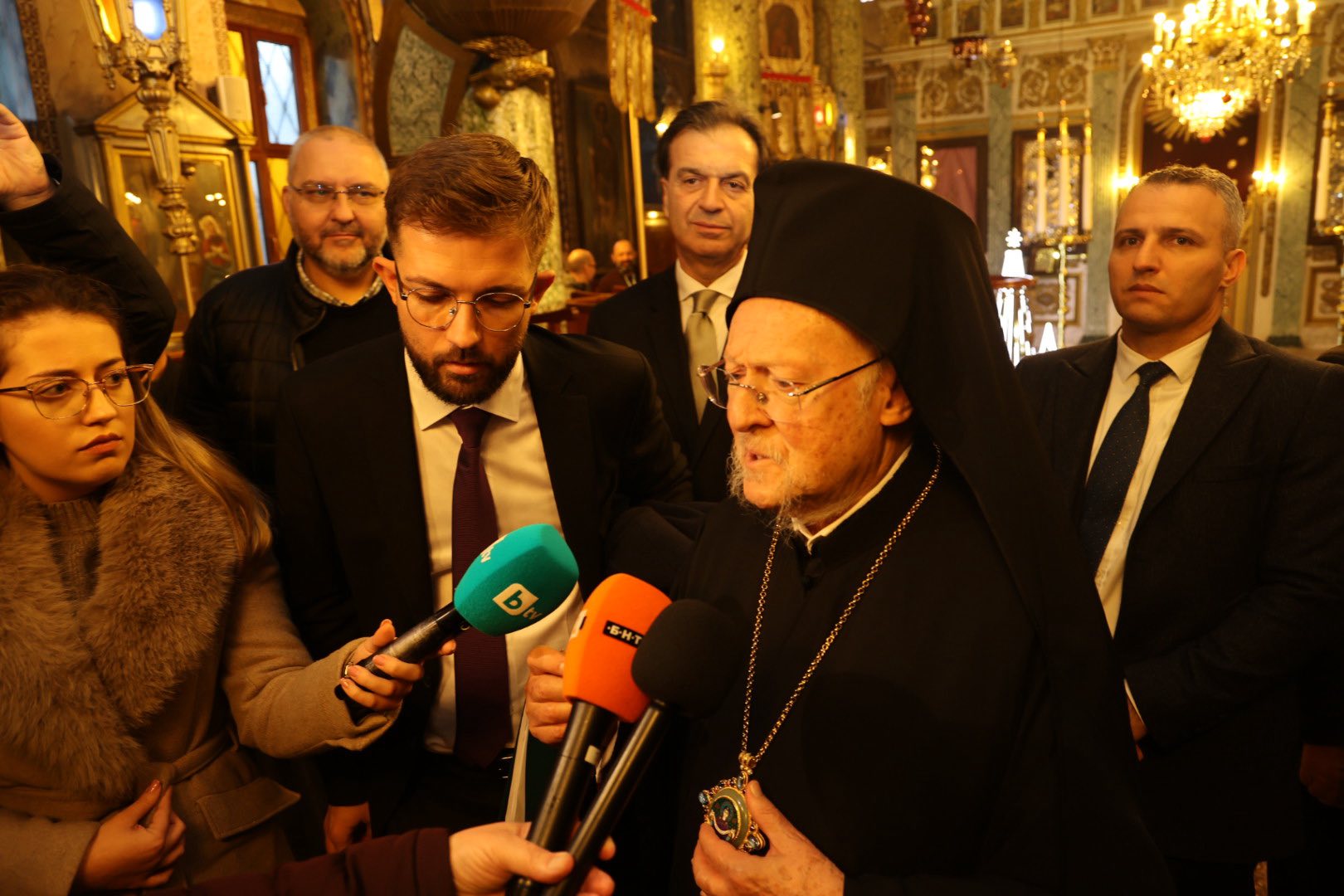
In an age in which the devaluation and dehumanization of human beings who are made in the image of God has become distressingly commonplace, His All-Holiness Ecumenical Patriarch Bartholomew spoke with a strong and unequivocal prophetic voice on Friday, December 19, 2025, at the 5th International Conference on Ecological Well-Being, “Decisions on the End of Life,” which was held at the Marasleio School in the Phanar.
His All-Holiness spoke frankly regarding euthanasia, pointing out that the 3rd Conference of the Bioethics Committee of the Ecumenical Patriarchate, which was held in Crete in October 2025, termed it “one of the most delicate and complex issues confronting contemporary societies.” The Ecumenical Patriarch emphasized that in dealing with this challenge, the Church’s response “must always be articulated with pastoral sensitivity and not through generalizations or a legalistic mindset.”
Orthodox Christian believers, said His All-Holiness, must “care for those at the final stage of life.” He noted, according to Orthodox Times, “the Church’s encouragement of the establishment of palliative care centers and its appeal to each person to devote time and energy to caring for patients in their homes. In such settings, he noted, patients are embraced within a community of solidarity, feel loved, accepted, and valued, and are able to live the remainder of their lives with dignity, confidence, and security.”
Ecumenical Patriarch Bartholomew also reminded those present that the Church’s document For the Life of the World: Towards a Social Ethos of the Orthodox Church discusses this issue. It states that “the aged in the community of the faith merit a special reverence from the faithful, for the wisdom they have acquired and for the perseverance in faith that they have demonstrated.” The “illness and disability” of the aged “can provide an opportunity for deepened humility and growth in faith, both for those who are aging and for their caregivers; but it is also a responsibility that the rest of the body of Christ must never shirk. And, in the modern world, this poses special difficulties and demands for many communities.”
The document notes that “the Orthodox Church teaches that there are no limits to the innate spiritual dignity of the person, no matter how the body or the mind may be afflicted by the passage of the years.” Ecumenical Patriarch Bartholomew emphasized this in his remarks at the “Decisions on the End of Life” conference. For the Life of the World continues: “The Church must require of any just society that it provide adequately for the elderly, and make sure that they are not subjected to neglect, mistreatment, or destitution. And it charges the community of the faithful to make every effort to care for and learn from its oldest members.”
For the Life of the World also states that suicide “can never be considered a permissible solution to worldly suffering”; it adds, however, that “it is entirely permissible for those approaching death to refuse emergency medical interventions and technologies that artificially prolong physical life beyond the point at which the body would naturally surrender the spirit.” Yet “even in the case of people suffering from severe and incurable illnesses, death must not be hastened, regardless of how philanthropic such an act may appear.”
This is because euthanasia is “a practice alien to the Christian understanding of life.” This does not change the fact, however, that “it is entirely permissible for those approaching death to refuse emergency medical treatments and technologies that artificially prolong physical life beyond the point at which the body would naturally surrender the spirit. It cannot be the duty of a Christian to prolong bodily suffering out of fear of the inevitable end or to cling irrationally to this world.”
Above all, Christians, “await the resurrection of the dead and the life of the age to come,” and so death “in the grace of God should not be feared.” His All-Holiness stressed the importance of this: “We Christians insist: we resist an ‘objectified life’ devoid of the breath of resurrection and without heaven. Reality is not limited to scientific knowledge, rigid logic, and measurable data alone. There is also mystery, the depth of things, meaning, beauty, and art, which deepen rather than diminish the mystery of the world.”
In our age, His All-Holiness Ecumenical Patriarch Bartholomew stands as one of the foremost voices who speak clearly and compellingly about vexed issues of this kind; the Archons of the Ecumenical Patriarchate are grateful to God for the privilege and blessing of working to amplify his voice.