His All-Holiness Ecumenical Patriarch Bartholomew has stated that “Christian unity is an imperative, particularly in our tumultuous times, when the world is fractured by wars, violence and all kinds of discrimination, while it is devastated by the desire for domination, the quest for profit, and the unrestrained exploitation of natural resources.”
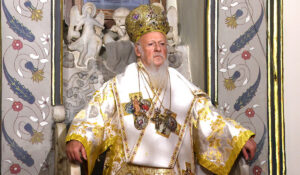
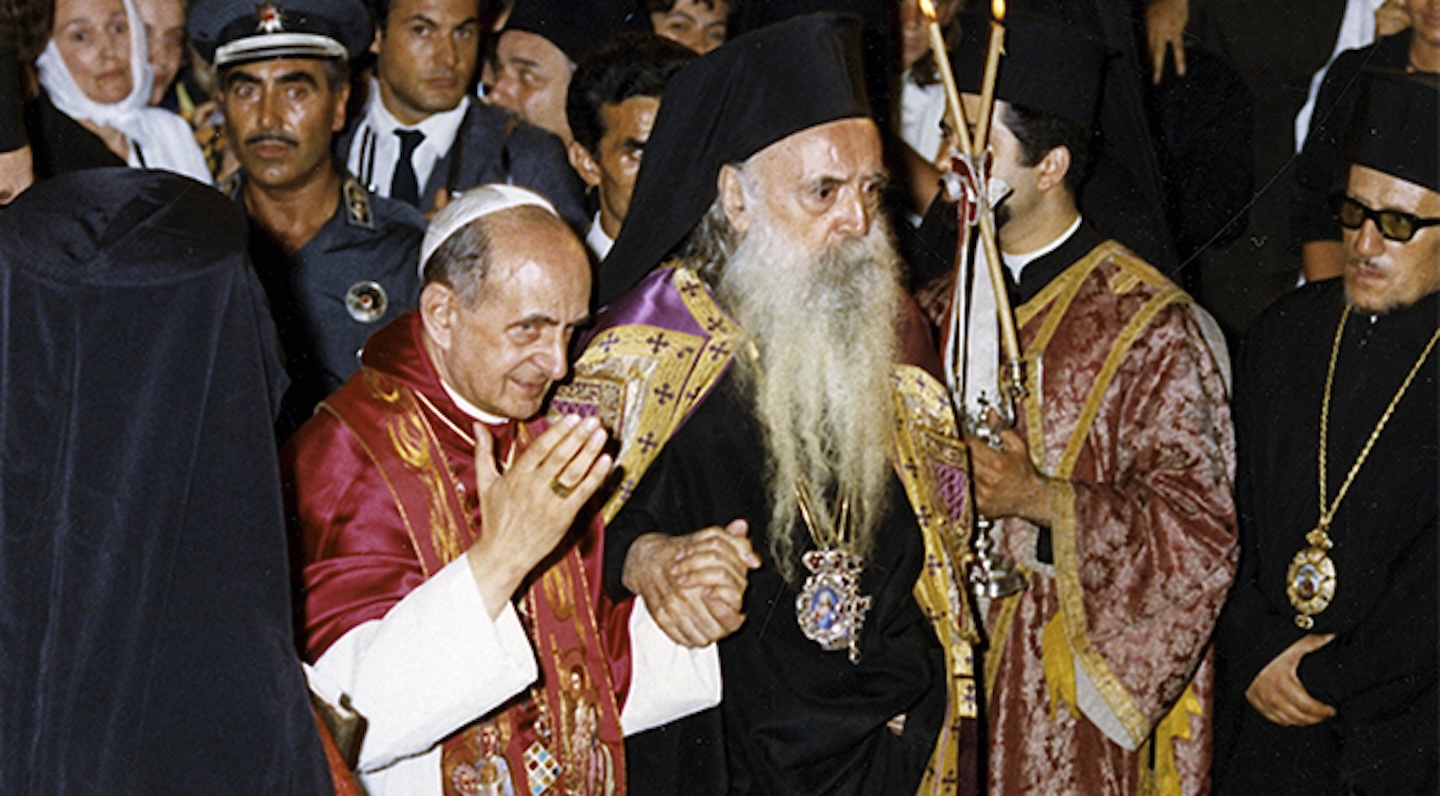
Animated by that imperative, on Sunday, December 7, 2025, at the Most Venerable Patriarchal Church of Saint George in the Phanar, His All-Holiness presided at the Divine Liturgy, during which a Doxology was offered to commemorate the 60th anniversary of the lifting of the 1054 Anathemas on December 7, 1965 by His All-Holiness Ecumenical Patriarch Athenagoras of blessed memory and His Holiness Pope Paul VI of Rome of blessed memory.
On July 16, 1054, a papal emissary to Constantinople, Cardinal Humbert, excommunicated Ecumenical Patriarch Michael Keroularios. Then on July 20, 1054, a Holy Synod in Constantinople excommunicated Cardinal Humbert and those who supported him. This became the Great Schism between the Orthodox Church and the Roman Catholic Church, which has not been healed to this day. Tremendous progress, however, was made toward the end of this tragic division six decades ago, when the Ecumenical Patriarch and the Pope removed the anathemas, that is, the formal excommunications that brought about the split between the Churches.
In their 1965 lifting of the anathemas, Ecumenical Patriarch Athenagoras and Pope Paul VI pointed out that these mutual anathemas were never intended to bring about a schism, much less one that has lasted for nearly a thousand years: “One cannot pretend that these events were not what they were during this very troubled period of history. Today, however, they have been judged more fairly and serenely. Thus it is important to recognize the excesses which accompanied them and later led to consequences which, insofar as we can judge, went much further than their authors had intended and foreseen. They had directed their censures against the persons concerned and not the Churches. These censures were not intended to break ecclesiastical communion between the Sees of Rome and Constantinople.”
In his commemoration of the sixtieth anniversary of this historic Common Declaration, Ecumenical Patriarch Bartholomew emphasized the crucial importance of healing the schism and offering the statement of Ecumenical Patriarch Athenagoras and Pope Paul as a guide. His All-Holiness stated that “in a period of increasing polarization throughout the world—including within the Christian oikoumene—this prophetic step toward unity deserves particular attention.”
Speaking about Ecumenical Patriarch Athenagoras and Pope Paul VI, His All-Holiness noted that “in their Common Declaration, they extended a decisive and sincere invitation to a new way of relating between our Sister Churches—not through ‘offensive words, unfounded accusations, and condemnable gestures,’ but through ‘the purification of hearts, the rejection of historical wrongs, and the determined will to reach a common understanding of and expression of the apostolic faith.’”
Similarly, in a 1967 Common Declaration that was a follow-up to the 1965 lifting of the anathemas, Ecumenical Patriarch Athenagoras and Pope Paul affirmed that they both recognized “that the true dialogue of charity, which should be at the basis of all relations between themselves and between their Churches, must be rooted in total fidelity to the one Lord Jesus Christ and in mutual respect for each one’s traditions. Every element which can strengthen the bonds of charity, of communion, and of common action is a cause for spiritual rejoicing and should be promoted; anything which can harm this charity, communion and common action is to be eliminated with the grace of God and the creative strength of the Holy Spirit.”
This is the dialogue of charity that Ecumenical Patriarch Bartholomew continues today with Pope Leo XIV. On December 6, 2025, the day before he observed the 60th anniversary of the lifting of the anathemas, His All-Holiness expressed his holy joy at his recent meetings with the Roman Pontiff: “We rejoice deeply, for the new Pope, just like his immediate predecessors, holds the same sincere intention concerning the great question of the unity of all. This he confirmed to us personally in both of his official addresses – at the Doxology upon his reception and during the Divine Liturgy on the feast of Saint Andrew – as well as during our private conversations. Together with him, we shall move forward, preserving the truth of our faith without compromise.”
His All-Holiness concluded: “We need your prayers – all of you! Support us through them, so that we may support the Church, and so that we may support you, the people of God, ‘that all may be one,’ to the glory of our heavenly Father.” Amen.