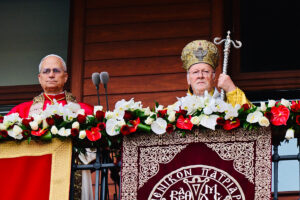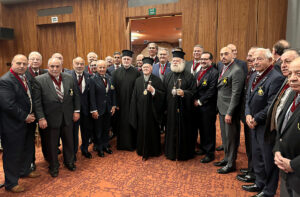
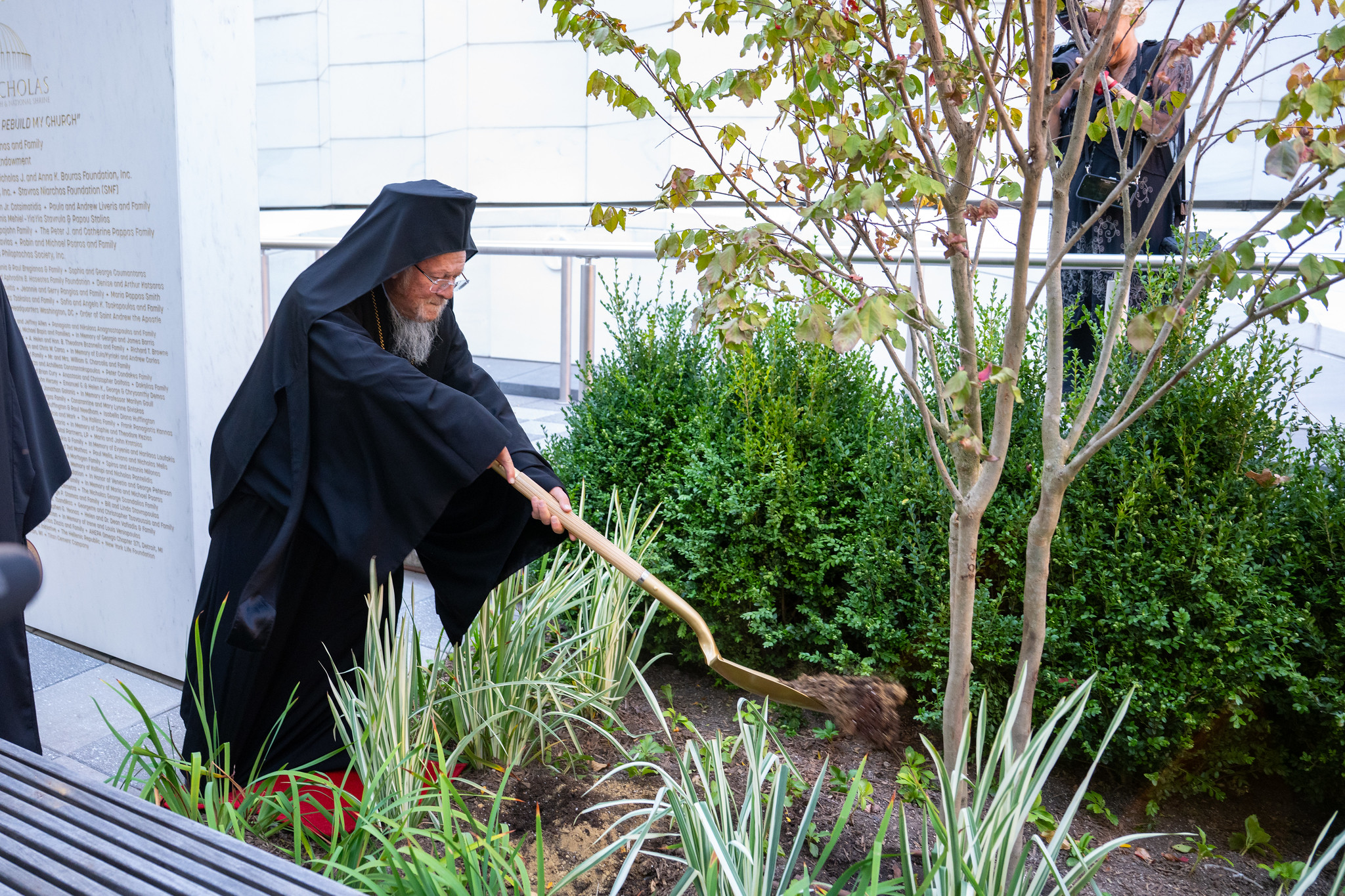
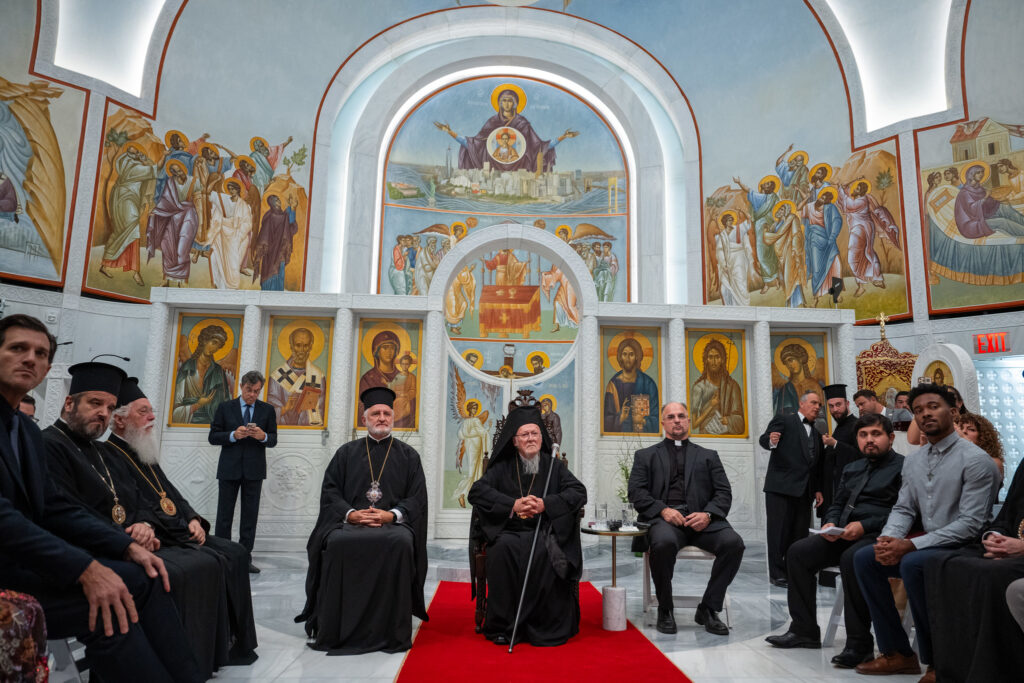
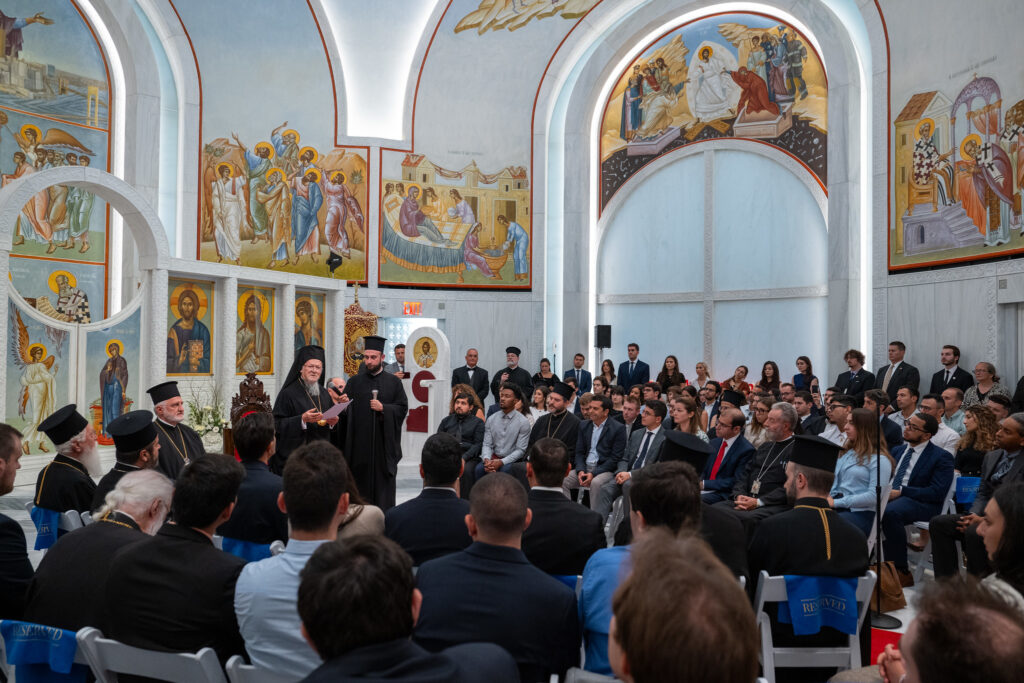
As his Apostolic Visit to the United States continued, His All-Holiness Ecumenical Patriarch Bartholomew on Friday, September 20, 2025 participated in a tree-planting ceremony outside of St. Nicholas Church and National Shrine in lower Manhattan. He then proceeded to meet with the Young Adult Leaders of New York and New Jersey of that community.
In his remarks to the youth, His All-Holiness stated: “You are much more than the future of our Church; you are also the ‘Now’ of our Church.”
The Ecumenical Patriarch also revealed that “we had an extraordinary opportunity to connect this blesséd Shrine with the Great Church of Christ: our Ecumenical Patriarchate of Constantinople, for to this day, Saint Nicholas’ Episcopal See of Myra is an integral part of the Mother Church as one of her dioceses. We brought with us soil from the Island of our birth, Imvros – which is also the native land of the ever-memorable Archbishop Iakovos of North and South America – and we planted a Myrtle Tree, a species native to Imvros, on the south side of the Shrine among Xanthippi’s Garden.”
Read the full text of His All-Holiness’ remarks here.
His All-Holiness’ participation in the tree-planting event is consistent with the environmental advocacy that has characterized the entirety of his extraordinary thirty-four years as Ecumenical Patriarch. From the beginning of his tenure in 1991, the Ecumenical Patriarch has frequently sounded a prophetic voice warning of the manifold dangers of abuse of the natural environment.
In 1991, His All-Holiness convened an ecological gathering on the island of Crete, “Living in the Creation of the Lord.” The following year, an unprecedented Synaxis of Orthodox Patriarchs and Primates at the Phanar endorsed September 1 as a Day of Pan-Orthodox Prayer for Creation.
In 1994, Ecumenical Patriarch Bartholomew convened a gathering on Religious Education and the Environment at the Theological School of Halki, the first of five successive summer seminars that dealt with environmental issues. That same year, he established the Religious and Scientific Committee (RSC), chaired by Metropolitan John (Zizioulas) of Pergamum, to promote dialogue with other Christian confessions and faiths, as well as scientific disciplines. The RSC has hosted numerous international Symposia on the environment.
When His All-Holiness visited the United States in 1997, Vice President Al Gore became the first to refer to him as “the Green Patriarch,” as he is now affectionately known worldwide. During that visit, Ecumenical Patriarch Bartholomew became the first major religious leader to declare that destruction of the natural world was a sin.
The next major step in the Ecumenical Patriarch’s environmental advocacy was his creation of the Halki Ecological Institute, which promotes interdisciplinary dialogue and encounter, implementing the ethos of the Religious and Scientific Committee. Then in 2002 Ecumenical Patriarch Bartholomew and Pope John Paul II co-signed the “Venice Declaration,” the first joint Orthodox-Catholic text on environmental ethics.
His All-Holiness’ prophetic witness has been heard worldwide. The U.N. Environment Programme in 2005 honored Ecumenical Patriarch Bartholomew as a “Champion of the Earth” for his leadership in the global environmental movement. In 2008, the World Council of Churches recognizes the pioneering environmental leadership of the Orthodox Church, designating an annual “Season of Creation” from September 1 to October 4. Pope Francis in 2015 cited the inspiration of Ecumenical Patriarch Bartholomew in his groundbreaking environmental encyclical, Laudato Si’.
And this year, Ecumenical Patriarch Bartholomew will receive the prestigious Templeton Prize for his longstanding efforts to reconcile modern scientific insight with Orthodox spirituality.
Throughout his thirty-four years on the Throne of Saint Andrew, His All-Holiness has demonstrated his care for the natural environment in small ways as well as large. His participation in the tree-planting at Saint Nicholas National Shrine is just the most recent example of this.