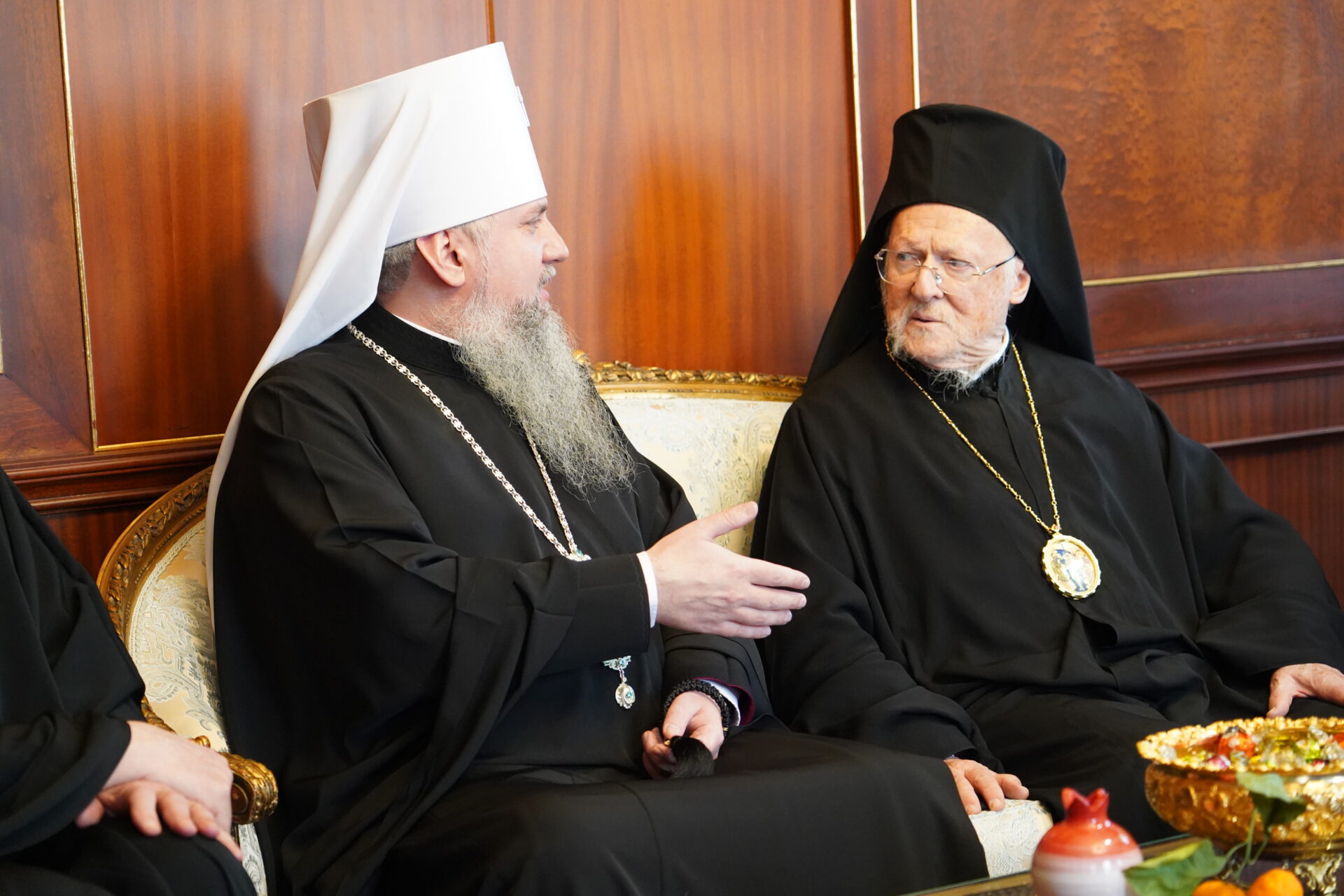
The autocephaly (independence) of the Holy Orthodox Church in Ukraine remains a point of controversy; His All-Holiness Ecumenical Patriarch Bartholomew once again demonstrated his profound commitment to peace and reconciliation when he called upon Orthodox Christians in Ukraine, both those who recognize the jurisdiction of His Beatitude Metropolitan Epiphaniy of Kyiv and All Ukraine and those who recognize the jurisdiction of Metropolitan Onufriy and the Moscow Patriarchate, “to unite, not only theoretically but in the practical realities of daily life, to become one local Church and to be recognized by all the other sister Orthodox Churches.”
His All-Holiness also explained that when he granted autocephaly to the Orthodox Church in Ukraine on January 5, 2019, “our motives were entirely ecclesiological. We were not guided by expediency, nor did we make a hasty or superficial judgment on this long-standing issue, as some have accused us.” In 2020, the Holy Monastery of Pantokratoros on Mount Athos published a pamphlet, The Whole Truth About the Ukrainian Church Issue, that elucidated His All-Holiness’ ecclesiological motives and answered the key objections to the Ecumenical Patriarchate’s grant of autocephaly to the Ukrainian Church. In light of the ongoing dispute, it is worth revisiting.
The primary claim of those who oppose Ukrainian autocephaly is that the Ecumenical Patriarchate intruded upon the canonical territory of the Moscow Patriarchate in granting Ukraine autocephaly. They claim that in 1686, the Ecumenical Patriarchate gave permission to the Moscow Patriarch to ordain and install the new elected Metropolitan of Kyiv, but fail to note that, as The Whole Truth points out, this permission was given with “the absolute and necessary condition that the Metropolitan of Kyiv will commemorate the name of the Ecumenical Patriarch in every divine Liturgy, which means that he was to stay under the canonical jurisdiction of the Ecumenical Patriarchate.”
It is noteworthy in this connection that in 1620, Patriarch Theophanis of Jerusalem, “as a delegate of the Ecumenical See… ordained a Metropolitan in Kyiv in 1620.” In stark contrast to the Moscow Patriarchate, however, Theophanis “did not consider that by ordaining the Metropolitan of Kyiv, its metropolis would come under the jurisdiction of the Patriarchate of Jerusalem.”
The Fourth Ecumenical Council, the Council of Chalcedon, which was held in 451, granted to the Ecumenical Patriarchate the authority to settle ecclesiastical disputes. “This was so well entrenched in the holy tradition of the Church,” The Whole Truth states, “that, in the question of the Russian clergy towards the Patriarchs of the East in 1663, whether the Ecumenical Patriarchate had the right to examine cases of other local Churches, all the Patriarchs answered affirmatively, and added that only the Ecumenical Patriarchate had this privilege.”
In light of this long-established reality, His All-Holiness emphasized in March 2019 that “the Ecumenical Patriarchate had always had the responsibility – not the privilege — to foresee the need of solving any problem at any local Church, and it openly declares its opinion without causing any kind of concern to the rest of the Patriarchs.”
As Ukrainians and Russians are distinct peoples, the Ukrainian people had petitioned Moscow to allow them autocephaly for decades, only for their appeals to fall upon deaf ears until His All-Holiness signed the Tomos of Autocephaly for the Orthodox Church in Ukraine. There need be no controversy over this today, and His All-Holiness’ appeal for unity should be received in the spirit it was given and acted upon with sincerity and trust in the power of Almighty God to heal what is broken.
In March 2021, the Ecumenical Patriarch declared that “the unity of Orthodoxy is not tested in any case due to the response of the Ecumenical Patriarchate to the request of the Ukrainian Orthodox. The granting of Autocephaly to the Orthodox Church of Ukraine in 2019 was mainly an expression of pastoral interest in spiritual justice and freedom. For decades, if not centuries, Ukraine has not been able to enjoy complete ecclesiastical independence from outside influences. Until recently, most Ukrainians did not belong to the Orthodox Church. This was a sad reality for the Body of Christ because the church division in your country was a deep wound in the society of the Orthodox Church.”
His All-Holiness moved to heal that wound. His immense courage and steadfastness in doing so are a powerful example and inspiration to Orthodox Christians and all people of good will everywhere.