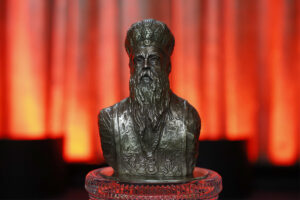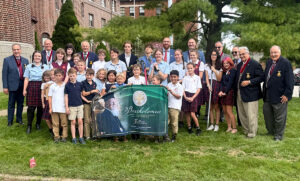
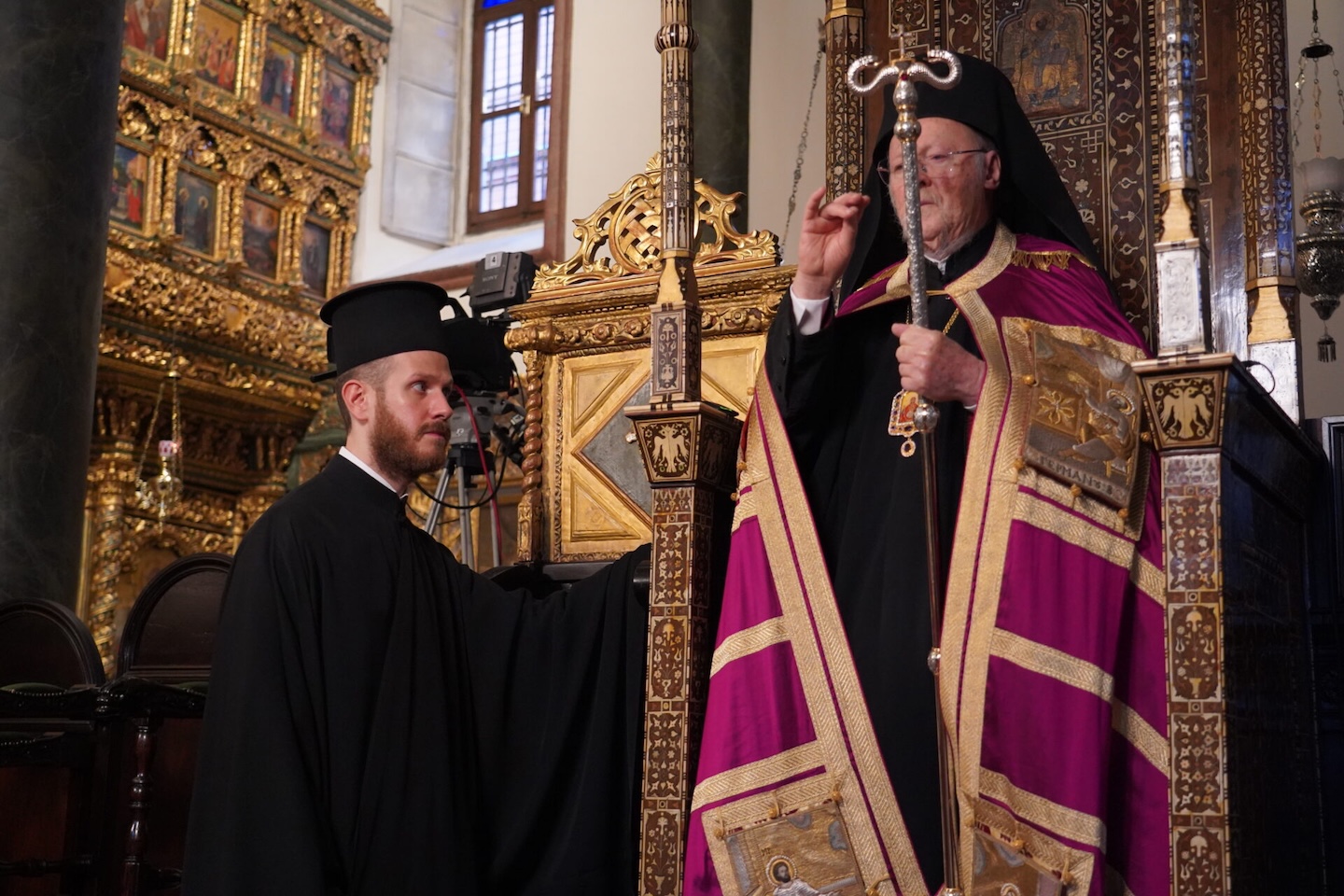
As he blessed the traditional New Year’s Vasilopita on Sunday, January 11, 2026 at the Marasleio School in Constantinople, His All-Holiness Ecumenical Patriarch Bartholomew gently and lovingly admonished youth to avoid some of the most pervasive snares of the modern world, including what he termed “digital golden cages.”
Orthodox Times reported that His All-Holiness “assured the youth of his prayers and support, urging them to become worthy heirs and continuers of the invaluable values and traditions of the Greek Orthodox heritage, firmly rooted in their ancestral land where Hellenism flourished.” He explained that this did not mean that they were merely the executors of bygone ages, emphasizing that “while the community faithfully preserves its traditions, it is not trapped in the past. Instead, it draws on centuries of experience to face the present and look toward the future with hope. For Christians, he said, the future rests in the hands of Christ, who promised to remain with humanity always, reminding that God’s love casts out fear.”
It was in that context that the Ecumenical Patriarch discussed some of the challenges of the digital age, noting “that life is not digital, friendships are not measured in ‘likes,’ and true communication requires personal presence. Addressing young people in particular, he urged them not to become imprisoned in ‘digital golden cages,’ but to step into the real world, breathe the air of authentic human relationships, and live within real communities rather than virtual ones.”
His All-Holiness “warned that modern technological culture often promotes isolation and excessive individualism, which he described as spiritually barren.” This echoed warnings he sounded in January 2020, when he said: “Television, the Internet, and computers have brought radical changes in the identity of children and in society. Technology has a lot of influence on the child ‘s psyche, education and daily life. Experts talk about the ‘disappearance’ of childhood as well as of the loss of childhood ‘innocence’. If we consider the violations of children’s rights worldwide, children-victims of war conflicts, children-refugees, and deprivation, then we understand why children do not have the right environment for development and protection in modern society.”
On that occasion, His All-Holiness observed that “the new social and cultural realities make the education of the new generation more difficult and complicated. Television and the Internet are also sources of values, that is a ‘parallel school’. Orthodox Christians, who are parents, must raise and educate their children properly and instill in them proper Christian values.”
Speaking directly to youth, the Ecumenical Patriarch said: “On the occasion of today’s gathering, we give advice to you, the youth, on how to use technology properly. Computers, smartphones, and the Internet are indeed a technological miracle and that is why they fascinate you. However, you have to make the right use of them. Technological advancement requires freedom and responsibility.”
In his address at the Marasleio School, His All-Holiness elucidated ways in which our Holy Orthodox Faith offers ways to understand and take hold of that freedom and responsibility: “Drawing on Orthodox tradition, he emphasized a vision of life that moves from the isolated individual to the person, from self-centeredness to love, and from the private to the common good. He recalled the spiritual and cultural legacy of the ancestors of Hellenism, who preserved faith, language, and identity through difficult times with trust in God’s providence and hope for a better tomorrow.”
In December 2024, the Ecumenical Patriarch likewise noted how easy it was to be ensnared within the digital world, and to become captivated within a wilderness of distraction: “Today, of course, everyone holds the captivating and brilliant smartphone, which contains everything—even the text of the Bible—though it is uncertain whether users will seek it out amidst the overwhelming sea of digital information.”
His All-Holiness added that “what Greek philosophy represented as a challenge to Christian theology for the great Fathers of the Church in the fourth century is, in modern times, mirrored by scientific knowledge and technological progress.” The Ecumenical Patriarch emphasized, however, that “the dialogue between theology and science must not be a clash between adversaries but a collaboration between two great forces that serve humanity. It should be a partnership, not a rivalry.”
His All-Holiness Ecumenical Patriarch Bartholomew, in his unhesitating embrace of science as well as theology, and in his constant concern not only for avoiding the pitfalls of the digital age but of caring properly for the natural environment, exemplifies that partnership in his own person.